
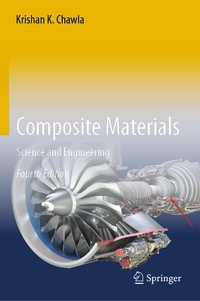
Composite Materials
Beschreibung
Alles über E-Books | Antworten auf Fragen rund um E-Books, Kopierschutz und Dateiformate finden Sie in unserem Info- & Hilfebereich.
The fourth edition of Krishan Chawla's widely used textbook,
Composite Materials,
offers integrated and completely up-to-date coverage of composite materials. The book focuses on the triad of processing, structure, and properties, while providing a well-balanced treatment of the materials science and mechanics of composites. In this edition of
Composite Materials
, revised and updated throughout, increasing use of composites in industry (especially aerospace and energy) and new developments in the field are highlighted. New material on the advances in non-conventional composites (which covers polymer, metal and ceramic matrix nanocomposites), self-healing composites, self-reinforced composites, biocomposites and laminates made of metals and polymer matrix composites is included. Examples of practical applications in various fields are provided throughout the book, with extensive references to the literature. The book is intended for use in graduate and upper-division undergraduate courses and as a reference for the practicing engineers and researchers in industry and academia.
Weitere Details
Weitere Ausgaben
Andere Ausgaben

Person
Inhalt
Systemvoraussetzungen
Dateiformat: PDF
Kopierschutz: Wasserzeichen-DRM (Digital Rights Management)
Systemvoraussetzungen:
- Computer (Windows; MacOS X; Linux): Verwenden Sie zum Lesen die kostenlose Software Adobe Reader, Adobe Digital Editions oder einen anderen PDF-Viewer Ihrer Wahl (siehe E-Book Hilfe).
- Tablet/Smartphone (Android; iOS): Installieren Sie bereits vor dem Download die kostenlose App Adobe Digital Editions oder die App PocketBook (siehe E-Book Hilfe).
- E-Book-Reader: Bookeen, Kobo, Pocketbook, Sony, Tolino u.v.a.m.
Das Dateiformat PDF zeigt auf jeder Hardware eine Buchseite stets identisch an. Daher ist eine PDF auch für ein komplexes Layout geeignet, wie es bei Lehr- und Fachbüchern verwendet wird (Bilder, Tabellen, Spalten, Fußnoten). Bei kleinen Displays von E-Readern oder Smartphones sind PDF leider eher nervig, weil zu viel Scrollen notwendig ist. Mit Wasserzeichen-DRM wird hier ein „weicher” Kopierschutz verwendet. Daher ist technisch zwar alles möglich – sogar eine unzulässige Weitergabe. Aber an sichtbaren und unsichtbaren Stellen wird der Käufer des E-Books als Wasserzeichen hinterlegt, sodass im Falle eines Missbrauchs die Spur zurückverfolgt werden kann.
Weitere Informationen finden Sie in unserer E-Book Hilfe.