

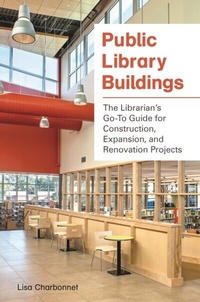
Public Library Buildings
The Librarian's Go-to Guide for Construction, Expansion, and Renovation Projects
1. Auflage
Erschienen am 5. Oktober 2015
240 Seiten
978-1-4408-3859-0 (ISBN)
Beschreibung
This go-to guide covers the entire process of building or renovating a public library-from initial planning, to maintaining the completed space, to measuring success.
In light of current social and technological shifts, libraries are reinventing themselves. Meeting place, makerspace, community center, cultural hub, multimedia lender-today's public library is all of these and more. Whether your library is undertaking a simple renovation or redesign or looking at a full-blown building project, the voice of the librarian is important to the project, and you need to understand both the processes involved and the questions to ask.
Beginning with the development of a pre-construction vision, the book guides you through the entire process. It covers everything from making a case for the project to the authorities and the community through fundraising, budgeting, and site and team selection. You'll read about space programming, the design phase, pre-construction preparation, staff management, and moving the library, as well as about post-construction management and maintenance. Measures of success are included, as are helpful forms and an invaluable glossary of relevant construction terms. With this guide in hand, you and your team can plan efficiently, avoid common pitfalls, and create a library you and your community will love for many years to come.
In light of current social and technological shifts, libraries are reinventing themselves. Meeting place, makerspace, community center, cultural hub, multimedia lender-today's public library is all of these and more. Whether your library is undertaking a simple renovation or redesign or looking at a full-blown building project, the voice of the librarian is important to the project, and you need to understand both the processes involved and the questions to ask.
Beginning with the development of a pre-construction vision, the book guides you through the entire process. It covers everything from making a case for the project to the authorities and the community through fundraising, budgeting, and site and team selection. You'll read about space programming, the design phase, pre-construction preparation, staff management, and moving the library, as well as about post-construction management and maintenance. Measures of success are included, as are helpful forms and an invaluable glossary of relevant construction terms. With this guide in hand, you and your team can plan efficiently, avoid common pitfalls, and create a library you and your community will love for many years to come.
Alle Preise
Weitere Details
Auflage
1. Auflage
Sprache
Englisch
Verlagsort
USA
Verlagsgruppe
Bloomsbury Publishing Plc
Zielgruppe
Interest Age: From 7 to 17 years
Illustrationen
37 bw illus
ISBN-13
978-1-4408-3859-0 (9781440838590)
Copyright in bibliographic data and cover images is held by Nielsen Book Services Limited or by the publishers or by their respective licensors: all rights reserved.
Schweitzer Klassifikation
Weitere Ausgaben
Person
Lisa Charbonnet, MIS, is director of the Pflugerville Public Library in Texas.
Inhalt
CONTENTS
Acknowledgments
Chapter 1: Getting Started
Chapter 2: The Site: Renovation or Expansion?
Chapter 3: Funding
Chapter 4: Selecting the Team
Chapter 5: Programming and Space Planning
Chapter 6: Preparing for Construction
Chapter 7: Construction: What's a Library Director to Do?
Chapter 8: Wrapping Up
Chapter 9: Post-Construction
Appendix A: Strategic Communications Planning, 2007-2009
Appendix B: Stories from the Library
Appendix C: Request for Qualifications: Owner's Representative Services, August, 2010
Appendix D: 2007 Library Program-Based on a 15,000 square foot Building
Appendix E: Scott Thornton Commons Policy for Private Events, Westbank Library
Appendix F: Pflugerville Public Library Policies, 2014
Appendix G: Sequence of Events for the Day of the Grand Opening at the Laura Bush Community Library, July, 2009
Glossary
Notes
Index
Acknowledgments
Chapter 1: Getting Started
Chapter 2: The Site: Renovation or Expansion?
Chapter 3: Funding
Chapter 4: Selecting the Team
Chapter 5: Programming and Space Planning
Chapter 6: Preparing for Construction
Chapter 7: Construction: What's a Library Director to Do?
Chapter 8: Wrapping Up
Chapter 9: Post-Construction
Appendix A: Strategic Communications Planning, 2007-2009
Appendix B: Stories from the Library
Appendix C: Request for Qualifications: Owner's Representative Services, August, 2010
Appendix D: 2007 Library Program-Based on a 15,000 square foot Building
Appendix E: Scott Thornton Commons Policy for Private Events, Westbank Library
Appendix F: Pflugerville Public Library Policies, 2014
Appendix G: Sequence of Events for the Day of the Grand Opening at the Laura Bush Community Library, July, 2009
Glossary
Notes
Index

