

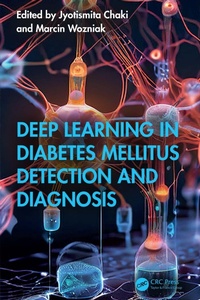
Deep Learning in Diabetes Mellitus Detection and Diagnosis
1. Auflage
Erschienen am 30. Januar 2025
200 Seiten
978-1-040-26063-0 (ISBN)
Beschreibung

Deep Learning in Diabetes Mellitus Detection and Diagnosis focuses on deep learning-based approaches in the field of diabetes mellitus detection and diagnosis, including preprocessing techniques that are an essential part of this subject. This is the first book of its kind to cover deep learning-based approaches in the specific field of diabetes mellitus. This book includes a detailed introductory overview as well as chapters on current applications, preprocessing of data using deep learning, deep learning techniques, complexity, challenges, and future directions. It will be of great interest to researchers and professionals working on diabetes mellitus as well as general medical applications of machine learning.
Features:
Highlights how the use of deep neural networks-based applications can address new questions and protocols, as well as improve upon existing challenges in diabetes mellitus detection and diagnosis
Assists scholars and students who might like to learn about this area as well as others who may have begun without a formal presentation, with no complex mathematical equations
Involves exceptional subject coverage and includes the principles needed to understand deep learning
Features:
Highlights how the use of deep neural networks-based applications can address new questions and protocols, as well as improve upon existing challenges in diabetes mellitus detection and diagnosis
Assists scholars and students who might like to learn about this area as well as others who may have begun without a formal presentation, with no complex mathematical equations
Involves exceptional subject coverage and includes the principles needed to understand deep learning
Weitere Details
Auflage
1. Auflage
Sprache
Englisch
Verlagsort
London
Großbritannien
Verlagsgruppe
Taylor & Francis Ltd
Zielgruppe
Für höhere Schule und Studium
Für Beruf und Forschung
Illustrationen
54 Line drawings, black and white; 54 Illustrations, black and white
ISBN-13
978-1-040-26063-0 (9781040260630)
Copyright in bibliographic data and cover images is held by Nielsen Book Services Limited or by the publishers or by their respective licensors: all rights reserved.
Schweitzer Klassifikation
Weitere Ausgaben
Andere Ausgaben
Jyotismita Chaki | Marcin Wozniak
Deep Learning in Diabetes Mellitus Detection and Diagnosis
Buch
ca. 06/2026
1. Auflage
CRC Press
67,00 €
Noch nicht erschienen
Jyotismita Chaki | Marcin Wozniak
Deep Learning in Diabetes Mellitus Detection and Diagnosis
Buch
01/2025
1. Auflage
CRC Press
175,70 €
Versand in 10-20 Tagen

Buch
12/2024
CRC Press
Preis leider unbekannt
Artikel ist vergriffen; siehe andere Ausgabe
Personen
Dr. Jyotismita Chaki is an Associate Professor at the School of Computer Science and Engineering, Vellore Institute of Technology, India. Holding a PhD in Engineering from Jadavpur University, Kolkata, her research focuses on Computer Vision, Image Processing, Pattern Recognition, Medical Imaging, Artificial Intelligence, and Machine Learning. With a prolific publication record, Dr. Chaki has authored over 50 international conference and journal papers and contributed to more than ten books as author or editor. Her editorial roles currently include Editor of Engineering Applications of Artificial Intelligence (Elsevier), Section Editor of PeerJ Computer Science, and Associate Editor for Computer and Electrical Engineering, Array, and Machine Learning with Applications journals (Elsevier). She is a Senior Member of IEEE.
Marcin Wozniak received the M.Sc. degree in applied mathematics, the Ph.D. degree in computational intelligence, the D.Sc. degree in computational intelligence and Full Professor honours from the President of Poland. M. Wozniak is currently a Full Professor with the Faculty of Applied Mathematics, Silesian University of Technology.
He is a Scientific Supervisor in editions of "The Diamond Grant" and "The Best of the Best" programs for highly talented students from the Polish Ministry of Science and Higher Education. He participated in various scientific projects (as Lead Investigator, Scientific Investigator, Manager, Participant and Advisor) at Polish, Italian and Lithuanian universities and projects with applied results at IT industry both funded from the National Centre for Research and Development and abroad. He was a Visiting Researcher with universities in Italy, Sweden, and Germany.
He has authored/coauthored over 300 research papers in international conferences and journals. His current research interests include neural networks with their applications together with various aspects of fuzzy logic and control, applied computational intelligence accelerated by evolutionary computation and federated learning models.
In 2017 Prof Marcin Wozniak was awarded by the Polish Ministry of Science and Higher Education with a scholarship for an outstanding young scientist. In years 2021 and 2024 he received two awards from the Polish Ministry of Science and Higher Education for research achievements. In 2020, 2021, 2022 and 2023 Prof Marcin Wozniak was presented among "TOP 2% Scientists in the World" by Stanford University for his career achievements. Prof Marcin Wozniak is also presented among the Best Computer Science Scientists in Poland by Research.com.
Marcin Wozniak is the Editorial Board member or an Editor for Biomedical Signal Processing and Control, Sensors, Machine Learning with Applications, Pattern Analysis and Applications. He also guest edit special issues ie. IEEE Journal Biomedical and Health Informatics, IEEE ACCESS, Measurement, Sustainable Energy Technologies and Assessments, Frontiers in Human Neuroscience, PeerJ CS, International Journal of Distributed Sensor Networks, Computational Intelligence and Neuroscience, Journal of Universal Computer Science, etc. Prof. Marcin Wozniak is a Session Chair at various international conferences and symposiums, including IEEE Symposium Series on Computational Intelligence, IEEE Congress on Evolutionary Computation, International Joint Conference on Neural Networks, etc.
Marcin Wozniak received the M.Sc. degree in applied mathematics, the Ph.D. degree in computational intelligence, the D.Sc. degree in computational intelligence and Full Professor honours from the President of Poland. M. Wozniak is currently a Full Professor with the Faculty of Applied Mathematics, Silesian University of Technology.
He is a Scientific Supervisor in editions of "The Diamond Grant" and "The Best of the Best" programs for highly talented students from the Polish Ministry of Science and Higher Education. He participated in various scientific projects (as Lead Investigator, Scientific Investigator, Manager, Participant and Advisor) at Polish, Italian and Lithuanian universities and projects with applied results at IT industry both funded from the National Centre for Research and Development and abroad. He was a Visiting Researcher with universities in Italy, Sweden, and Germany.
He has authored/coauthored over 300 research papers in international conferences and journals. His current research interests include neural networks with their applications together with various aspects of fuzzy logic and control, applied computational intelligence accelerated by evolutionary computation and federated learning models.
In 2017 Prof Marcin Wozniak was awarded by the Polish Ministry of Science and Higher Education with a scholarship for an outstanding young scientist. In years 2021 and 2024 he received two awards from the Polish Ministry of Science and Higher Education for research achievements. In 2020, 2021, 2022 and 2023 Prof Marcin Wozniak was presented among "TOP 2% Scientists in the World" by Stanford University for his career achievements. Prof Marcin Wozniak is also presented among the Best Computer Science Scientists in Poland by Research.com.
Marcin Wozniak is the Editorial Board member or an Editor for Biomedical Signal Processing and Control, Sensors, Machine Learning with Applications, Pattern Analysis and Applications. He also guest edit special issues ie. IEEE Journal Biomedical and Health Informatics, IEEE ACCESS, Measurement, Sustainable Energy Technologies and Assessments, Frontiers in Human Neuroscience, PeerJ CS, International Journal of Distributed Sensor Networks, Computational Intelligence and Neuroscience, Journal of Universal Computer Science, etc. Prof. Marcin Wozniak is a Session Chair at various international conferences and symposiums, including IEEE Symposium Series on Computational Intelligence, IEEE Congress on Evolutionary Computation, International Joint Conference on Neural Networks, etc.
Inhalt
1. Introduction to Diabetes Mellitus Detection and Diagnosis using deep Learning. 2. Pre-processing and Detection of Diabetes Mellitus from physiological data using deep learning. 3. Graph-based Explainable Method for Blood Glucose Prediction through Federated Learning. 4. Automated Early detection of Diabetes Mellitus from Retinal Fundus images using Residual U-Network Approach. 5. Towards Classifying the Severity of Diabetic Retinopathy Using Deep Learning. 6. Deep Learning saves lives of diabetes mellitus patients and cuts treatment costs. 7. Diabetes mellitus detection using deep learning model. 8. A Comprehensive Review of the Use of Deep Learning Algorithms in Diabetes Mellitus Detection and Diagnosis. 9. Examining the Role of Machine Learning and Deep Learning in Diabetes Mellitus Detection and Diagnosis - A Critical Review. 10. Deep Learning in Diabetes Mellitus Detection and Diagnosis. 11. Title: Deep Learning Algorithms for Diabetes Mellitus Detection and Management. 12. An Analysis of Deep Learning Models for Diabetic Retinopathy Detection and Classification Based on Fundus Image.
