

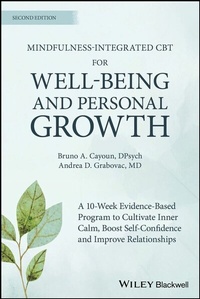
Mindfulness-integrated CBT for Well-being and Personal Growth
Beschreibung

Provides practical guidance for mental resilience and flourishing
Mindfulness-integrated Cognitive Behavior Therapy (MiCBT) has gained significant recognition as an effective approach for addressing depression, stress, anxiety, and emotional difficulties in general. Mindfulness-integrated CBT for Well-being and Personal Growth is an evidence-based guide to integrating mindfulness and cognitive behavioural therapy for personal development and mental well-being. It is a self-help version of a powerful 10-week therapy that has helped tens of thousands to enhance inner calm, boost self-confidence and improve relationships. With the inclusion of new research, more detailed techniques, and expanded practical exercises, this new edition reflects the latest advancements in both mindfulness and psychotherapy.
Leading experts in the field offer a structured yet adaptable pathway for individuals seeking self-improvement, as well as professionals guiding clients through MiCBT. The book delivers step-by-step instructions for each phase of the programme, supported by research insights, audio-guided meditations, and new case studies and success stories illustrating real-world application of MiCBT principles. Enhancements in the second edition include the latest research supporting MiCBT, a deeper exploration of neurobiological mechanisms, refined explanations of mindfulness-based exposure techniques, and an in-depth discussion on ethical awareness practices.
- A Proven Transformative 10-Week Guide to Cultivate Inner-Calm, Boost Self-Confidence and Improve Relationships
- Addresses contemporary concerns about mindfulness, such as the potential for reactivating traumatic memories, with evidence-based solutions
- Incorporates the latest research on mindfulness and neurobiology, providing a scientifically grounded approach to MiCBT
- Integrates an updated companion website with additional MP3 audio instructions for guided mindfulness meditations and emotion-regulation exercises
- Introduces the MiCBT Guide phone app with audio instructions, practice tracking, and reminders for easier adherence
With chapters aligned with the weekly structure of the MiCBT programme, making implementation more intuitive, Mindfulness-integrated CBT for Well-being and Personal Growth, Second Edition, is ideal for mental health professionals, psychologists, therapists, and counsellors seeking to incorporate a powerful transdiagnostic mindfulness-based intervention into their practice. Refined over the course of two decades and consistently demonstrating amazing outcomes, this approcah is also valuable for individuals interested in structured self-improvement. It is a valuable resource for courses in clinical psychology, cognitive behavioural therapy, mindfulness-based interventions, and psychotherapy training.
Weitere Details
Weitere Ausgaben
Andere Ausgaben
Personen
Dr. BRUNO A. CAYOUN is a clinical and research psychologist and the developer of Mindfulness-integrated Cognitive Behaviour Therapy (MiCBT). As Director of the MiCBT Institute, he has trained mental health professionals worldwide. He is the author of Mindfulness-integrated CBT: Principles and Practice and co-author of The Clinical Handbook of Mindfulness-integrated CBT.
Dr. ANDREA D. GRABOVAC is a Clinical Professor of Psychiatry at the University of British Columbia and a Co-Director of the North American Chapter of the MiCBT Institute. She specialises in mindfulness-based interventions for psychiatric conditions and has co-authored competency-based training guidelines for mindfulness-based therapies.
Inhalt
About the Authors xi
Preface xiii
Acknowledgments xv
Disclaimer xvii
Introduction 1
Stage 1 Personal Stage 9
1 Week 1: Establishing Self- Care and Committing to Change 11
Practice Background and Rationale 11
Three Ways of Learning During the MiCBT Program 11
Inheritance and Maintenance of Unhappiness 15
Impermanence: The Trigger for Suffering 15
The Three Unwholesome Cravings and How They Reinforce Suffering 18
Unawareness: Maintaining Factor for Suffering 23
Identifying with Experience and Creating a Sense of Self 23
Rationale for the Practice of Mindfulness 26
Training Mindfulness Skills 27
Commitment to Self- Care Agreement 27
Readiness for Change 29
Accessing the Tools 30
Progressive Muscle Relaxation 34
Integrating Skills in Daily Life 37
Mindfulness of the Body 38
This Week's Practice 39
Frequently Asked Questions 40
Proceeding with the Next Chapter 43
References 43
2 Week 2: Regulating Attention and Gaining More Control of Your Mind 45
Practice Background and Rationale 45
Definition and Purpose of Mindfulness 45
Neurologically Wired to Think 48
Three Internal Causes of Intrusive Thoughts 50
Co- emergence in Dreams 54
Training Mindfulness Skills 55
Practice Set- Up 56
Mindfulness of Breath 58
Integrating Skills in Daily Life 69
Right Effort 69
This Week's Practice 73
Frequently Asked Questions 74
References 82
3 Week 3: Understanding and Regulating Emotions 85
Practice Background and Rationale 85
Understanding the Mechanisms of Mind and Behavior 85
The Co- emergence Model of Reinforcement 86
The Role of Mindfulness 101
Training Mindfulness Skills 103
Checking Your Readiness 103
Unilateral Body Scanning 104
Equanimity: Your Power Within 111
Definition of Equanimity 111
Integrating Skills in Daily Life 115
Cultivating Interoceptive Awareness 115
This Week's Practice 116
Frequently Asked Questions 119
References 126
4 Week 4: Applying Mindfulness Skills in Daily Life 133
Practice Background and Rationale 133
Integrating the Wisdom of Impermanence Through Body Scanning 133
Working Skillfully with Craving 134
Body Sensations and Trauma 138
Wisdom in Your Practice 142
Training Mindfulness Skills 142
Checking Your Readiness 142
Unilateral Body Scanning in Silence with Strong Determination 144
Integrating Skills in Daily Life 149
Cultivating Equanimity Toward Sensations 149
This Week's Practice 158
Frequently Asked Questions 163
References 170
Stage 2 Exposure Stage 173
5 Week 5: Regulating Behavior to Overcome Avoidance 175
Practice Background and Rationale 175
Decreasing Avoidance and Freeing Yourself to Act 175
Training Mindfulness Skills 179
Checking Your Readiness 179
Symmetrical Scanning 180
Integrating Skills in Daily Life 182
Magnifying Equanimity through Exposure 182
This Week's Practice 192
Frequently Asked Questions 197
References 202
6 Week 6: Improving Self- Confidence 203
Practice Background and Rationale 203
Noticing Causes and Effects 204
Training Mindfulness Skills 206
Checking Your Readiness 206
Partial Sweeping 207
Integrating Skills in Daily Life 210
Applied Practice 210
Bipolar and In Vivo Exposure 211
Measuring Progress with Desensitization 213
This Week's Practice 215
Frequently Asked Questions 216
References 224
Stage 3 Interpersonal Stage 225
7 Week 7: Improving Relationships with Interpersonal Mindfulness 227
Practice Background and Rationale 227
Developing Interpersonal Mindfulness 227
Training Mindfulness Skills 230
Checking Your Readiness 230
Sweeping En Masse 231
Integrating Skills in Daily Life 239
Experiential Ownership 239
This Week's Practice 246
Frequently Asked Questions 249
References 252
8 Week 8: Improving Relationships with Mindful Communication 255
Practice Background and Rationale 255
Schemas in the Body: Somatic Markers of Beliefs 255
Accessing Core Schemas with Transversal Scanning 256
Training Mindfulness Skills 258
Checking Your Readiness 258
Transversal Scanning 259
Integrating Skills in Daily Life 260
Mindful Assertiveness 260
Seven Assertive Statements 264
This Week's Practice 273
Frequently Asked Questions 274
References 278
Stage 4 Compassion Stage 281
9 Week 9: Cultivating Compassion and Connectedness with Others 283
Practice Background and Rationale 283
Connecting and Feeling Connected to Others 283
Training Mindfulness Skills 287
Checking Your Readiness 287
Sweeping in Depth 288
Loving- Kindness Meditation 290
Integrating Skills in Daily Life 301
Ethical Conduct as an Expression of Compassion 301
This Week's Practice 312
Frequently Asked Questions 314
References 321
Shaping Your Future 325
10 Week 10: Maintaining Well- Being and Personal Growth 327
Practice Background and Rationale 327
Measuring Progress 328
Facing Change Productively 334
Training Mindfulness Skills 336
Maintenance Practice 336
Integrating Skills in Daily Life 341
10 Maturing Factors of Personal Growth 341
Shaping a Bright Future 348
Practice Going Forward 350
Concluding Comments 350
References 352
Index 355
Introduction
If we don't change, we don't grow. If we don't grow, we aren't really living.
-Gail Sheehy
We all share a fundamental yearning for long-lasting well-being. Everything we do, we usually do with the belief that it will either relieve us of unhappiness or increase our happiness. But happiness is more than the mere absence of unhappiness. By picking up this book, the chances are that this is already clear to you.
When we feel a moment of joy, how long does it last? We may ask ourselves, "Now that I have a job and a partner I love, why do I feel more frustrated than before?" We may reflect, "I have everything I thought I needed to be happy, yet I feel stressed, and my sleep is so restless." Or, "I have many caring friends, but I can't really be honest with them about what's going on for me-I feel so alone." These questions often become more pressing when life feels uncertain or when our sense of purpose is shaken, for example, after losing someone we love.
Happiness leads to suffering when it relies on particular conditions being present. Conditions inevitably change, sooner or later. They are impermanent. Consequently, what we generally define as "feeling happy" is also fleeting. So is it possible to find an enduring, authentic happiness? One that lasts, that we can rely on, and that we are certain will be here tomorrow? The answer is yes, but it requires outgrowing unhelpful patterns of thinking and behavior that contribute to our dissatisfaction.
The process and need for growth and learning are lifelong. It is woven into the fabric of our lives and is part of our evolution. Choosing to grow reflects a deep commitment to benefiting both ourselves and others. As such, it's an act of compassion, generosity, and kindness. Have you ever thought, "I want to be a better person"? Often, this longing translates to wanting to grow, to become wiser, and to enjoy life more fully. If this resonates with you, then you are one of the people for whom this book was written. It aims to share the best of our knowledge, practice, and experience to support your growth and, in turn, empower you to benefit others.
This book, along with the accompanying audio instructions, provides the tools to develop invaluable mental, emotional, and behavioral skills-skills that are not innate, no matter how fortunate we may have been to have kind and mindful parents and grandparents. A key part of developing these skills is comprehensive mindfulness training. Through this, you'll learn to be fully present and aware of your internal experiences, with objectivity and acceptance, rather than avoiding or clinging to them.
This step-by-step experiential approach will deepen your understanding of your own experience and that of others, and will enable you to witness change, day by day, within a few weeks. Across countries and cultures, people of all ages (from about age seven), even those facing severe and chronic challenges, have reported remarkable benefits from this practice. The program can benefit anyone, whether or not they adhere to a religious faith. What you will learn here is universally applicable and complements, rather than conflicts with, religious beliefs. In fact, many clients have said they gained a better understanding of their faith after developing the skills taught in this book.
During his final therapy session yesterday, a client, Tom, who had a long history of trauma, expressed his deepest gratitude:
"I still have intrusive thoughts, but I let them go straight away, and I no longer like the effect that alcohol has on me. I am enjoying the company of my wife so much more and I spend more time with her, and I can now see the suffering of my parents. I am equanimous and relaxed, and at peace with the world, so your course has done a lot of good for me."
After completing the program presented in this book, Tom finally found the internal peace and well-being he had been seeking.
Whether or not we might benefit from therapy, the practice of mindfulness has the potential to help us feel peaceful and more present with our experience. Accordingly, it is increasingly included in well-being and personal growth programs [1]. You may already have practiced mindfulness yourself. To be mindful is to be attuned to our experience of events in the present moment, with as little judgment and as much objectivity as possible. With mindfulness, we become attuned to our internal experiences, enabling us to understand them and respond skillfully, in ways that best support our well-being [2]. Research shows that people can learn mindfulness skills and benefit from them through self-help programs [3], such as the one described in this book.
Mindfulness training has found its place both in community [4] and mental health [5, 6] settings as an effective way to both improve well-being and address psychological distress. Research shows that even for people who are neither depressed nor anxious, regular mindfulness practice for 8 weeks increases well-being [7]. Mindfulness-based programs help healthcare professionals cope better with stress [8] and improve their therapeutic efficacy [9]. Mindfulness training has also been shown to improve staff quality of life in diverse organizations such as Google [10] and the US military [11].
This book will guide you on a journey of personal growth using a unique, evidence-based approach called Mindfulness-integrated Cognitive Behavior Therapy (MiCBT). MiCBT (pronounced M-I-C-B-T) is a sophisticated integration of mindfulness training from a well-documented Burmese Vipassana tradition [12] with novel techniques from Cognitive Behavior Therapy (CBT), some of which have been further refined to improve their effectiveness.
MiCBT is a four-stage program that has its origins in Dr. Bruno Cayoun's own transformative experiences during his practice of mindfulness meditation in the Burmese Vipassana tradition of his teacher, S.N. Goenka, which he began in March 1989. Years of study and theoretical conceptualization led him to develop a program integrating mindfulness and CBT-two significant Eastern and Western psychological systems for reducing emotional and mental suffering. Clinical trials of this approach began in 2001, initially with groups of people experiencing difficulties managing anger or anxiety. After three more years of testing and refining, every skill taught in this program was made universally understandable and applicable to a wide range of individuals and emotional challenges.
Since its introduction in 2001, the program has been successfully implemented in both clinical and nonclinical settings. The effectiveness of MiCBT has been shaped by over a decade of refinement, informed by feedback from participants, supervision of psychology interns and experienced therapists, and insights from scientific studies [13]. One key reason for its success is its focus on helping individuals achieve meaningful personal growth. This includes not only addressing the underlying causes of emotional challenges but also supporting participants in moving forward to lead more fulfilling lives [14].
In this program, you will practice mindfulness meditation as it has been taught for the past 2,500 years, while integrating Western psychological skills to change unhelpful mental habits and emotional reactivity. You'll investigate and understand the deeper reality underlying your experiences in order to cultivate inner calm, enhance self-confidence, and improve relationships. The program is structured in four distinct stages and typically takes between 9 and 12 weeks to complete, though it can be extended to suit your own pace. This flexibility allows you to focus on specific mindfulness or behavioral methods for as long as needed to fully benefit from the training.
The Four Stages of the MiCBT Program
The MiCBT program introduces you to several sets of skills, as outlined in Figure 1. The first set focuses on paying attention to your inner experiences in a specific way to enhance attention regulation, increase awareness of thoughts and feelings, and develop equanimity for better emotional regulation. Subsequent stages emphasize applying these skills in daily situations to improve self-confidence and reduce avoidant behaviors, particularly in areas where these tendencies may have previously held you back. Let's have a brief look at them.
In Stage 1, the personal stage, you'll learn mindfulness methods to manage your attention and emotions through four modes of experience: bodily activities, body sensations, mental states, and mental contents (such as thoughts and images). In the first week, you focus on your body's posture and movements in the present moment while discerning the difference between tension and relaxation. This helps reduce muscle tension in daily life. Then you'll learn techniques to interrupt and prevent unhelpful ways of thinking, such as rumination or catastrophic thinking. In the third week, you begin body-scanning practices, which will build skills to reduce unhelpful habits of reacting emotionally. By the end of Stage 1, you'll find it easier to let go of unhelpful thoughts and emotional reactions, setting the foundation for the next three stages.
Stage 2 focuses on overcoming anxiety that may...
