

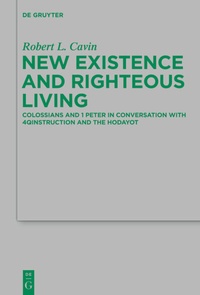
New Existence and Righteous Living
Colossians and 1 Peter in Conversation with 4QInstruction and the Hodayot
1. Auflage
Erschienen am 29. August 2013
XIV, 279 Seiten
978-3-11-030403-9 (ISBN)
Beschreibung

As the first comparative study of Colossians and 1 Peter, the book fills a lacuna by exploring each author's understanding of the new existence and the means to righteous living. If the epistles end up offering almost identical paraenesis, why do they have such distinctive theological patterns of thought? The conventional starting point in Colossian and 1 Peter studies centers on the recipients' needs. Much has been learned from these investigations and is kept in view. However, the extent to which each epistle's theology reflects an underlying pattern of ideas within each author's worldview is less well understood. Setting the author's views in the context of the literature of early Judaism throws fresh light on his thought-world and understanding of the new existence and moral enablement. Evidence exists which indicates that streams of traditions in Early Judaism Literature, factors other than the recipients' needs, contribute to the theology within each epistle and may account for distinctive aspects identified between Colossians and 1 Peter. Exploration of 4QInstruction and the Hodayot, texts discovered at Qumran, provides precedents, precursors, and parallels for the distinctive emphases investigated. Thus, they shed new light on each epistle.
Weitere Details
Weitere Ausgaben
Andere Ausgaben
Robert L. Cavin
New Existence and Righteous Living
Colossians and 1 Peter in Conversation with 4QInstruction and the Hodayot
Buch
08/2013
1. Auflage
De Gruyter
174,95 €
Versand in 7-9 Tagen
Person
Robert L. Cavin, Basking Ridge, NJ, USA.
Inhalt
- Intro
- Acknowledgements
- Abbreviations
- Chapter 1: Introduction
- 1.1 Similarities
- 1.2 Basis for the Comparison
- 1.3 The Need for this Study
- 1.4 Method
- 1.5 Statement of the Thesis
- 1.6 Thesis Contribution
- Chapter 2: Overview of Scholarship
- 2.1 An Overview of Colossian Scholarship
- 2.1.1 Insights from Jewish Background Studies
- 2.1.2 The Opponents: a Fascination of Scholarship
- 2.1.2.1 A Different Approach than Mirror-Reading
- 2.1.3 Behavior as a Main Concern: "Walk worthy" (1:10, 28
- 2:6)
- 2.1.4 The Christ-Event, the New Existence, and Paraenesis
- 2.1.4.1 Realized Eschatology and the New Existence
- 2.1.4.2 The Story of "in Christ"
- 2.1.4.3 ?? ????? and Ultimate Allegiance
- 2.1.4.4 ?? ???st?, Baptism, and Participation
- 2.1.4.5 The Spirit and Living Rightly
- 2.1.4.6 Cognition "in Christ"
- 2.1.5 Summary: Review of Colossians Scholarship
- 2.2 An Overview of 1 Peter Scholarship
- 2.2.1 Insights From Jewish Background Studies
- 2.2.2 Literary Analysis: Unified, Paraenetic Epistle
- 2.2.3 Behavior as a Main Concern: "Be Holy" (1:15-16)
- 2.2.4 The Christ-Event, the New Existence, and Paraenesis
- 2.2.4.1 The New Existence: the Individual and the Community
- 2.2.4.2 ?? ???st? as the Controlling Center
- 2.2.4.3 The Function of Narrative
- 2.2.4.4 Present Suffering and Future glory (d??a) "in" Christ
- 2.2.4.5 Functions of Suffering "in" Christ
- 2.2.4.6 Cognition "in" Christ
- 2.2.5 Summary: Review of 1 Peter Scholarship
- Chapter 3: 1 Peter: New Existence and Righteous Living
- 3.1 Suffering as God's Eschatological People at 'the End' (1:20
- 4:7)
- 3.1.1 Suffering is God's Will/Calling (2:19-21
- 3:9, 17
- 4:14, 19
- 5:9)
- 3.1.2 Suffering and "Doing Good" (2:12, 15, 20
- 3:6, 8-17
- 4:4)
- 3.1.3 Suffering as Witness
- 3.1.3.1 Witness Leading to Condemnation
- 3.1.3.2 Witness Leading to Conversion
- 3.1.4 Suffering and the End (1:6, 17
- 2:23
- 3:14
- 4:5, 7, 17
- 5:8)
- 3.1.5 Suffering as "Tests" and "Testing" (1:6-7
- 4:12)
- 3.2 Universal Problems (p?t?)
- 3.2.1 The Problem of "Sins"
- 3.2.2 The Problem of the "flesh" (s???)
- 3.3 Hermeneutical Use of the OT and Suffering
- 3.3.1 An "Inspirational" and Christocentric Hermeneutic Applied to the OT
- 3.3.1.1 Christ as the Suffering Servant of Isaiah 53
- 3.3.1.2 Revelation, Salvation-History, and the People of God in 1 Peter
- 3.3.2 Locating the Author Within a Milieu of "Inspirational" Exegesis of Isaiah
- 3.4 The Christ-Event and Present Effects (???, 2:10)
- 3.4.1 Redeemed from ?µa?t?a?
- 3.4.2 The New Existence and the Battle Within (2:11
- 4:1)
- 3.4.2.1 Live for Righteousness (1:16
- 2:23)
- 3.4.2.2 Anthropological Dualism: The Inner Person of the Elect
- 3.4.2.3 Psychological Dualism: The s??? and ?p???µ?a? of the Elect
- 3.4.2.4 Future s?t???a, Present Persecutions, and Imminent Judgment
- 3.4.2.5 Identity as God's Earthly Temple-Community
- 3.4.2.5.1 The New Existence: A Temple-Community, but Mystical Union?
- 3.4.2.5.2 The Spirit of God on the Community and Eschatological Salvation
- 3.4.2.5.3 Cosmological Location of Christ with Respect to the Elect
- 3.4.2.5.4 Movement Between the Spheres and Location of the Elect
- 3.5 Suffering and Ceasing to Sin
- 3.5.1 Following in Christ's Footsteps (2:21, 24)
- 3.5.2 Intra-textuality and the ?????a of Christ (4:1-2, 19)
- 3.5.3 Conclusion
- Chapter 4: The Hodayot and Patterns of Thought in 1 Peter
- 4.1 Developments in Views On Suffering
- 4.2 Hermeneutical Use of the OT in the Hodayot
- 4.3 Worldview and the Elect's Existence in the Hodayot
- 4.3.1 Psychological Dualism: "flesh" ( ???? ) and "inclination"(???)
- 4.3.2 Election and "Insight" for Resolving Psychological Dualism
- 4.3.3 Present Hope of Imminent Salvation to End Suffering
- 4.3.3.1 Future Salvation, Present Persecutions and Imminent Judgment
- 4.3.3.2 Identity as God's Earthly Temple-Community
- 4.3.3.3 The Spirit of God on the Community and Eschatological Salvation
- 4.3.4 Determinism in the Hodayot versus Human Agency in 1 Peter
- 4.4 Unjust Suffering as an Enabler to Live Rightly
- 4.4.1 1QHa IV 21-27, 29-37
- 4.4.2 1QHa V 12 - VI 33
- 4.4.3 1QHa XIII 7-21
- 4.5 Concluding Remarks on the Hodayot and 1 Peter
- Chapter 5: Colossians: New Existence and Righteous Living
- 5.1 Recipient Context and Refuting Teaching ?? ?at? ???st????
- 5.2 Universal Problem (p?t?)
- 5.2.1 The Problem of "Sins" (1:14, 21
- cf. "Trespasses," 2:13 [2x]
- 3:7)
- 5.2.2 The Problem of the s??? (2:11, 13, 18, 23)
- 5.2.3 The Problem of the Powers (1:13, 16
- 2:8, 10, 15, 20)
- 5.2.3.1 Spatial and Cosmic Dualism in the OT and EJL
- 5.2.3.2 Evil Powers in Colossians (1:13, 16
- 2:8, 10, 15, 20)
- 5.3 Hermeneutical Use of the OT
- 5.4 The Christ-Event and Present Effects (???? d?)
- 5.4.1 Redeemed from "Sins" (1:14, 21-22
- 2:13-14)
- 5.4.2 Freed from the "Powers" (1:15-20
- 2:10, 15
- cf. 2:8, 15, 20)
- 5.4.3 Indwelt by God from the "Heavenlies"
- 5.4.3.1 God in Christ (1:19
- 2:9)
- 5.4.3.2 The µ?st????? of Christ in the Elect (1:27
- 2:10)
- 5.4.4 Circumcision of the s??? (2:11-13
- cf. 1:15-20, 21-22)
- 5.4.4.1 Participating (s??-) in Christ's Death and Resurrection
- 5.4.4.2 Absence of Psychological Dualism: Defeat of the s???/Death to ?p???µ?a?
- 5.4.5 Transformed into the One s?µa of Christ (2:19
- 1:18
- cf. 1:24
- 3:15)
- 5.4.6 Transferred to the "Heavenlies" (1:12-13
- 3:1-4)
- 5.4.6.1 Rescued from the "Authority of Darkness" (1:13)
- 5.4.6.2 Promised a Share in "Heavenly" Angelic Privileges (1:12)
- 5.5 Future Salvation
- 5.6 The Call: To "walk worthy" (1:10
- 2:6
- 3:12-17
- 4:5-6
- cf. 1:28)
- 5.7 Understanding the "Mystery" to Live Rightly
- 5.7.1 Cosmology, New Existence, and "the parts of the earth" (3:5)
- 5.7.2 Teaching, Admonishing, and Worshiping as One s?µa (3:16-17)
- 5.7.3 Songs, Hymns, and Spiritual Songs "in Christ"
- 5.7.4 Learning Activities and Growth in Understanding
- 5.7.5 Revelation and Living Rightly (2:2-3
- cf. 1:9, 10, 28
- 2:23
- 3:2, 10, 16
- 4:5)
- 5.8 Conclusion
- Chapter 6: 4QInstruction and Patterns of Thought in Colossians
- 6.1 Tradition-Historical Developments: The Motif of Hidden Wisdom
- 6.2 Wisdom Instruction in 4QInstruction and the Colossian Author
- 6.2.1 Non-sectarian Text Representing Ideas Pre-dating Colossians
- 6.2.2 Topics of Instruction that Correlate with Colossians
- 6.2.3 Colossians and a New 'Type' of Sapiential Instruction
- 6.3 Patterns of Thought in 4QInstruction Reflected in Colossians
- 6.3.1 Revealed Mysteries: the raz nihyeh
- 6.3.2 Ethical Dualism and No "Flesh" for a "Spiritual People"
- 6.3.3 Eschatology and Coming Judgment
- 6.3.3.1 Distant Horizon of Judgment
- 6.3.3.2 Creation and the Lordship of God as a Frame for the "Mystery" and Ethics
- 6.3.4 Emphasis on a Realized Eschatology
- 6.3.4.1 Present Forgiveness and "Heavenly Books"
- 6.3.4.2 Revelation of Sharing in the Lot of the "Holy Ones" in the Light
- 6.4 Enabler to Live Rightly: Growing in Knowledge by Studying the "Mystery"
- 6.5 Conclusion
- Chapter 7: Summary and Conclusions
- 7.1 The s??? of the Elect (Anthropology)
- 7.2 The Temporal Axis of Salvation (Eschatology)
- 7.3 The New Existence in its Spatial Dimension (Cosmology)
- 7.4 The Means To Live Rightly (Agency)
- 7.5 Diversity in Second Temple Judaism
- Bibliography
- Primary Literature and Translations
- Secondary Literature
- Index of Modern Authors
- Index of References
