

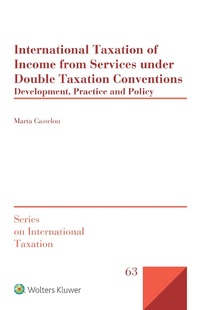
International Taxation of Income from Services under Double Taxation Conventions
Development, Practice and Policy
Erschienen am 24. April 2016
544 Seiten
978-90-411-9595-1 (ISBN)
Beschreibung

The provision of international services has increased enormously, mainly due to the precipitous growth of the digital economy. Accordingly, the interpretation and application of double taxation conventions (DTCs) to income from services has become a dominant focus in the international taxation. This multiple-award-winning book is an indispensable tool for practitioners and a major contribution to the debate about tax reform. It responds to the need for a comprehensive overview of the tax opportunities and risks relating to the provision of international services.
It also offers the rst in-depth analysis of the taxation of income from services vis-à-vis the multilateral instrument (MLI) resulting from the OECD's Base Erosion and Pro t Shifting (BEPS) initiative.
With the thorough analysis of the international taxation of income from services over the last two centuries, the author sheds new light on present tax policy debates and develops workable proposals for bringing brick-and-mortar DTCs into the digital reality.
With an abundance of case studies, treaty interpretations, appraisals of policy discussions, and practical solutions, the author examines every aspect of the subject, including the following:
- - the Model DTCs of the OECD, the United Nations, Germany, and the United States, their similarities and differences;
- - relationships among the MLI, the Model DTCs, and speci c DTCs;
- - development of the provisions dealing with services in the DTCs;
- - how tax authorities and courts of different countries (e.g., the United States, Germany, Brazil, India, and China) apply DTC provisions on the taxation of international services;
- - opportunities and risks relating to different business practices, such as the subcontracting of services provisions, the hiring-out of labour, the secondment of employees, and the engagement of contract and toll manufacturers;
- - practical questions about the taxation of different distribution models - from fully edged distributors to commissionaires;
- - challenges and proposals relating to the differentiation between various types of services under DTCs;
- - the permanent establishment concept; - to what extent the structure, purposes, and scope of DTCs differ from those of the General Agreement on Trade in Services (GATS);
- - how changes in the US Model DTC of 2016 affect international service provisions; and
- - proposed changes to amending the OECD and UN Model DTCs.
Viable proposals to simplify DTC provisions dealing with service income and align them with current challenges such as the digital economy and the increasing volume of remote services are offered, particularly in light of the likely impact of the 'BEPS package' and its subsequent MLI.
This book is poised to become one of the key practice resources for tax lawyers, in-house counsel, and policymakers in the coming years. Interested academics too will bene t from the author's skill in recognizing the ongoing role of taxation fundamentals in the major revolution currently underway.
It also offers the rst in-depth analysis of the taxation of income from services vis-à-vis the multilateral instrument (MLI) resulting from the OECD's Base Erosion and Pro t Shifting (BEPS) initiative.
With the thorough analysis of the international taxation of income from services over the last two centuries, the author sheds new light on present tax policy debates and develops workable proposals for bringing brick-and-mortar DTCs into the digital reality.
With an abundance of case studies, treaty interpretations, appraisals of policy discussions, and practical solutions, the author examines every aspect of the subject, including the following:
- - the Model DTCs of the OECD, the United Nations, Germany, and the United States, their similarities and differences;
- - relationships among the MLI, the Model DTCs, and speci c DTCs;
- - development of the provisions dealing with services in the DTCs;
- - how tax authorities and courts of different countries (e.g., the United States, Germany, Brazil, India, and China) apply DTC provisions on the taxation of international services;
- - opportunities and risks relating to different business practices, such as the subcontracting of services provisions, the hiring-out of labour, the secondment of employees, and the engagement of contract and toll manufacturers;
- - practical questions about the taxation of different distribution models - from fully edged distributors to commissionaires;
- - challenges and proposals relating to the differentiation between various types of services under DTCs;
- - the permanent establishment concept; - to what extent the structure, purposes, and scope of DTCs differ from those of the General Agreement on Trade in Services (GATS);
- - how changes in the US Model DTC of 2016 affect international service provisions; and
- - proposed changes to amending the OECD and UN Model DTCs.
Viable proposals to simplify DTC provisions dealing with service income and align them with current challenges such as the digital economy and the increasing volume of remote services are offered, particularly in light of the likely impact of the 'BEPS package' and its subsequent MLI.
This book is poised to become one of the key practice resources for tax lawyers, in-house counsel, and policymakers in the coming years. Interested academics too will bene t from the author's skill in recognizing the ongoing role of taxation fundamentals in the major revolution currently underway.
Weitere Details
Weitere Ausgaben
Andere Ausgaben
Marta Castelon
International Taxation of Income from Services under Double Taxation Conventions
Development, Practice and Policy
Buch
02/2018
Kluwer Law International
182,22 €
Versand in 10-20 Tagen
Inhalt
- Intro
- Foreword
- Acknowledgments
- List of Abbreviations
- CHAPTER 1Introduction
- I Preliminary Considerations
- 1 Jurisdiction to Tax Income from the Provision of Services
- 2 Avoidance of Double or Multiple Taxation on Income from the International Provision of Services
- 2.1 Double Taxation Conventions
- 2.2 The Multilateral Instrument (MLI) Resulting from BEPS Action 15
- 2.2.1 Background: The OECD and G20 BEPS Project
- 2.2.2 Content, Functioning and Implementation of the MLI
- 2.2.3 The Status of the Explanatory Statement to the MLI
- 2.3 The Focus of the Present Research
- II Services and the International Provision of Services
- 1 Definition of Services
- 2 Modes of Provision of International Services
- 2.1 The Modes of Provision of International Services According to GATS
- 2.2 The Modes of Provision of International Services for the Purposes of DTCs
- 2.3 Importance of Thinking in Terms of Forms of Market Access
- 2.3.1 In the Context of the GATS
- 2.3.2 In the Context of DTCs
- 2.3.3 Summary and Conclusion
- III Research Questions
- 1 Why Do So Many DTC Articles Deal with Income from the Provision of Services?
- 2 Should the Distinction Between Business Profits, Income from Independent Personal Services, Employ
- 3 What Are the Origins of the Current DTC Provisions on Income from Entrepreneurial and Professional
- 4 Do Legal or Economic Principles Provide an Answer as to the Division of the Right to Tax?
- 5 What Are the Challenges Presented by the Allocation of Taxing Rights over Income from Entrepreneur
- IV Terminology
- 1 Other State, Source State, Non-residence State, Host State
- 2 Developed Versus Developing Countries
- V Structure of the Book
- CHAPTER 2History of the Taxation of Income from Independent Services under Double Tax Conventions
- I 1869 DTC Between Prussia and Saxony
- 1 Introductory Remarks
- 2 Overview of the Taxation of Income from the Provision of Enterprise Services under the DTC
- 3 The Fixed Trade ("Stehendes Gewerbe") Concept from an Interpretative and a Tax Policy Point of Vie
- 3.1 Interpreting the Expression "Fixed Trade"
- 3.1.1 Meaning under Prussian Law
- 3.1.1.1 Was There a Force of Attraction for Fixed Trade?
- 3.1.2 Meaning under Saxon Law
- 3.1.3 Meaning under the 1869 Trade, Commerce and Industry Regulation Act of the North-German Confede
- 3.1.4 Liberal Professionals: Neither Fixed nor Itinerant Traders
- 3.1.4.1 General Remarks
- 3.1.4.2 Historical Roots and Main Characteristics
- 3.1.4.3 Why Were Liberal Professions Neither Fixed Trade nor Itinerant Trade?
- 3.1.5 Comparing the Fixed Trade with the PE and the Fixed Base Thresholds
- 3.1.5.1 Thresholds in Comparison
- 3.1.5.2 Similarities Between Traders and Professionals
- 3.2 Why Was the Taxation of Income and Yields/Returns from the Provision of Services by Non-resident
