

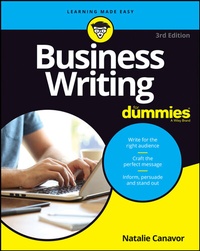
Business Writing For Dummies
Beschreibung

Do you wish you could write better? In today's business world, good writing is key to success in just about every endeavor. Writing is how you connect with colleagues, supervisors, clients, partners, employees, and people you've never met. No wonder strong writers win the jobs, promotions and contracts. Business Writing For Dummies shows you, from the ground up, how to create persuasive messages with the right content and language every time--messages your readers will understand and act on.
This friendly guide equips you with a step-by-step method for planning what to say and how to say it in writing. This sytem empowers you to handle every writing challenge with confidence, from emails to proposals, reports to resumes, presentations to video scripts, blogs to social posts, websites to books. Discover down-to-earth techniques for sharpening your language and correcting your own writing problems. Learn how to adapt content, tone and style for each medium and audience. And learn to use every message you write to build better relationships and solve problems, while getting to the "yes" you want.
Whether you're aiming to land your first job or are an experienced specialist in your field, Business Writing For Dummies helps you build your communication confidence and stand out.
* Present yourself with authority and credibility
* Understand and use the tools of persuasion
* Communicate as a remote worker, freelancer, consultant or entrepreneur
* Strategize your online presence to support your goals
* Bring out the best in people and foster team spirit as a leader
* Prepare to ace interviews, pitches and confrontations
Good communication skills, particularly writing, are in high demand across all industries. Use this book to gain the edge you need to promote your own success, now and down the line as your career goals evolve.
Weitere Details
Weitere Ausgaben
Andere Ausgaben
Person
Inhalt
Introduction
Delivering your message well and being heard. What could be more important in today's world, which demands that we connect and compete for what we want? When the second edition of this book was published just a few years ago, it didn't seem necessary to talk about who needs to practice business writing. Business writing was assumed to mean writing for work purposes, typically in an office setting, but also encompassing independent contractors and professional specialists.
Today, who needs to write? Who doesn't? We all stand on our own for everyday messaging to get the job done, build relationships and prevent and solve problems. We may need to create traditional materials like reports, proposals and marketing copy. And we typically aim to play a role in the online world and use websites, blogs, networking sites and/or social media to our advantage.
But we also need to write well for personal purposes. Do you want to be a good advocate for a cause you believe in - or yourself? Have you needed to write an effective letter of complaint when you were dissatisfied with a purchase, or write a good message when you needed a favor from a friend or relative or stranger? Have you ever competed for something important - like buying a home that other people wanted - by writing a good letter that explained why you were a perfect match? Did you know you could do that?
We're all making our way today through a rapidly changing culture. This affects the role of writing, who uses it and how we apply those skills. For example, the line between "work" and "life" grows blurrier every year. Our friends become our business network; we look for work schedules that accommodate our personal lives; we like recreational opportunities at the office; we bring work home if it engages us.
Let's put that in a fuller perspective of what is changing, how that affects communication and how you can use what this book teaches for your own success.
Change #1 is how fluid our lives are becoming. Today's executive is tomorrow's consultant, a scientist builds a business based on his discovery, a lawyer becomes a stay-at-home mom and influential blogger. An obscure person can create a startup or build a charitable cause. A freelancer can decide to take a full-time job - or vice versa. Long-term employees may find their organizations restructured, requiring them to behave like entrepreneurs and create their own opportunities.
The future seems to offer little in the way of a straight-and-narrow career path - nor do most of us want one. We expect to bounce back and forth among a myriad of options, watching for chances and re-ordering our priorities. Beyond enabling you to make the most of your immediate opportunities, good writing is your best springboard for navigating from one opportunity to the next more successfully. It's often the written messages, résumés and online profiles, social presence, emails and even old-fashioned letters that enable you to be seen as credible, credentialed and creative.
Change #2 is the growing predominance of remote work. This trend has been developing over the last decade, but was sped up unimaginably by the coronavirus pandemic in 2020. Organizations of all varieties discovered that expensive office space is a whole lot less necessary than they thought. Some studies showed that at-home workers in many spheres actually became more productive at home - wherever that might be - and that many workers decided they prefer it. A scattered workforce makes good communication - especially writing - pivotal to accomplishing everyday simple tasks and long-range goals.
An allied trend is the drift toward a gig economy. Many people, especially those new to the workforce, are piecing together short-term jobs to add up to a living sufficient for their needs. If this is where you are right now, you are forever pitching for those gigs. You need all the assets of the classic entrepreneur and must be able to carry on good written conversations by email or other channels.
Change #3 is the growing degree of informality in writing for work purposes. The Internet and fast messaging channels have already played an enormous part in promoting spontaneity and even the ability to share feelings in writing via new devices like emojis, for example. Does this mean you no longer need to write well? No! It does mean knowing how to draw the lines and strategize for your audiences.
Change #4 is the growing dominance of visual media in social platforms and of course, video. Does this mean less writing? No! A good video is scripted. Moreover, writing is the essential tool for planning. Creators of print and video advertising have always known that it's challenging to produce high-quality material. Top users of Instagram and Snapchat and TikTok know this, too. We think in words. We think better when we write. If in the end product only a few words accompany the images, they must be exactly the right ones.
This is similarly true of oral and in-person communication. You may be surprised to see how much this book covers spoken media and even difficult conversations. A good speech begins with writing. Today, the oral, virtual and visual dimensions of business communication are inseparable from each other, and from writing. All must work together.
As you read this book, I think you'll be surprised by how many ways good writing can reward you. Beyond giving you the tools to handle the full range of media, building your skills will help you think strategically, solve problems and understand people - and yourself - better.
About This Book
I wrote this book to give you a high-stakes tool for accomplishing your own goals and dreams. While the ultimate aim is to sharpen your thinking, the methods I show you are totally pragmatic. Every idea and technique is ready to use and fully demonstrated. I base everything on my own decades of trial and error as a journalist, magazine editor, corporate communications director, consultant and college instructor. The methods I show you have been field-tested in hundreds of my workshops and courses for businesspeople, public relations professionals, corporate communicators and nonprofit leaders.
This book gives you a complete foundation for effective business writing as well as guidelines to instantly improve everything you write. You may wonder how a single book can teach you how to write for all media - especially since new channels materialize constantly. In fact, new communication media simply give us more ways to deliver messages. The thinking-writing process applies to all and holds steady for all, though each suggests specific adaptations.
It's like the old story about giving a person a fish versus teaching a person to fish. I can't be with you to meet every writing challenge you encounter, and truthfully, can't anticipate all of them. But I can teach you how to fish - to use your brain and your tools to figure out the message that best achieves what you want.
Foolish Assumptions
Do you assume any of the following?
- Writing well is a talent you're born with - or not.
- Improving poor writing is difficult.
- Good writing is defined by correct grammar and spelling "rules."
- Expressing complex thought demands complex language.
- Writing dense copy with long words makes you look more intelligent and educated.
- "New" media like social, video, chat messaging and presentations don't require good writing.
- Reserving your best skills for "important" material makes sense.
Every one of these assumptions is false. I debunk all of them in this book. For now, the important truth is that you can write better, whether you need basic grounding or are already a good writer and want to become better yet. This book gives you down-to-earth, easy-to-use techniques. It's not about rules - I don't give you grammar lessons, but instead, show you practical ways to spot technical problems and fix them. Many of the ideas and thinking processes are drawn from the toolkits of professional writers who in large part learn by expensive trial and error. I want to save you that time. My mission is to show you how to figure out what to say and how to say it, whatever the challenge.
Icons Used in This Book
To help you focus on what's most important and move it into memory, look to the icons.
These are practical ideas and techniques you can put to work immediately - and amaze yourself with good results!
This icon keys you in to guidelines and strategies to absorb and use for everything you write.
This icon signals thin ice, don't take the risk! Observe these cautions to avoid endangering your business, image or cause.
A new special feature, this icon offers time-saving strategies that were years in the making and now yours for the taking.
You'll also find sections that begin, "Try This:". Why leave all the work to me? Take these opportunities to try your own hand or apply an idea. Nothing builds your skills like practice.
Beyond the Book
In addition to what you're reading now, this book also comes with a free access-anywhere Cheat Sheet that gives you even more pointers on how to write effectively in the business world. To get this Cheat Sheet, simply go to...
