

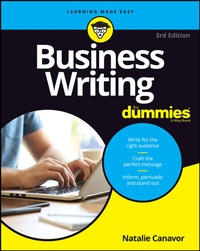
Business Writing For Dummies
3. Auflage
Erschienen am 20. Januar 2021
432 Seiten
978-1-119-69670-4 (ISBN)
Beschreibung

Learn how to write for the results you want every time, in every medium!
Do you wish you could write better? In today's business world, good writing is key to success in just about every endeavor. Writing is how you connect with colleagues, supervisors, clients, partners, employees, and people you've never met. No wonder strong writers win the jobs, promotions and contracts. Business Writing For Dummies shows you, from the ground up, how to create persuasive messages with the right content and language every time--messages your readers will understand and act on.
This friendly guide equips you with a step-by-step method for planning what to say and how to say it in writing. This sytem empowers you to handle every writing challenge with confidence, from emails to proposals, reports to resumes, presentations to video scripts, blogs to social posts, websites to books. Discover down-to-earth techniques for sharpening your language and correcting your own writing problems. Learn how to adapt content, tone and style for each medium and audience. And learn to use every message you write to build better relationships and solve problems, while getting to the "yes" you want.
Whether you're aiming to land your first job or are an experienced specialist in your field, Business Writing For Dummies helps you build your communication confidence and stand out.
* Present yourself with authority and credibility
* Understand and use the tools of persuasion
* Communicate as a remote worker, freelancer, consultant or entrepreneur
* Strategize your online presence to support your goals
* Bring out the best in people and foster team spirit as a leader
* Prepare to ace interviews, pitches and confrontations
Good communication skills, particularly writing, are in high demand across all industries. Use this book to gain the edge you need to promote your own success, now and down the line as your career goals evolve.
Do you wish you could write better? In today's business world, good writing is key to success in just about every endeavor. Writing is how you connect with colleagues, supervisors, clients, partners, employees, and people you've never met. No wonder strong writers win the jobs, promotions and contracts. Business Writing For Dummies shows you, from the ground up, how to create persuasive messages with the right content and language every time--messages your readers will understand and act on.
This friendly guide equips you with a step-by-step method for planning what to say and how to say it in writing. This sytem empowers you to handle every writing challenge with confidence, from emails to proposals, reports to resumes, presentations to video scripts, blogs to social posts, websites to books. Discover down-to-earth techniques for sharpening your language and correcting your own writing problems. Learn how to adapt content, tone and style for each medium and audience. And learn to use every message you write to build better relationships and solve problems, while getting to the "yes" you want.
Whether you're aiming to land your first job or are an experienced specialist in your field, Business Writing For Dummies helps you build your communication confidence and stand out.
* Present yourself with authority and credibility
* Understand and use the tools of persuasion
* Communicate as a remote worker, freelancer, consultant or entrepreneur
* Strategize your online presence to support your goals
* Bring out the best in people and foster team spirit as a leader
* Prepare to ace interviews, pitches and confrontations
Good communication skills, particularly writing, are in high demand across all industries. Use this book to gain the edge you need to promote your own success, now and down the line as your career goals evolve.
Weitere Details
Weitere Ausgaben
Andere Ausgaben
Vorauflage
Person
Natalie Canavor's career spans national magazine editing, journalism, corporate communications and public relations. Her writing for business media, professional audiences and The New York Times have won dozens of national and international awards. She has taught advanced writing seminars for NYU and conducts frequent workshops.
Inhalt
- Intro
- Title Page
- Copyright Page
- Table of Contents
- Introduction
- About This Book
- Foolish Assumptions
- Icons Used in This Book
- Beyond the Book
- Where to Go from Here
- Part 1 Winning with Writing
- Chapter 1 Making Writing Your Weapon for Success
- Putting Strategic Writing to Work for You
- Planning and Structuring Every Message
- Applying the Goal-Plus-Audience Strategy to More Media
- Succeeding with email, letters and business documents
- Writing to present yourself powerfully
- Writing online: From websites to blogs to tweets
- Leveraging your writing skills
- Remembering to think globally
- Chapter 2 Planning Your Message Every Time
- Adopting the Plan-Draft-Edit Principle
- Fine-Tuning Your Plan: Your Goals and Audience
- Defining your goal
- Defining your audience
- Brainstorming the best content for your purpose
- Writing to groups and strangers
- Imagining your readers
- Making People Care
- Connecting instantly with your reader
- Focusing on what's-in-it-for-me
- Persuading with benefits, not features
- Finding the concrete, limiting the abstract
- Choosing Your Written Voice: Tone
- Sound positive, never negative
- Align tone with the occasion, relationship and culture
- Writing as your authentic self
- Using Relationship-Building Techniques
- Showing active caring and respect
- Personalizing what you write
- Framing messages with "you" not "I"
- Chapter 3 Making Your Writing Work: The Basics
- Stepping into Twenty-First-Century Writing Style
- Writing to be understood
- Applying readability guidelines
- Finding the right rhythm
- Achieving a conversational tone
- Energizing Your Language
- Relying on everyday wording
- Choosing reader-friendly words
- Focusing on the real and concrete
- Finding action verbs
- Crafting comparisons to help readers
- Employing Reader-Friendly Graphic Techniques
- Building in white space
- Choosing a typeface
- Keeping colors simple
- Adding effective graphics
- Breaking space up with sidebars, boxes and lists
- Chapter 4 Self-Editing: Professional Ways to Improve Your Work
- Changing Hats: From Writer to Editor
- Choosing a way to edit
- Distancing yourself from what you write
- Reviewing the Big and Small Pictures
- Assessing content success
- Assessing your language
- Avoiding telltale up-down-up inflection
- Looking for repeat word endings
- Pruning prepositions
- Cutting all non-contributor words
- Moving from Passive to Active
- Thinking "action"
- Trimming "there is" and "there are"
- Cutting the haves and have nots
- Using the passive deliberately
- Sidestepping Jargon, Clichés and Extra Modifiers
- Reining in jargon
- Cooling the clichés
- Minimizing modifiers
- Energizing What You Write
- Chapter 5 Fixing Common Writing Problems
- Organizing Your Document
- Paragraphing for logic
- Building with subheads
- Working with transitions
- Working in lists: Numbers and bulleting
- Catching Common Mistakes
- Fine-tuning punctuation
- Using comma sense
- More punctuation tools
- Using "however" correctly
- Weighing "which" versus "that"
- Considering "who" versus "that"
- Choosing "who" versus "whom"
- Beginning with "and" or "but"
- Using sentence fragments
- Ending with prepositions
- Fielding Pronoun Challenges
- Match nouns and pronouns
- Be mindful of personal pronouns
- Spot common pronoun errors
- Fixing Common Word Confusions
- It's or its
- Their, there and they're
- Your, yours and you're
- Affect versus effect
- Reviewing and Proofreading: The Final Check
- Checking the big picture
- Proofreading your work
- Cutting to fit
- Creating your personal writing improvement guide
- What about my personal style?
- Part 2 Applying Your Skills to Business Messages and Documents
- Chapter 6 Writing Email and Letters That Get Results
- Fast-Forwarding Your Agenda with Email
- Starting Strong
- Writing subject lines that pull people in
- Using appropriate salutations
- Drafting a strong email lead
- Building Content That Achieves Your Goals
- Clarifying what you want
- Assessing what matters to your audience
- Determining the best substance
- Structuring Your Middle Ground
- Closing Strong
- Polishing Your Email
- Monitoring length and breadth
- Simplifying style
- Going short: Words, sentences, paragraphs
- Using graphic techniques to promote clarity
- Using the signature block
- Using Email for Marketing
- Composing Effective Letters
- Chapter 7 Creating High-Impact Business Materials
- Creating Valued Reports
- Writing activity reports
- Reporting project results
- Fast-Tracking Your Proposals
- Writing formal proposals
- Writing informal proposals
- Writing a business plan
- Applying for grants
- Writing an Executive Summary
- Giving perspective to complex material
- Determining what matters
- Putting headlines to work
- Writing Tips for All Business Documents
- Part 3 Writing to Present Yourself Effectively
- Chapter 8 Building Persuasion into Your Writing
- Connecting with Your Readers
- Drawing from psychology
- Communicating with conviction
- Strategizing in Many Dimensions
- Centering on benefits
- Creating a friendly and reasonable tone
- Giving people time
- Planning Your Persuasive Message
- Step 1: Clarify your goal to yourself
- Step 2: Characterize your audience
- Step 3: Determine the best content
- Step 4: Create action headlines that relate to your audience
- Step 5: Develop a compelling lead that connects content and reader
- Step 6: Draft the rest of the message
- Using Persuasive Language
- Choosing words that persuade
- Structuring material to support persuasion
- Knowing what language to choose and what to avoid
- Finding Your Core Business Message
- Searching for true value
- Making your case in business terms
- Finding, Shaping and Using Stories
- Finding your business story
- Building your story
- Story-writing tips
- Translating Words into Visuals
- Chapter 9 Speaking Well for Yourself
- Building Your Elevator Speech
- Defining your goal
- Defining your audience
- Strategizing your content
- Using your mini-speech
- Representing your organization and yourself
- Preparing and Giving Presentations
- Planning what to say
- Crafting your presentations with writing
- Integrating visuals
- Standing and delivering
- Composing Talking Points for Live Interaction
- Chapter 10 Writing for the Job Hunt
- Knowing and Expressing Your Value
- Pinpointing your personal strengths
- Pulling your ideas together
- Assessing All Your Skills
- Writing Résumés That Win the Race
- Choosing a format
- Sidestepping presentation problems
- Styling Language for Résumés
- Using keywords: An essential
- Writing the summary statement
- Building your work history section
- Showing off strengths
- Succeeding with Cover Letters
- Planning a cover letter
- Opening with pizzazz
- Networking with Messages
- Requesting informational interviews
- Saying thank you
- Part 4 Writing for Online Media
- Chapter 11 Writing for the Digital World
- Positioning Yourself Online
- Understanding Visual Platforms
- Choosing Your Platforms
- Breaking down your goals
- Finding your audiences
- Writing for Digital Media
- Loosening up
- Keeping language simple and clear
- Communicating credibility
- Cutting hype, maxing evidence
- Devising nonlinear strategies
- Incorporating interactive strategies
- Using Social Media Platforms
- Engaging with social media
- Exploring content ideas
- Networking with Twitter
- Planning your Twitter program
- Guidelines for tweeting
- Working with LinkedIn
- Chapter 12 Creating Content for Your Online Life
- Creating a Website from the Ground Up
- Shaping your site to goals and audience
- Planning a basic website
- Creating the site structure
- Assembling and writing a home page
- Writing the About Us page
- Writing the inside pages
- Content tips for websites
- Writing tips for websites
- Graphic tips for websites
- Creating a Blog
- Choosing your best subject
- Developing tone and style
- Drawing from the journalist's toolkit
- Creating magnetic headlines
- Organizing with progressive subheads
- Considering articles for publication
- Telling Your Story with Video
- Using video to accomplish goals
- Scripting your video
- Producing video step-by-step
- Sharing expertise with video
- Introducing yourself with video
- Part 5 Leveraging Your Writing Skills
- Chapter 13 Writing for the Workplace: Managing Up, Down and Sideways
- Communicating as a Manager
- Relating to your team members
- Writing to inspire and motivate
- Delivering bad news
- Writing good news messages
- Criticizing with kindness
- Writing requests and giving orders
- Writing to Manage Up
- Guarding your tone
- Avoiding the blame game
- Making it easy to respond
- Writing to Colleagues, Collaborators and Teammates
- Using Backup Memos
- Language for Communicating Sideways
- Using Turnaround Techniques
- Communicating with a Team of Equals
- Chapter 14 Writing for Entrepreneurs and Virtual Workers
- Communicating as a Virtual Worker
- Teaming Techniques and Practices
- Using Everyday Communication Tools: Email and Group Chat
- Making email more personal
- Using team chat to your advantage
- Using teleconferencing effectively
- Writing as an Entrepreneur
- Charting your communication plan
- Pitching the media for free publicity
- Writing Challenges for the Entrepreneur
- Introducing yourself in writing
- Writing to pitch your services
- Creating letters that get you in
- Part 6 The Part of Tens
- Chapter 15 Ten (or So) Ways to Grow Your Personal Power with Writing
- Use Writing to Problem-Solve
- Write a "Pro" and "Con" List
- Handwrite to Spark Creativity
- Write to Take Charge of Your Emotions
- Take Notes about Your Work
- Take the Meeting Notes
- Take Notes of Your Anytime Ideas
- Prepare for Confrontation
- Write a Long-Range Career Plan
- Create Profiles of Your VIPs
- Write Gratefully
- Chapter 16 Ten Steps to Writing Your Own Book
- Envision Your Finished Book
- Create an Elevator Speech for Your Book
- Think about Marketing - Early
- Break the Writing into Pieces
- Create a Folder System
- Assess the Practicalities
- Write a Proposal
- Draft the Copy
- Liven Up Your Content
- Check Out Self-Publishing Options
- Index
- EULA
