

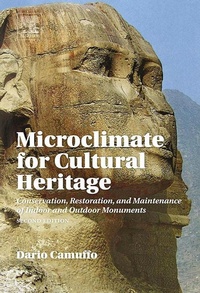
Microclimate for Cultural Heritage
Conservation, Restoration, and Maintenance of Indoor and Outdoor Monuments
2. Auflage
Erschienen am 4. Oktober 2013
560 Seiten
978-0-444-63298-2 (ISBN)
Beschreibung

Microclimate for Cultural Heritage: Conservation and Restoration of Indoor and Outdoor Monuments, Second Edition, is a cutting-edge, theoretical, and practical handbook concerning microclimate, environmental factors, and conservation of cultural heritage. Although the focus is on cultural heritage objects, most of the theory and instrumental methodologies are common to other fields of application, such as atmospheric and environmental sciences.
Microclimate for Cultural Heritage, Second Edition, is a useful treatise on microphysics and a practical handbook for conservators and specialists in physics, chemistry, architecture, engineering, geology, and biology who work in the multidisciplinary field of the environment, and, in particular, in the conservation of works of art. Part I, devoted to applied theory, is a concise treatise on microphysics, which includes a survey on the basic ideas of environmental diagnosis and conservation. The second part of the book focuses on practical utilization, and shows in detail how field surveys should be performed, with many suggestions and examples, as well as some common errors to avoid.
- Presents updated scientific and technological findings based on the novel European standards on microclimate and cultural heritage
- Includes the latest information on experimental research on environmental factors and their impact on materials, such as the behavior of water and its interactions with cultural heritage materials
- Contains case studies of outdoor and indoor microclimate conditions and their effects, providing ideas for readers facing similar problems caused by heat, water, radiation, pollution, or air motions
- Covers instruments and methods for practical applications to help readers understand, to observe and interpret observations, and avoid errors
Weitere Details
Weitere Ausgaben
Nachauflagen
Dario Camuffo
Microclimate for Cultural Heritage
Measurement, Risk Assessment, Conservation, Restoration, and Maintenance of Indoor and Outdoor Monuments
E-Book
06/2019
3. Auflage
Elsevier
175,00 €
Als Download verfügbar
Andere Ausgaben
D. Camuffo
Microclimate for Cultural Heritage
Conservation, Restoration, and Maintenance of Indoor and Outdoor Monuments
Buch
11/2013
2. Auflage
Elsevier
184,50 €
Versand in 15-20 Tagen
Vorauflage
Dario Camuffo
Microclimate for Cultural Heritage
E-Book
04/1998
1. Auflage
Elsevier
265,00 €
Als Download verfügbar
Person
Physicist. From 1969 at the National Research Council of Italy (CNR), Institute of Atmospheric Sciences and Climate, where his last position was Research Director. He retired in 2008, he now continues research and teaching as emeritus Associate. Since 1979, he has been lecturer of Environmental Physics and Physics for Conservation at the University of Padua, the Cignaroli Academy of Fine Arts, Verona, the Polytechnic of Milan. For ten years, he was the Co- Director of the European Doctoral Course "Sciences and Materials of the Cultural Heritage, of the European University Centre for Cultural Heritage, Ravello. His activities are mainly devoted to atmospheric physics applied to the conservation of the cultural heritage and to climate change. He has recovered and studied the earliest regular observations of the Medici Network (1654-1670) and a number of long-term instrumental series starting from the early 17th century. Similarly with written documentary proxies (e.g. chronicles, annals) over the last millennium: he reads fluent Latin, the official language of the Middle Ages and the language of scientific literature up to the French Revolution, Italian, French, English, Spanish, and ancient Greek. The possibility of reading original documents and books is very helpful in recovering data, but also in the interpretation of old recipes or scientific writings. He analyzed the sea level rise in Venice, over the last 500 years after the algae belt marked on the paintings by Canaletto, Bellotto and Veronese, who reproduced precise details with the help of a camera obscura. He was requested by the Holy Father John Paul II to improve the microclimate of Michelangelo's frescoes in the Sistine Chapel, and appointed by UNESCO for the Great Sphinx and Pyramid Plateau, Egypt, Thracian Tombs, the city of Nassebur and the Madara Rider, Bulgaria, all included in the World List of Cultural Heritage (WLCH). He also studied the Leonardo's Last Supper, Milan; the Uffizi Gallery, Florence; the Louvre and the Orangerie Museum, Paris; the Kunsthistorisches Museum, Vienna; the Orvieto Cathedral, and many other monuments. Active in standardization for cultural heritage, convenor of two working teams of the European Committee for Standardization (CEN) Technical Committee for Cultural Heritage, and vice-president of UNI-Normal (Italian Standardization Body). Member of various international scientific committees (e.g. European Commission, UNESCO, U.S. NAPAP) on the conservation of works of art, environment and climate. He wrote over 300 scientific papers and some books. He leaded many research projects, some fifteen of them funded by the European Commission Directorate General Research and Innovation, and the European Science Foundation (COST).
Inhalt
1. Microclimate, Air and Temperature2A. Theoretical grounds for Humidity2B. Humidity and Conservation3. Parameters to Describe Air Masses and Vertical Motions4. Radiation and Light5. Physics of Drop Formation and Micropore Condensation6. Atmospheric Water and Stone Weathering7. Atmospheric Stability and Pollutant Dispersion8. Dry Deposition of Airborne Particulate Matter: Mechanisms and Effects9. Consequences of the Maxwell-Boltzmann distribution10. Introduction to Field Measurements11. Measuring Temperature12. Measuring Humidity13. Measuring Wind and Indoor Air Motions14. Measuring Rainfall and Windborne Droplets Appendix 1. List of fundamental constants met in this bookAppendix 2. Summary of key equations to calculate humidity variablesAppendix 3. ESSENTIAL GLOSSARYRelevant Objects, Museums, Monuments etc exemplified in Figures
