

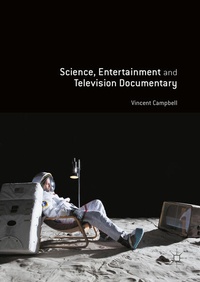
Science, Entertainment and Television Documentary
Beschreibung
The shift from traditional documentary to "factual entertainment" television has been the subject of much debate and criticism, particularly with regard to the representation of science. New types of factual programming that combine documentary techniques with those of entertainment formats (such as drama, game-shows and reality TV) have come in for strident criticism. Often featuring spectacular visual effects produced by Computer Generated Imagery these programmes blur the boundaries between mainstream science and popular beliefs. Through close analysis of programmes across a range of sciences, this book explores these issues to see if criticisms of such hybrid programmes as representing the "rotting carcass of science TV" really are valid. Campbell considers if in fact; when considered in relation to the principles, practices and communication strategies of different sciences; these shows can be seen to offer more complex and rich representations that construct sciences as objects of wonder, awe and the sublime.
Weitere Details
Weitere Ausgaben
Person
Vincent Campbell is Senior Lecturer in the Department of Media and Communication at the University of Leicester, UK. He has written on issues relating to the communication of science in factual television, and more widely on issues relating to screen communication. He co-edited Controversial Images: Media Representations on the Edge (with Atwood, F., Hunter, I. and Lockyer, S., Palgrave 2013).
Inhalt
Acknowledgements.- 1) Introduction: The Changing Landscape of Science Television.- 2) Analytical Frameworks: Science, Documentary and Factual Entertainment.- 3) Space Sciences: Wonders of the Cosmos.- 4) Palaeontology: Monsters from Lost Worlds.- 5) Archaeology: Ancient Secrets and Treasures.- 6) Earth and Atmospheric Sciences: Extreme Weather and Natural Disasters.- 7) Pseudoscience and Popular Beliefs.- Bibliography.-
