

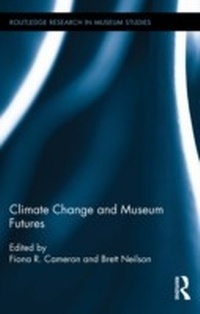
Climate Change and Museum Futures
1. Auflage
Erschienen am 5. Dezember 2014
300 Seiten
978-1-135-01352-3 (ISBN)
Beschreibung

Climate change is a complex and dynamic environmental, cultural and political phenomenon that is reshaping our relationship to nature. Climate change is a global force, with global impacts. Viable solutions on what to do must involve dialogues and decision-making with many agencies, stakeholder groups and communities crossing all sectors and scales. Current policy approaches are inadequate and finding a consensus on how to reduce levels of greenhouse gases in the atmosphere through international protocols has proven difficult. Gaps between science and society limit government and industry capacity to engage with communities to broker innovative solutions to climate change.
Drawing on leading-edge research and creative programming initiatives, this collection details the important roles and agencies that cultural institutions (in particular, natural history and science museums and science centres) can play within these gaps as resources, catalysts and change agents in climate change debates and decision-making processes; as unique public and trans-national spaces where diverse stakeholders, government and communities can meet; where knowledge can be mediated, competing discourses and agendas tabled and debated; and where both individual and collective action might be activated.
Drawing on leading-edge research and creative programming initiatives, this collection details the important roles and agencies that cultural institutions (in particular, natural history and science museums and science centres) can play within these gaps as resources, catalysts and change agents in climate change debates and decision-making processes; as unique public and trans-national spaces where diverse stakeholders, government and communities can meet; where knowledge can be mediated, competing discourses and agendas tabled and debated; and where both individual and collective action might be activated.
Rezensionen / Stimmen
"This is a fascinating compilation of essays about an important contemporary environmental issue. The book makes an important contribution to the museological literature, demonstrating how museums can play a significant role in debating and interpreting climate change, so becoming democratic actors by acting as a focal point for specialists and the public." - Peter Davis, Newcastle University, UKWeitere Details
Reihe
Sprache
Englisch
Verlagsort
London
Großbritannien
Verlagsgruppe
Taylor & Francis Ltd
Zielgruppe
Für höhere Schule und Studium
Für Beruf und Forschung
Produkt-Hinweis
Reflowable
Illustrationen
18 s/w Photographien bzw. Rasterbilder, 19 s/w Abbildungen, 1 s/w Zeichnung
1 Line drawings, black and white; 18 Halftones, black and white; 19 Illustrations, black and white
Dateigröße
9,04 MB
ISBN-13
978-1-135-01352-3 (9781135013523)
Copyright in bibliographic data and cover images is held by Nielsen Book Services Limited or by the publishers or by their respective licensors: all rights reserved.
Schweitzer Klassifikation
Weitere Ausgaben
Andere Ausgaben
Fiona Cameron | Brett Neilson
Climate Change and Museum Futures
Buch
12/2017
1. Auflage
Routledge
61,70 €
Versand in 15-20 Tagen
Fiona Cameron | Brett Neilson
Climate Change and Museum Futures
Buch
12/2014
1. Auflage
Routledge
232,10 €
Versand in 15-20 Tagen
Personen
Fiona R. Cameron is Senior Research Fellow at the Institute for Culture and Society, University of Western Sydney, Australia. She was the lead Chief Investigator on the Australian Research Council Linkage project, Hot Science, Global Citizens: The Agency of the Museum Sector in Climate Change Interventions.
Brett Neilson is Professor and Research Director at the Institute for Culture and Society, University of Western Sydney, Australia. With Sandro Mezzadra, he is author of Border as Method, or, the Multiplication of Labor. He currently leads the tricontinental research project Logistical Worlds: Infrastructure, Software, Labour (http://logisticalworlds.org).
Brett Neilson is Professor and Research Director at the Institute for Culture and Society, University of Western Sydney, Australia. With Sandro Mezzadra, he is author of Border as Method, or, the Multiplication of Labor. He currently leads the tricontinental research project Logistical Worlds: Infrastructure, Software, Labour (http://logisticalworlds.org).
Inhalt
Introduction: Climate Change, Museum Futures Fiona R. Cameron and Brett Neilson 1. Why We Should Disagree about Climate Change Mike Hulme 2. Ecologizing Experimentations: A Method and Manifesto for the Post-Human Museum Fiona R. Cameron 3. Prospects for a Common World: Museums, Climate Change, Cosmopolitics Ben Dibley 4. We are on Nature's Side? Experimental Work in Re-writing Narratives of Climate Change for Museum Exhibitions Fiona R. Cameron 5. Pushing Boundaries: Curating the Anthropocene at the Deutsches Museum Luke Keogh and Nina Moellers 6. Futuring Global Change in Science Museums and Centers: A Role for Anticipatory Practices and Imaginative Acts Juan F. Salazar 7. Tools for Alternate Temporalities Garth Priday, Tim Mansfield and Jose Ramos Programming Interlude I: Curating Fire Christine Hansen Programming Interlude II: Pacific Museums and Climate Change: Sharing Our Stories through Regional Workshops and Exhibitions Tarisi Vunidilo 8. Beyond Confrontation: The Trialogue Strategy for Mediating Climate Change Bob Hodge Programming Interlude III: Visualizing Climate Change: Beyond Technological Enchantment and Critical Deconstruction Tina Simone-Neset and Ola Uhrqvist 9. Portraying the Political: Contemporary Art Exhibitions and their Engagement with Climate Change Politics Kellie Payne 10. Inside and Outside the Tent: Climate Change Politics at the 2009 United Nations Climate Change Conference Brett Neilson 11. What Color is Citizenship? Toby Miller, Richard Maxwell and George Yudice 12. Putting a Human Face on Climate Change Ashley Dawson 13. Museum Affect: Crocheted Coral, Children's Stories & Possibilities in Queer Time Scott East Programming Interlude IV: Under the Icecap: Sonic Objects and "BioLogging" Nigel Heyler and Mary Anne Lea Programming Interlude V: Adaptation Cecellia Cmielewski Programming Interlude VI: How the Open Web Performs Socio-Environmental Conflicts Mauricio Corbalan 14. Conclusion: Climate Change Engagement: A Manifesto for Museums and Science Centres Fiona R. Cameron, Bob Hodge and Juan F. Salazar
