

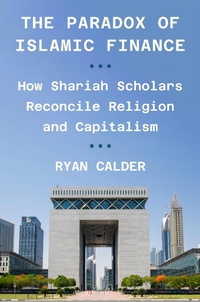
The Paradox of Islamic Finance
How Shariah Scholars Reconcile Religion and Capitalism
1. Auflage
Erschienen am 2. August 2024
376 Seiten
978-0-691-25832-4 (ISBN)
Beschreibung
How the booming Islamic finance industry became an ultramodern hybrid of religion and markets
In just fifty years, Islamic finance has grown from a tiny experiment operated from a Volkswagen van to a thriving global industry worth more than the entire financial sector of India, South America, or Eastern Europe. You can now shop with an Islamic credit card, invest in Islamic bonds, and buy Islamic derivatives. But how has this spectacular growth been possible, given Islam's strictures against interest? In The Paradox of Islamic Finance, Ryan Calder examines the Islamic finance boom, arguing that shariah scholars-experts in Islamic law who certify financial products as truly Islamic-have made the industry a profitable, if controversial, hybrid of religion and markets.
Critics say Islamic finance merely reproduces conventional interest-based finance, with the shariah scholars' blessing. From an economic perspective, they are right: the most popular Islamic products act like conventional interest-bearing ones, earning healthy profits for Islamic banks and global financial heavyweights like Deutsche Bank and Goldman Sachs. Yet as Calder shows by delving into the shariah scholars' day-to-day work, what seem like high-tech work-arounds to outsiders carry deep and nuanced meaning to the scholars-and to the hundreds of millions of Muslims who respect their expertise. He argues that shariah scholars' conception of Islamic finance is perfectly suited to the age of financialization and the global efflorescence of shariah-minded Islam.
In just fifty years, Islamic finance has grown from a tiny experiment operated from a Volkswagen van to a thriving global industry worth more than the entire financial sector of India, South America, or Eastern Europe. You can now shop with an Islamic credit card, invest in Islamic bonds, and buy Islamic derivatives. But how has this spectacular growth been possible, given Islam's strictures against interest? In The Paradox of Islamic Finance, Ryan Calder examines the Islamic finance boom, arguing that shariah scholars-experts in Islamic law who certify financial products as truly Islamic-have made the industry a profitable, if controversial, hybrid of religion and markets.
Critics say Islamic finance merely reproduces conventional interest-based finance, with the shariah scholars' blessing. From an economic perspective, they are right: the most popular Islamic products act like conventional interest-bearing ones, earning healthy profits for Islamic banks and global financial heavyweights like Deutsche Bank and Goldman Sachs. Yet as Calder shows by delving into the shariah scholars' day-to-day work, what seem like high-tech work-arounds to outsiders carry deep and nuanced meaning to the scholars-and to the hundreds of millions of Muslims who respect their expertise. He argues that shariah scholars' conception of Islamic finance is perfectly suited to the age of financialization and the global efflorescence of shariah-minded Islam.
Weitere Details
Weitere Ausgaben
Person
Ryan Calder is assistant professor of sociology and director of the Program in Islamic Studies at Johns Hopkins University. Before entering academia, he worked in management consulting and then covered the Libyan Arab Spring uprising for The Atlantic and Foreign Policy.
Inhalt
- Cover
- Contents
- Preface
- Translation and Romanization
- Glossary of Arabic and Urdu Terms
- Introduction
- 1. Origins
- 2. Ethics
- 3. Profitability
- 4. Legitimation
- 5. Justification
- 6. Restriction
- 7. State and Society
- Conclusion
- Acknowledgments
- Methodological Appendix
- Notes
- Bibliography
- Index
