

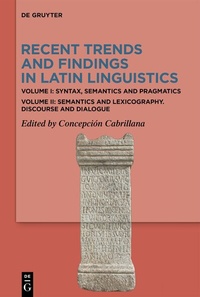
Recent Trends and Findings in Latin Linguistics
Beschreibung

These volumes contain a selection of contributions first presented at the 21 st International Colloquium on Latin Linguistics, held in Santiago de Compostela (2022). They cover essential topics in Latin linguistics from a variety of theoretical and methodological approaches.
The first volume includes papers on Latin Syntax and Semantics, Latin Syntax and Pragmatics, Greek-Latin language, and Digital Linguistics. The contributions report on the latest research into very relevant issues in specific areas such as definiteness, casual syntax, sentence structure, word order, etc.; in addition, the most recent methodological advances using a variety of databases, a key tool in contemporary research, are presented.
The second volume includes papers on Semantics and Lexicography, Etymology, Discourse strategies, and a special section devoted to the analysis of Conversation and Dialogue. The contributions report on the latest research into highly relevant issues in specific areas such as nominal and adjectival lexicology from both a synchronic and a diachronic perspectives, the use of Greek words as a vehicle for the expression of philosophical concepts, the choice and rendering of various linguistic strategies in direct and indirect discourse, etc. A particularly innovative section deals with various aspects of conversational language in a number of text types, as well as the use of different devices that contribute to the expression of (im)politeness by participants in the speech act.
A knowledge of the work collected in these volumes is essential for all those involved in research in the field of Latin linguistics.
Weitere Details
Weitere Ausgaben
Andere Ausgaben
Person
Concepción Cabrillana , University of Santiago de Compostela, Galicia, Spain.
Inhalt
- Intro
- Preface
- Contents
- Volume I
- Latin Linguistics in Harm's Way
- Section 1: Syntax and Semantics
- Aspects of the Expression of Definiteness in Classical Latin
- On the Zero Anaphora of Arguments in the Dative Case
- Interferencias colocacionales entre facere, agere y gerere en latín tardío
- Sensus censendi: On the Expression of Opinions in Latin, apropos CIC. Att. 1, 4, 1
- Substitution in Latin
- Remarks on the Aspect of the Present Tense in Latin
- Section 2: Syntactic Constructions
- El acusativo adverbial deadjetival en latín
- Expression of (Non-)Permanent Qualities and Coding of the Praedicativum in Latin
- Coordinative Repetition: Repetition as a Means of Coordination in Classical Latin
- Is au nominatif en fonction de sujet
- Non-finite Constructions in Latin, German and Turkish: A Trilateral Comparison
- Latin Translations of Greek ?t?-clauses in the Vulgate and the Vetus Latina: A Comparative Analysis of the Four Gospels
- Section 3: Syntax and Pragmatics
- Les subordonnées causales corrélatives en latin
- The Sequence [sola + VIR at the Beginning of the Verse]: A New Textual Motif in Ovidian Elegy?
- Prepositional Phrase Hyperbaton in Cicero's Orations
- Section 4: Digital Linguistics
- Lemmas in Dialogue: Linking the L.A.S.L.A. Corpus to the LiLa Knowledge Base
- New Perspectives on Latin Phraseology: Phrasemes and Textual Motifs
- Section 5: Semantics and Lexicography
- A Cognitive-Pragmatic Description of Evaluative Suffixes in Latin Letters: The Case of -llus
- Nota su perticarius e sarcitor: due nomi di mestiere di rara attestazione
- Expressing Rose Colour (roseus) from Ancient to Modern Latin: A Corpus-Based Study
- Glossing as a Rhetorical Strategy: Seneca the Younger's Use of Greek Loan-Words in his Philosophical Works
- Le micro-champ lexical des noms de pains en latin - une approche étymologique
- L'expression de la non-virilité par le féminin en latin : lat. effeminare, lat. effeminatus, lat. effeminate
- Semántica y sintaxis de dare. Consideraciones intralingüísticas e interlingüísticas
- La lingua del De errore profanarum religionum di Firmico Materno
- Qualche esempio di usi linguistici sommersi nei grammatici latini
- Nescio an: Maybe or Maybe not? Constructions of Doubting Used Adverbially
- Section 6: Discourse Strategies
- Verbes introducteurs et stratégies d'introduction du Discours Direct dans la narration romanesque latine (le Satyricon de Pétrone et les Métamorphoses d'Apulée)
- Degrés et manières d'élaboration textuelle chez quelques historiens romains
- Límites del discurso directo en la lengua latina
- Linguistik der Emotionen: Gefühlsausdruck bei Terenz und Cicero
- Fronto's Theory of Metaphor? An Enactivist and Psycholinguistic Perspective
- Section 7: Conversation and Dialogue
- Age/agite: the Artistic Re-elaboration of a Polyfunctional Interjection in Virgil's Works
- Self-interruptions (aposiopesis) in Roman Comedy
- Gestualità disfunzionale nelle tragedie di Seneca
- Conversational Behaviour after Quarrels: Im/politeness in Latin Dialogues
- Conversational Strategies in Non- Conversational Texts: The Communicative Structure of Cicero's Fourth Catilinarian
- The Pragmatic Marker age: Its Pragmatic Functions in Comedy and its Contribution to the Expression of Im/Politeness
- Subject Index
