

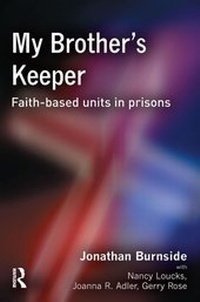
My Brother's Keeper
1. Auflage
Erschienen am 17. Juni 2013
400 Seiten
978-1-134-04011-7 (ISBN)
Beschreibung

Ten years ago there were no faith-based units in prisons outside South America. Today, they are spreading all over the world, including the United States, Europe and the Commonwealth. My Brother's Keeper is the first major study of a global phenomenon.
Exploring the roots of faith-based units in South America, it explains why the Prison Service of England and Wales set up the first Christian-based unit in the western world in 1997 - and its rapid expansion. It also explains how, at exactly the same time, the United States introduced Christian-based units - and why they were complimented by interfaith and multifaith initiatives.
At the heart of My Brother's Keeper is an interior account of life inside four Christian-based prison units in England. It draws on the findings of a detailed evaluation conducted by the authors for the Home Office, Prison Service and Kainos Community between 2000 and 2001, including an updated reconviction study. It is an authoritative account of an innovative programme. Its analysis of what works and what doesn't in faith-based units around the world makes My Brother's Keeper a valuable roadmap for all who care about improving prison conditions. It presents a vision of justice that is not just concerned with building more prisons but with rebuilding more prisoners. It argues that by making prisons more human and punishment more humane, faith-based units can be of value - and keep faith in prisons.
Exploring the roots of faith-based units in South America, it explains why the Prison Service of England and Wales set up the first Christian-based unit in the western world in 1997 - and its rapid expansion. It also explains how, at exactly the same time, the United States introduced Christian-based units - and why they were complimented by interfaith and multifaith initiatives.
At the heart of My Brother's Keeper is an interior account of life inside four Christian-based prison units in England. It draws on the findings of a detailed evaluation conducted by the authors for the Home Office, Prison Service and Kainos Community between 2000 and 2001, including an updated reconviction study. It is an authoritative account of an innovative programme. Its analysis of what works and what doesn't in faith-based units around the world makes My Brother's Keeper a valuable roadmap for all who care about improving prison conditions. It presents a vision of justice that is not just concerned with building more prisons but with rebuilding more prisoners. It argues that by making prisons more human and punishment more humane, faith-based units can be of value - and keep faith in prisons.
Weitere Details
Sprache
Englisch
Verlagsort
London
Großbritannien
Verlagsgruppe
Taylor & Francis Ltd
Zielgruppe
Für höhere Schule und Studium
Dateigröße
2,49 MB
ISBN-13
978-1-134-04011-7 (9781134040117)
Copyright in bibliographic data and cover images is held by Nielsen Book Services Limited or by the publishers or by their respective licensors: all rights reserved.
Schweitzer Klassifikation
Weitere Ausgaben
Andere Ausgaben
Jonathan Burnside | Joanna Adler
My Brother's Keeper
Buch
06/2015
1. Auflage
CRC Press
73,60 €
Versand in 10-20 Tagen
Jonathan Burnside | Joanna Adler | Nancy Loucks
My Brother's Keeper
Buch
10/2005
1. Auflage
Willan Publishing
207,60 €
Versand in 3-4 Wochen
Personen
Jonathan Burnside is Reader in Biblical Law at the School of Law, Bristol University. His work explores the relationship between law, theology and criminology.
Joanna Adler is a Lecturer in Forensic Psychology at Middlesex University. Recent publications include Forensic Psychology, 2e (Willan, 2010).
Nancy Loucks is Chief Executive of Families Outside, a voluntary organisation that specialises in advocacy and support for families affected by imprisonment. Prior to this, she worked as an independent Criminologist and her research focused primarily on prison policy and comparative criminology.
Gerry Rose is a Senior Research Associate at the Institute of Criminology, Cambridge University.
Joanna Adler is a Lecturer in Forensic Psychology at Middlesex University. Recent publications include Forensic Psychology, 2e (Willan, 2010).
Nancy Loucks is Chief Executive of Families Outside, a voluntary organisation that specialises in advocacy and support for families affected by imprisonment. Prior to this, she worked as an independent Criminologist and her research focused primarily on prison policy and comparative criminology.
Gerry Rose is a Senior Research Associate at the Institute of Criminology, Cambridge University.
Inhalt
Foreword by Sir Anthony Bottoms Prologue: Beatitudes Behind Bars: Christianity and Imprisonment 1. The prison that started it all 2. From Cursillo to prison: the story of Kairos 3. The rise and fall of Kairos-APAC 4. Kainos Community: views from the inside 5. Kainos Community: views from the top 6. Kainos Community and religious freedom 7. Navigatingbythe heavens: Horizon Communities 8. Preparing Evangelists: Inner Change Freedom Initiative 9. Psycho-social impact of Kainos 10. The impact of Kainos and Christian-based units on recidivism 11. Keeping faith in prison: the promise of faith-based units
