

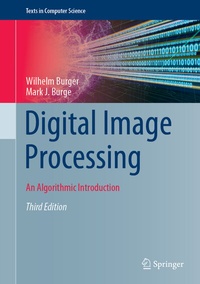
Digital Image Processing
Beschreibung

Topics and features:
-
- Contains new chapters on fitting of geometric primitives, randomized feature detection (RANSAC), and maximally stable extremal regions (MSER).
- Includes exercises for most chapters and provides additional supplementary
- materials and software implementations at an associated website.
- Uses ImageJ for all examples, a widely used open source imaging environment that
- can run on allmajor platforms.
- Describes each solution in a stepwise manner in mathematical form, as abstract pseudocode algorithms, and as complete Java programs that can be easily ported to other programming languages.
- Presents suggested outlines for a one- or two-semester course in the preface.
Advanced undergraduate and graduate students will find this comprehensive and example-rich textbook will serve as the ideal introduction to digital image processing. It will also prove invaluable to researchers and professionals seeking a practically focused self-study primer.
Weitere Details
Weitere Ausgaben
Andere Ausgaben
Personen
Dr. Wilhelm Burger is a faculty member of the University of Applied Sciences Upper Austria, Hagenberg, where he serves as Director of the Digital Media degree programs at the School of Informatics, Communications and Media.
Dr. Mark J. Burge
is a scientist at the non-profit organization Noblis in Falls Church, VA, USA. His other publications include the
Handbook of Iris Recognition
.
Inhalt
1. Digital Images.- 2. ImageJ.- 3. Histograms and Image Statistics.- 4. Point Operations.- 5. Filters.- 6. Edges and Contours.- 7. Corner Detection.- 8. Finding Simple Curves.- 9. Morphological Filters.- 10. Regions in Binary Images.- 11. Automatic Thresholding.- 12. Color Images.- 13. Color Quantization.- 14. Colorimetric Color Spaces.- 15. Filters for Color Images.- 16. Edge Detection in Color Images.- 17. Edge-Preserving Smoothing Filters.- 18. Introduction to Spectral Techniques.- 19. The Discrete Fourier Transform in 2D.- 20. Geometric Operations.
