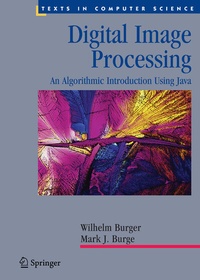
Digital Image Processing
Beschreibung

This is a hugely informative and highly practical book on a subject that is extremely relevant in today's world, where more and more households own and take pictures on digital cameras. Written as an introduction for undergraduate students, this textbook covers the most important methods in digital image processing. Formal and mathematical aspects are discussed at a fundamental level and various practical examples and exercises supplement the text. The book uses the image processing environment ImageJ, freely distributed by the National Institute of Health. A comprehensive website supports the book, and contains full source code for all examples in the book, a question and answer forum, slides for instructors, etc. Digital Image Processing in Java is the definitive textbook for computer science students studying image processing and digital processing. In all, it is a compact introduction to the methods of the digital image processing.
Rezensionen / Stimmen
From the reviews:
a welcome resource.
The algorithm discussions do not depend on any toolkit, allowing ready translations to other environments, as I have found with OpenGL shaders.
Useful either as a reference or as a textbook ... a very accessible textbook in image processing, quite suitable for undergraduate courses Starts with very fundamental concepts of digital images and goes through quite sophisticated algorithms with sound mathematical basis ... providing a deeper understanding of the algorithms.
This will be one my continuing reference books for some time to come.
Steve Cunningham, PhD
Past SIGGRAPH President and Chair
An excellent resource, I highly recommend.
Wayne Rasband, Author of ImageJ, U.S. National Institutes of Health (NIH)
"This modern, self-contained, textbook explains the fundamental algorithms of digital image processing through practical examples and complete Java implementations. Available for the first time in English, Digital Image Processing is the definitive textbook for students, researchers, and professionals in search of critical analysis and modern implementations of the most important algorithms in the field. . Self-contained chapters and additional online material suitable for a flexible one- or two semester course." (www.amazon.com, December 2007)
"This book teaches the basic algorithms used in image processing and implements many of these algorithms in ImageJ. . The book succeeds at showing the mathematics of each transform, of showing pseudocode for each algorithm, and implementing various algorithms in complete code. Each chapter has exercises for the student, and I found the textbook to be well illustrated and well written." (www.amazon.com, December 2007)
"This book is an introduction to image processing and analysis in the deeper sense, covering the structure of digital images . and the basic algorithmsinvolved in image processing. It is intended for advanced undergraduates and graduate students, as well as computer professionals. . The text is accompanied by a number of images . as well as clear and well-designed diagrams where appropriate. Good exercises for each chapter are given." (Jeffrey Putnam, Computing Reviews, March, 2009)
Weitere Details
Weitere Ausgaben
Andere Ausgaben