

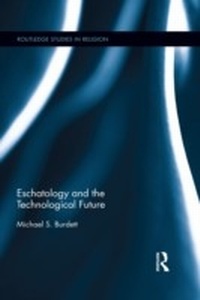
Eschatology and the Technological Future
1. Auflage
Erschienen am 5. Dezember 2014
266 Seiten
978-1-317-57665-5 (ISBN)
Beschreibung

The rapid advancement of technology has led to an explosion of speculative theories about what the future of humankind may look like. These "technological futurisms" have arisen from significant advances in the fields of nanotechnology, biotechnology and information technology and are drawing growing scrutiny from the philosophical and theological communities. This text seeks to contextualize the growing literature on the cultural, philosophical and religious implications of technological growth by considering technological futurisms such as transhumanism in the context of the long historical tradition of technological dreaming. Michael Burdett traces the latent religious sources of our contemporary technological imagination by looking at visionary approaches to technology and the future in seminal technological utopias and science fiction and draws on past theological responses to the technological future with Pierre Teilhard de Chardin and Jacques Ellul. Burdett's argument arrives at a contemporary Christian response to transhumanism based around the themes of possibility and promise by turning to the works of Richard Kearney, Eberhard Juengel and Juergen Moltmann. Throughout, the author highlights points of correspondence and divergence between technological futurisms and the Judeo-Christian understanding of the future.
Rezensionen / Stimmen
"This book offers an interesting reflection upon one of the most important topics in transhumanism." - Luis Torro Ferrero, European Society for the Study of Science and Theology"The author offers a remarkable interaction between technological and theological views of the future. Providing a readable and expert guide through the maze of utopianism, futurism, transhumanism and science fiction, he also draws skilfully on major theologians and philosophers to craft something much more original and exciting than a survey. In this book which should be required reading for all futurologists, he contrasts Christian hope convincingly with the limited possibilities promised by technology, while remaining appreciative of the contribution made by technology to the human community." - Paul Fiddes, Professor of Systematic Theology, University of Oxford, UK
"This book offers an insightful and timely analysis of key theorists and ideas in the intersection between theology and technology. From the religiously inspired technological optimism of Pierre Teilhard de Chardin and Nikolai Fedorov, to the darker technological pessimism of Jacques Ellul, the contributions of Christian theorists to understanding the technological milieu can offer us fresh perspectives on some intractable problems of modern life. As Burdett clearly shows, technological optimism and utopianism have religious roots, and a technological culture that ignores its own roots is in danger not only of environmental devastation, but also existential and spiritual despair. A fine book at a critical time." - David Lewin, Liverpool Hope University, UK
"An important, illuminating and timely engagement with one of the great intellectual and cultural issues of our time." - Alister E. McGrath, University of Oxford, UK
"Amongst the growing literature addressing the debate around transhumanism, Michael Burdett's work makes a unique contribution, and in several ways. Firstly, he contextualizes contemporary discussions in a long history of scientific and fictional utopias. Secondly, he offers a comprehensive account of the major theological responses to technological utopianism. And, thirdly, he brings into play an account of theological hope that moves the whole discussion onto a new level. Clearly written and cogently argued, this new book merits the attention of students from a wide spectrum of theological and philosophical disciplines." - George Pattison, 1640 Chair of Divinity, University of Glasgow, UK
Weitere Details
Reihe
Sprache
Englisch
Verlagsort
London
Großbritannien
Verlagsgruppe
Taylor & Francis Ltd
Zielgruppe
Für höhere Schule und Studium
Illustrationen
3 s/w Photographien bzw. Rasterbilder
3 Halftones, black and white
Dateigröße
1,42 MB
ISBN-13
978-1-317-57665-5 (9781317576655)
Copyright in bibliographic data and cover images is held by Nielsen Book Services Limited or by the publishers or by their respective licensors: all rights reserved.
Schweitzer Klassifikation
Weitere Ausgaben
Andere Ausgaben
Michael S. Burdett
Eschatology and the Technological Future
Buch
03/2017
1. Auflage
Routledge
86,20 €
Versand in 10-20 Tagen
Michael S. Burdett
Eschatology and the Technological Future
Buch
12/2014
1. Auflage
Routledge
231,90 €
Versand in 10-20 Tagen
Person
Michael S. Burdett is Postdoctoral Fellow at Wycliffe Hall, University of Oxford, UK and a Visiting Fellow at the University of St Andrews, UK
Inhalt
1. Introduction: Our Technological Future, Philosophy and Religion Part I: Visionary Approaches to Technology and the Future 2. Planning for the Technological Future: Technological Utopianism 3. Science Fiction and the Technological Imagination 4. Transhumanism and the Future Part II: Theological Responses to Technology and the Future 5. Pierre Teilhard de Chardin and Eschatology: The Technological Optimist 6. Jacques Ellul and Eschatology: The Technological Pessimist Part III: Philosophical and Theological Issues in Technology and the Future 7. Heidegger: Ontology, Technology and Eschatology 8. Possibility and Promise: A Christian Response 9. Conclusion: Hope in a Technological World
