

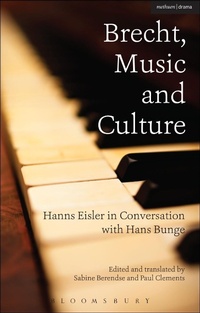
Brecht, Music and Culture
Hanns Eisler in Conversation with Hans Bunge
1. Auflage
Erschienen am 23. Oktober 2014
312 Seiten
978-1-4725-3441-5 (ISBN)
Beschreibung
The Austrian composer Hanns Eisler was Bertolt Brecht's closest friend and most politically committed collaborator. In these conversations with Hans Bunge which took place over a period of four years, from 1958 until his death in 1962, Eisler offers a compelling and absorbing account of his and Brecht's period of exile in Europe and the USA between 1933 and 1947, and of the quality of artistic, social and intellectual life in post-war East Germany.
Brecht, Music and Culture includes a discussion of a number of Brecht's principal plays, including Life of Galileo and The Caucasian Chalk Circle, considers the place of music in Brecht's work and discusses the time that Brecht was brought before The House of Un-American Activities Committee. It includes lively accounts of Brecht's meetings with key cultural figures, including Arnold Schönberg, Charlie Chaplin and Thomas Mann, and offers throughout a sustained response to the question of the purpose of art in a time of political turmoil.
Throughout the conversations, Eisler provides illuminating and original insights into Brecht's work and ideas and gives a highly entertaining first-hand account of his friend's personality and attitudes. First published in Germany in 1975, and now published in English for the first time, the conversations provide a fascinating account of the lives and work of two of the twentieth century's greatest artists.
Brecht, Music and Culture includes a discussion of a number of Brecht's principal plays, including Life of Galileo and The Caucasian Chalk Circle, considers the place of music in Brecht's work and discusses the time that Brecht was brought before The House of Un-American Activities Committee. It includes lively accounts of Brecht's meetings with key cultural figures, including Arnold Schönberg, Charlie Chaplin and Thomas Mann, and offers throughout a sustained response to the question of the purpose of art in a time of political turmoil.
Throughout the conversations, Eisler provides illuminating and original insights into Brecht's work and ideas and gives a highly entertaining first-hand account of his friend's personality and attitudes. First published in Germany in 1975, and now published in English for the first time, the conversations provide a fascinating account of the lives and work of two of the twentieth century's greatest artists.
Weitere Details
Auflage
1. Auflage
Sprache
Englisch
Verlagsort
London
Großbritannien
Verlagsgruppe
Bloomsbury Publishing PLC
Zielgruppe
Für Beruf und Forschung
Illustrationen
5 bw integrated illus
ISBN-13
978-1-4725-3441-5 (9781472534415)
Copyright in bibliographic data and cover images is held by Nielsen Book Services Limited or by the publishers or by their respective licensors: all rights reserved.
Schweitzer Klassifikation
Weitere Ausgaben
Personen
Hanns Eisler was an Austrian composer. A Schoenberg pupil and committed Marxist, he was one of the great distinctive musical personalities of the twentieth century.
Hans Bunge was assistant director and dramaturg at the Berliner Ensemble in Germany in the 1950s and later became first director of the Brecht Archive. He published his conversations with Eisler in Germany under the title Gespräche mit Hans Bunge - Fragen Sie mehr über Brecht.
Sabine Berendse, the daughter of the late Hans Bunge, is a Librarian and Information Specialist in Berlin, Germany.
Paul Clements was Principal of Mountview Academy of Theatre Arts in London, UK, for twelve years until his retirement in July 2008. He has taught, acted and directed in the UK, Canada and Scandinavia.
Hans Bunge was assistant director and dramaturg at the Berliner Ensemble in Germany in the 1950s and later became first director of the Brecht Archive. He published his conversations with Eisler in Germany under the title Gespräche mit Hans Bunge - Fragen Sie mehr über Brecht.
Sabine Berendse, the daughter of the late Hans Bunge, is a Librarian and Information Specialist in Berlin, Germany.
Paul Clements was Principal of Mountview Academy of Theatre Arts in London, UK, for twelve years until his retirement in July 2008. He has taught, acted and directed in the UK, Canada and Scandinavia.
Inhalt
Notes to the German edition by Hans Bunge
Translator's note
Conversation 1
14 Ways of Describing Rain - Meetings between Brecht and Arnold Schoenberg, Charlie Chaplin and Thomas Mann - Brecht and Music
Conversation 2
Galileo - Hollywood Elegies - Brecht and Feuchtwanger - Brecht and Music for the Theatre - Schweyk in the Second World War
Conversation 3
Brecht on Arnold Schoenberg - Gestic Music - The Caucasian Chalk Circle - Döblin's 65th Birthday Party
Conversation 4
Music for The Private Life of the Master Race - Prologue to Galileo - Eisler and the House Committee on Un-American Activities - The Mother in New York - Brecht and Stefan Zweig - Bajazzo
Conversation 5
Brecht's Hexameters for the Communist Manifesto - Was Brecht a Marxist? - Brecht's Method of Verfremdung
Conversation 6
'To Those Born Later' - Boogie-Woogie - Eisler on Religion - Galileo
Conversation 7
'Hotel Room 1942' - Hölderlin
Conversation 8
On Stupidity in Music I - Hölderlin
Conversation 9
Hans Mayer's book on Brecht - Brecht and Georg Lukács
Conversation 10
The Music to Schweyk in the Second World War - On Stupidity in Music II
Conversation 11
Hölderlin Poems - On Stupidity in Music III
Conversation 12
Eisler on Classical Literature, on the Function of Art, on Cybernetics and on Napoleon
Conversation 13
Serious Songs - Eisler's Plans for a Symphony
Conversation 14
Eisler and Bunge Compare Their Experiences as Soldiers
Afterword: For the First Edition of the 'Conversations' by Stephan Hermlin
Notes
Appendix
Index
Translator's note
Conversation 1
14 Ways of Describing Rain - Meetings between Brecht and Arnold Schoenberg, Charlie Chaplin and Thomas Mann - Brecht and Music
Conversation 2
Galileo - Hollywood Elegies - Brecht and Feuchtwanger - Brecht and Music for the Theatre - Schweyk in the Second World War
Conversation 3
Brecht on Arnold Schoenberg - Gestic Music - The Caucasian Chalk Circle - Döblin's 65th Birthday Party
Conversation 4
Music for The Private Life of the Master Race - Prologue to Galileo - Eisler and the House Committee on Un-American Activities - The Mother in New York - Brecht and Stefan Zweig - Bajazzo
Conversation 5
Brecht's Hexameters for the Communist Manifesto - Was Brecht a Marxist? - Brecht's Method of Verfremdung
Conversation 6
'To Those Born Later' - Boogie-Woogie - Eisler on Religion - Galileo
Conversation 7
'Hotel Room 1942' - Hölderlin
Conversation 8
On Stupidity in Music I - Hölderlin
Conversation 9
Hans Mayer's book on Brecht - Brecht and Georg Lukács
Conversation 10
The Music to Schweyk in the Second World War - On Stupidity in Music II
Conversation 11
Hölderlin Poems - On Stupidity in Music III
Conversation 12
Eisler on Classical Literature, on the Function of Art, on Cybernetics and on Napoleon
Conversation 13
Serious Songs - Eisler's Plans for a Symphony
Conversation 14
Eisler and Bunge Compare Their Experiences as Soldiers
Afterword: For the First Edition of the 'Conversations' by Stephan Hermlin
Notes
Appendix
Index
