

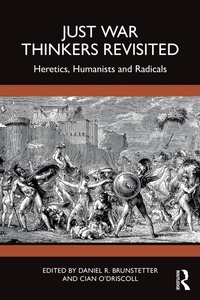
Just War Thinkers Revisited
Heretics, Humanists and Radicals
1. Auflage
Erschienen am 25. November 2024
332 Seiten
978-1-040-25871-2 (ISBN)
Beschreibung

This book comprises essays that focus on a range of thinkers who challenge the boundaries of the just war tradition.
The ethics of war scholarship has become a rigid and highly disciplined activity, closely associated with a very particular canon of thinkers. This volume moves beyond this by presenting thinkers not typically regarded as part of that canon but who have interesting and potentially important things to say about the ethics of war. The book presents 20 profile essays on an eclectic cast of heretics, humanists, and radicals, from ancient Greece to the twenty-first century, who lived through and theorized about violence. The book asks how ethics of war scholars might benefit from engaging with them. Some of these thinkers engage directly with-to augment or criticize-the just war tradition, while others contribute to military thinking across the ages, pushing the boundaries of what was acceptable in war. Many proffer alternative moral frameworks regarding the legitimacy of political violence. The present volume thus invites scholars to reconsider the ethics of war in a way that challenges the standard delineation between just war theory, realism, and pacifism and to reflect on how those positions might inform our own approach to these matters.
This book will be of much interest to students of just war theory, ethics of war, war studies, and International Relations.
The ethics of war scholarship has become a rigid and highly disciplined activity, closely associated with a very particular canon of thinkers. This volume moves beyond this by presenting thinkers not typically regarded as part of that canon but who have interesting and potentially important things to say about the ethics of war. The book presents 20 profile essays on an eclectic cast of heretics, humanists, and radicals, from ancient Greece to the twenty-first century, who lived through and theorized about violence. The book asks how ethics of war scholars might benefit from engaging with them. Some of these thinkers engage directly with-to augment or criticize-the just war tradition, while others contribute to military thinking across the ages, pushing the boundaries of what was acceptable in war. Many proffer alternative moral frameworks regarding the legitimacy of political violence. The present volume thus invites scholars to reconsider the ethics of war in a way that challenges the standard delineation between just war theory, realism, and pacifism and to reflect on how those positions might inform our own approach to these matters.
This book will be of much interest to students of just war theory, ethics of war, war studies, and International Relations.
Rezensionen / Stimmen
"In an exciting break with convention, Just War Thinkers Revisited replaces the usual protagonists with an unexpected ensemble of radicals, heretics and nonconformists, whose work is often pushed to the margins or neglected altogether. Engaging with these intellectual outsiders allows the contributors to the collection to revamp tired ethical debates, reinvent accepted ethical assumptions, and reimagine settled ethical concepts."Thomas Gregory, Lecturer in Politics and International Relations, University of Auckland, New Zealand
"A much welcome - and delightfully lyrical - disruption of entrenched categories in the Just War tradition. The authors mobilize thinkers and ideas from a broader spectrum of political philosophy than is the norm, and in so doing, they pay heed to the ethos of thinking ethically about war. The volume is a refreshing departure from endless reinterpretations of traditional texts in the understanding that these, albeit important, can take us only so far in understanding war and violence. And it is a step forward in coming to terms with the political power of the Just War tradition itself."
Elke Schwarz, Reader (Associate Professor) in Political Theory, Queen Mary University London
Weitere Details
Reihe
Auflage
1. Auflage
Sprache
Englisch
Verlagsort
London
Großbritannien
Verlagsgruppe
Taylor & Francis Ltd
Zielgruppe
Für höhere Schule und Studium
Für Beruf und Forschung
Dateigröße
0,81 MB
ISBN-13
978-1-040-25871-2 (9781040258712)
Copyright in bibliographic data and cover images is held by Nielsen Book Services Limited or by the publishers or by their respective licensors: all rights reserved.
Schweitzer Klassifikation
Weitere Ausgaben
Andere Ausgaben
Buch
11/2024
1. Auflage
Routledge
196,90 €
Versand in 10-20 Tagen
Buch
11/2024
1. Auflage
Routledge
58,80 €
Versand in 10-20 Tagen
Personen
Daniel R. Brunstetter is Professor in Political Science at University of California, Irvine, the United States. He is the author of two books and editor of two volumes, including Just War Thinkers (2018).
Cian O'Driscoll is Professor of International Relations at the Australian National University (ANU), Canberra, Australia. He is the author of two books and editor of three volumes, including Just War Thinkers (2018).
Cian O'Driscoll is Professor of International Relations at the Australian National University (ANU), Canberra, Australia. He is the author of two books and editor of three volumes, including Just War Thinkers (2018).
Inhalt
Introduction: Introduction: Heretics, Humanists, and Radicals 1: Aristotle (384 BC-322 BC) 2: Epictetus (c. 50-c. 135 AD) 3: Juan Gines de Sepulveda (1490-1573) 4: Alonso de la Vera Cruz (1507-1584) 5: Martin Luther (1483-1546) 6: Michel de Montaigne (1533-1592) 7: John Brown (1800-1859) 8: Pierre-Joseph Proudhon (1809-1865) 9: Carlos Calvo (1824-1906) 10: Rosa Luxemburg (1871-1919) 11: Luigo Sturzo (1871-1959) 12: Reinhold Niebuhr (1892-1971) 13: G.E.M. Anscombe (1919-2001) 14: Frantz Fanon (1925-1961) 15: Alasdair MacIntyre (1929-) 16: Martin Luther King Jr. (1929-1968) 17: John Rawls (1921-2002) 18: Judith Butler (1956-) 19: Pope Francis (1936-) 20: Charles W. Mills (1951-2021) Conclusion: Heretics and Humanists and Radicals, Oh My!
