

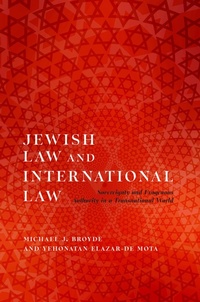
Jewish Law and International Law
Sovereignty and Exogenous Authority in a Transnational World
Erschienen am 8. April 2025
224 Seiten
978-0-19-780525-1 (ISBN)
Beschreibung
Jewish Law and International Law offers a timely exploration of the intricate relationship between Jewish law (or halakhah) and international legal systems. In an era marked by rising antisemitism and increasing tensions between the Israel and the international community, the book offers a deeper understanding of Jewish law's contributions to the broader legal landscape.
Offering relevant analysis and a forward-looking approach, Jewish Law and International Law illuminates the significant jurisprudential and methodological parallels between the two systems. Its eight chapters weave together the connections between Jewish law and international law, from the foundational concepts and histories of both legal systems to their shared values and transnational nature. The book delves into how Jewish law incorporates local and international legal principles in areas such as war, humanitarian law, copyright law, and governance. Envisioning a future where Jewish law and international law work in concert rather than conflict, the book offers a more nuanced perspective on both systems and looks toward promoting global justice.
Weitere Details
Weitere Ausgaben
Personen
Michael J. Broyde is Professor of Law, the director of the SJD program, and the Berman Projects Director at the Center for the Study of Law and Religion, all at Emory University. He is also an adjunct professor of Law at Columbia University School of Law, where he teaches advanced Jewish Law. Ordained as a rabbi by Yeshiva University, he has served as a judge (dayyan) in America's largest Jewish law court (bet din) and was founding rabbi at the Young Israel synagogue in Atlanta, Georgia.
Yehonatan Elazar-De Mota is a Senior Research Fellow at the Center for the Study of Law and Religion at Emory University's Law School. In 2020 and the beginning of 2021, Elazar-De Mota was a visiting lecturer at Universidade Lusófona Porto, and in 2022, he continued post-doctoral research at the University of Antwerp's Political Science Department. He is rosh yeshiba of Beth Midrash Eleazar and judge (ab beth din) of Beth Din Zedek of the Dominican Republic.
Inhalt
1. An Introduction to Jewish Law and an Introduction to International Law: Two legal systems that transcend Territoriality
2. Jewish Law and Incorporation of Local Law: Theories of why, what, and when
3. Areas of Incorporation of International Law: War and humanitarian law
4. Areas of Incorporation of International Law: Copyright law
5. Jewish Law and International Law: The past
6. Jewish Law and International Law: The present
7. Jewish Law and Antisemitic Legal Systems: The past, present, and future
8. Jewish Law and International Law: The future
