

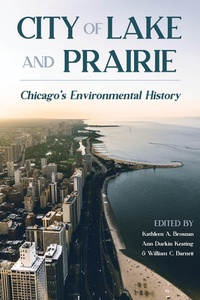
City of Lake and Prairie
Chicago's Environmental History
Erschienen am 8. September 2020
417 Seiten
978-0-8229-8772-7 (ISBN)
Beschreibung

Known as the Windy City and the Hog Butcher to the World, Chicago has earned a more apt sobriquet-City of Lake and Prairie-with this compelling, innovative, and deeply researched environmental history. Sitting at the southwestern tip of Lake Michigan, one of the largest freshwater bodies in the world, and on the eastern edge of the tallgrass prairies that fill much of the North American interior, early residents in the land that Chicago now occupies enjoyed natural advantages, economic opportunities, and global connections over centuries, from the Native Americans who first inhabited the region to the urban dwellers who built a metropolis in the nineteenth and twentieth centuries. As one millennium ended and a new one began, these same features sparked a distinctive Midwestern environmentalism aimed at preserving local ecosystems. Drawing on its contributors' interdisciplinary talents, this volume reveals a rich but often troubled landscape shaped by communities of color, workers, and activists as well as complex human relations with industry, waterways, animals, and disease.
Weitere Details
Weitere Ausgaben
Andere Ausgaben
Kathleen Brosnan | Ann Durkin Keating | William C. Barnett
City of Lake and Prairie
Chicago's Environmental History
Buch
09/2020
University of Pittsburgh Press
70,56 €
Artikel ist vergriffen; siehe andere Ausgabe
Personen
Kathleen A. Brosnan (Editor)
Kathleen Brosnan is the Paul and Doris Eaton Travis Chair of Modern American History at the University of Oklahoma.
William C. Barnett (Editor)
William C. Barnett is associate professor and chair of the History Department at North Central College in Naperville, Illinois.
Ann Durkin Keating (Editor)
Ann Durkin Keating is Dr. C. Frederick Toenniges Professor of History at North Central College in Naperville, Illinois.
Kathleen Brosnan is the Paul and Doris Eaton Travis Chair of Modern American History at the University of Oklahoma.
William C. Barnett (Editor)
William C. Barnett is associate professor and chair of the History Department at North Central College in Naperville, Illinois.
Ann Durkin Keating (Editor)
Ann Durkin Keating is Dr. C. Frederick Toenniges Professor of History at North Central College in Naperville, Illinois.
Inhalt
- Intro
- Contents
- Acknowledgments
- Introduction | William C. Barnett
- Part I. Where Prairie Meets Lake
- 1. Native Peoples in the Tallgrass Prairies of Illinois | Robert Morrissey
- 2. Cholera and the Evolution of Early Chicago | Ann Durkin Keating and Kathleen A. Brosnan
- 3. Animals at Work in Industrializing Chicago | Katherine Macica
- Part II. A Freshwater City
- 4. An Inland Sea? Coming to Terms with Lake Michigan in Nineteenth-Century Chicago | Theodore J. Karamanski
- 5. Cleansing Chicago: Environmental Control and the Reversal of the Chicago River | Mathhew Corpolongo
- 6. Too Much Water: Coping with Climate Change and Suburban Sprawl in a Flood-Prone Environment | Harold L. Platt
- 7. Water, Oil, and Fish: The Chicago River as a Technological Matrix of Place | Daniel MacFarlane and Lynne Heasley
- Part III. The Nature of Working-Class Chicagoans
- 8. May Day: The Green Vision of Chicago's Gilded Age Anarchists | Colin Fisher
- 9. Black Migrant Foodways in the "Hog Butcher for the World" | Brian McCammack
- 10. "No Cheerful Patches of Green": Mexican Community and the Industrial Environment on the Far Southeast Side of Chicago | Michael Innis-Jimenez
- 11. Work Relief Labor in the Cook County Forest Preserves, 1931-1942 | Natalie Bump Vena
- A Cartographic Interlude
- 12. Maps and Chicago's Environmental History | Peter Nekola and James R. Akerman
- Part IV. Managing (or not) Urban-Industrial Complexity
- 13. Blood on the Tracks: Accidental Death and the Built Environment | Joshua A. T. Salzmann
- 14. Air and Water Pollution in the Urban-Industrial Nexus: Chicago, 1840s-1970s | Steven H. Corey
- 15. Chicago's Wastelands: Refuse Disposal and Urban Growth, 1840-1990 | Craig E. Colten
- 16. Mrs. Block Beautiful: African American Women and the Birth of the Urban Conservation Movement in Chicago, 1917-1954 | Sylvia Hood Washington
- Part V. Reenvisioning the Lake and Prairie
- 17. May Theilgaard Watts and the Origins of the Illinois Prairie Path | William C. Barnett
- 18. "Hard-Nosed Professionals": Gordon Sherman, Businessmen for the Public Interest, and Environmentalism in 1970s Chicago | Robert Gioielli
- 19. The Calumet Region: A Line in the Sand | Mark Bouman
- Notes
- Contributors
- Index
