

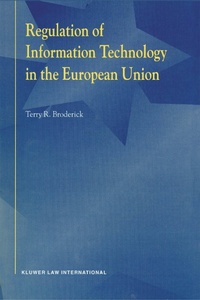
Regulation of Information Technology in the European Union
Erschienen am 1. November 2000
94 Seiten
978-90-411-7457-4 (ISBN)
Beschreibung
Information technology is continuing to transform global communications and the world economy with innovative products and services. In this dynamic environment, events tend to be market-driven and it may be difficult for the regulators to keep up. At the same time, there is a need for public authorities to promote effective competition within a clear, coherent and predictable framework.
This useful reference work summarizes the major rules and policies for information technology at European level. It describes the institutional framework and general policies for the "information society", examines the detailed rules for external trade, competition and intellectual property, and discusses the internet and electronic commerce. It provides an excellent overview of the subject as well as a good starting point for additional research on particular issues. This unique work will be of great value for practising lawyers, corporate counsel, business executives, consultants, academics and government or trade association officials.
Terry Broderick is a graduate of Harvard Law School and a member of the Pennsylvania (U.S.A.) bar. Since 1983, he has specialized in the practice of European Union law with a focus on information technology.
This useful reference work summarizes the major rules and policies for information technology at European level. It describes the institutional framework and general policies for the "information society", examines the detailed rules for external trade, competition and intellectual property, and discusses the internet and electronic commerce. It provides an excellent overview of the subject as well as a good starting point for additional research on particular issues. This unique work will be of great value for practising lawyers, corporate counsel, business executives, consultants, academics and government or trade association officials.
Terry Broderick is a graduate of Harvard Law School and a member of the Pennsylvania (U.S.A.) bar. Since 1983, he has specialized in the practice of European Union law with a focus on information technology.
Weitere Details
Weitere Ausgaben
Inhalt
- Cover
- Half Title Page
- Title Page
- Copyright Page
- Table of Contents
- CHAPTER 1 INTRODUCTION
- CHAPTER 2 INSTITUTIONAL FRAMEWORK
- 1. BACKGROUND
- 2. MEMBER STATES
- 3. MAJOR AGENCIES
- 3.1. European Parliament
- 3.2. Council of Ministers
- 3.3. European Commission
- 3.4. European Court of Justice
- 3.5. Others
- 4. LEGISLATION
- 5. EUMINATION OF TECHNICAL BARRIERS
- 5.1. Mutual Recognition
- 5.2. New Barriers
- 5.3. Standards and Specifications
- 5.4. Testing and Certification
- CHAPTER 3 INFORMATION SOCIETY
- 1. GENERAL
- 2. CONVERGENCE OF TECHNOLOGY
- 3. RESEARCH AND DEVELOPMENT
- 4. TRANS-EUROPEAN NETWORKS
- 5. PRODUCT LIABILITY
- 6. MILLENNIUM PROBLEM
- CHAPTER 4 EXTERNAL TRADE RELATIONS
- 1. INTERNATIONAL ARRANGEMENTS
- 1.1. World Trade Organization
- 1.2. Information Technology Agreement
- 1.3. Mutual Recognition
- 2. STRATEGIC EXPORT CONTROLS
- 3. COMMUNITY CUSTOMS CODE
- 3.1. Combined Nomenclature
- 3.2. Non-Preferential Tariffs
- 3.3. Preferential Tariffs
- 3.4. Duty Suspension
- 3.5. Tariff Classification
- 3.6. Origin of Goods
- 4. COMMERCIAL POLICY MEASURES
- 4.1. Antidumping and Countervailing Duties
- 4.2. Safeguards
- 4.3. Unfair Trade Practices
- 4.4. Counterfeit Goods
- CHAPTER 5 COMPETITION POLICY
- 1. GENERAL: ARTICLES 81 AND 82
- 1.1. Article 81: Restriction of Competition
- 1.2. Article 82: Abuse of Dominant Position
- 2. PROCEDURES: ARTICLES 81 AND 82
- 2.1. Notices and Communications
- 2.2. Negative Clearance and Individual Exemption
- 2.3. Limitation Periods
- 2.4. Judicial Review
- 3. BLOCK EXEMPTIONS
- 3.1. Distribution and Purchasing
- 3.2. Franchising
- 3.3. Research and Development
- 3.4. Specialization
- 3.5. Technology Transfer
- 4. MERGER CONTROL REGULATION
- 4.1. Community Dimension
- 4.2. Concentrations and Joint Ventures
- 4.3. Substantive Evaluation
- 4.4. Procedure
- 5. STATE AID
- 6. APPENDIX: SELECTED CASES
- 6.1. Article 81
- 6.1.1. Computerland
- 6.1.2. Fujitsu AMD Semiconductor
- 6.1.3. Olivetti/Digital
- 6.1.4. STACK International
- 6.1.5. Systemform
- 6.1.6. X/Open Group
- 6.2. Article 82
- 6.2.1. Digital Equipment
- 6.2.2. IBM
- 6.2.3. Microsoft
- 6.3. Merger Control Regulation
- 6.3.1. AT&T/NCR
- 6.3.2. Digital/Philips
- 6.3.3. EDS/SD-Scicon
- 6.3.4. Samsung/AST
- 6.3.5. Schibsted Multimedia/Telenor/Telia
- 6.4. State Aid
- 6.4.1. Groupe Bull
- CHAPTER 6 INTELLECTUAL PROPERTY
- 1. GENERAL
- 1.1. Copyright
- 1.2. Industrial Design
- 1.3. Patents and Utility Models
- 1.4. Trademarks
- 2. COMPUTER SOFTWARE
- 2.1. Scope and Limitations
- 2.2. Authors and Beneficiaries
- 2.3. Restricted Acts and Exceptions
- 2.4. Decompilation
- 2.5. Special Remedies
- 2.6. Term of Protection
- 2.7. Other Provisions
- 3. DATABASES
- 3.1. Scope and Limitations
- 3.2. Copyright
- 3.3. Sui Generis Right
- 3.4. Remedies and Other Provisions
- 4. SEMICONDUCTOR TOPOGRAPHIES
- 4.1. Scope and Limitations
- 4.2. Protected Parties
- 4.3. Registration Procedure
- 4.4. Restricted Acts and Exceptions
- 4.5. Term of Protection
- 4.6. Other Provisions
- CHAPTER 7 INTERNET AND ELECTRONIC COMMERCE
- 1. VOICE TELEPHONY
- 2. INTERNET GOVERNANCE
- 3. NETWORK SECURITY
- 3.1. Cybercrime
- 3.2. Harmful and Illegal Content
- 3.3. Electronic Signatures
- 3.4. Encryption and Conditional Access
- 4. PROTECTION OF PERSONAL DATA
- 4.1. Scope and Limitations
- 4.2. Applicable Law
- 4.3. Lawful Processing
- 4.4. Rights of the Data Subject
- 4.5. Exemptions and Restrictions
- 4.6. Remedies and Sanctions
- 4.7. Transfer to Third Countries
- 4.8. Other Provisions
- 5. ELECTRONIC COMMERCE
- 5.1. General
- 5.2. E-Commerce Directive
- 5.3. Distance Selling
- 5.4. Electronic Data Interchange
- 5.5. Electronic Payment
- 5.6. Taxation
- INDEX
- Back Cover
