

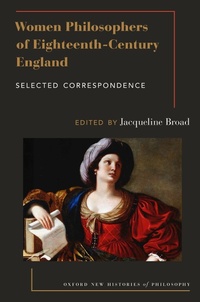
Women Philosophers of Eighteenth-Century England
Selected Correspondence
1. Auflage
Erschienen am 26. Mai 2020
304 Seiten
978-0-19-750701-8 (ISBN)
Beschreibung
This is the second of two collections of correspondence written by early modern English women philosophers. In this volume, Jacqueline Broad presents letters from three influential thinkers of the eighteenth century: Mary Astell, Elizabeth Thomas, and Catharine Trotter Cockburn. Broad provides introductory essays for each figure and explanatory annotations to clarify unfamiliar language, content, and historical context for the modern reader. Her selections make available many letters that have never been published before or that live scattered in various archives, obscure manuscripts, and rare books. The discussions range in subject from moral theology and ethics to epistemology and metaphysics; they involve some well-known thinkers of the period, such as John Norris, George Hickes, Mary Chudleigh, John Locke, and Edmund Law. By centering epistolary correspondence, Broad's anthology works to reframe early modern philosophy, the foundation for so much of twentieth-century philosophy, as consisting of collaborative debates that women actively participated in and shaped. Together with its companion volume, Women Philosophers of Eighteenth-Century England: Selected Correspondence is an invaluable primary resource for students, scholars, and those undertaking further research in the history of women's contributions to the formation and development of early modern thought.
Weitere Details
Weitere Ausgaben
Person
Jacqueline Broad is Associate Professor of Philosophy in the School of Philosophical, Historical, and International Studies at Monash University, Melbourne. Her main areas of research are early modern philosophy, the history of women's ideas, and historical feminist thought. She recently published Women Philosophers of Seventeenth-Century England: Selected Correspondence (OUP 2019), and an edited collection of essays with Karen Detlefsen, Women and Liberty, 1600-1800 (OUP 2017).
Inhalt
Contents
Acknowledgements
Note on the Texts
Introduction
1. Mary Astell (1666-1731)
1.1 Mary Astell and John Norris
1.2 Mary Astell, George Hickes, and an anonymous lady
2. Elizabeth Thomas (1675-1731)
2.1 Elizabeth Thomas and John Norris
2.2 Elizabeth Thomas and Mary Chudleigh
2.3 Elizabeth Thomas and Richard Hemington
3. Catharine Trotter Cockburn (1679?-1749)
3.1 Catharine Trotter Cockburn and John Locke
3.2 Catharine Trotter Cockburn and Ann Hepburn Arbuthnot
3.3 Catharine Trotter Cockburn and Edmund Law
Bibliography
Index
