

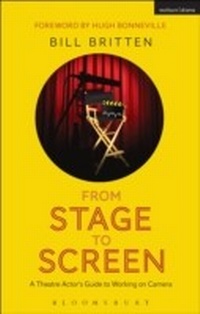
From Stage to Screen
A Theatre Actor's Guide to Working on Camera
1. Auflage
Erschienen am 20. November 2014
248 Seiten
978-1-4725-2264-1 (ISBN)
Beschreibung

The camera enables us to see right into a character's soul, revealing his or her innermost thoughts and emotions. Screen acting requires a more rigorously truthful and spontaneous performance than the stage, as well as very different technical expertise. From Stage to Screen is a handbook for the professional actor packed with advice on how to make the transition and fully prepare for a TV or film role.
The book is divided into three sections: the first examines the relationship between the actor and the camera and how it differs from that of a performer with a stage audience; the second addresses the technical skills the screen actor needs in order to work as part of a large collaborative team and 'make the shot work'; and the third explores the very different experience of an actor working on a screen project, including getting the job, how to prepare properly, what to expect and how to manage the whole process, from casting through to ADR, in order to deliver the very best work.
The book is divided into three sections: the first examines the relationship between the actor and the camera and how it differs from that of a performer with a stage audience; the second addresses the technical skills the screen actor needs in order to work as part of a large collaborative team and 'make the shot work'; and the third explores the very different experience of an actor working on a screen project, including getting the job, how to prepare properly, what to expect and how to manage the whole process, from casting through to ADR, in order to deliver the very best work.
Weitere Details
Auflage
1. Auflage
Sprache
Englisch
Verlagsort
London
Großbritannien
Verlagsgruppe
Bloomsbury Publishing PLC
Zielgruppe
Für Beruf und Forschung
ISBN-13
978-1-4725-2264-1 (9781472522641)
Copyright in bibliographic data and cover images is held by Nielsen Book Services Limited or by the publishers or by their respective licensors: all rights reserved.
Schweitzer Klassifikation
Weitere Ausgaben
Andere Ausgaben
Buch
11/2014
Methuen Drama
36,80 €
Versand in 10-20 Tagen
Person
Bill Britten is a senior lecturer in Screen Acting and Directing at the Drama Centre, London. He regularly runs classes for professional actors at the Actors Centre and coaches performers from other disciplines wanting to move into acting. He also works extensively internationally as a business communications coach.
Inhalt
- Intro
- Title Page
- Copyright Page
- CONTENTS
- ACKNOWLEDGEMENTS
- FOREWORD
- INTRODUCTION
- Chapter 1 LET'S PRETEND
- Acting is easy
- Acting is difficult
- The intellectual actor
- Developing yourself
- Emotional intelligence
- Chapter 2 THE BIG DIFFERENCES
- The similarities
- The differences
- Section 1 - SHOWING, SHARING AND THE INNER WORLD
- Chapter 3 SHOWING AND SHARING
- The act of observing changes the thing that's being observed
- Showing
- Where's your attention?
- Don't just do something, stand there
- Chapter 4 THE INNER WORLD
- The close-up and the inner monologue
- Chapter 5 LISTENING
- Listening and the inner world
- Point of attention
- Spontaneity
- Chapter 6 COMMITMENT
- Creating the imaginary world
- Commitment
- Section 2 - MAKE THE SHOT WORK
- Chapter 7 FILMING - THE BIG PICTURE
- Development (and pre-pre-production)
- Three phases of production
- Pre-production
- Post-production
- Production
- Meeting the schedule
- Collaboration
- Practice
- Chapter 8 UNDERSTANDING THE SHOTS
- Single versus multi-camera shooting
- What do I need to know about the shots and camera terminology?
- Chapter 9 GLOSSARY OF SHOTS
- Master
- Wide/Mid/Close
- Single
- Dirty/Clean
- 2 Shot
- Tracking shot
- Coverage
- Set-ups
- Reverse
- Slate
- Working with technophile/geek actors
- Chapter 10 HITTING MARKS
- Marks
- Focus
- Putting down marks
- How to hit your marks
- The soft bag
- The real challenge
- Practice
- Chapter 11 OVERLAPS
- Why overlaps matter
- Chapter 12 CONTINUITY
- Why continuity matters
- Movement drives the cut
- How to manage your continuity
- Emotional continuity
- Practice
- Chapter 13 POSITIONING YOURSELF FOR THE CAMERA
- Opposing singles
- Finding the camera
- Reverses
- Standing up and sitting down
- Chapter 14 THE VOICE
- Projection
- Mumbling
- Chapter 15 FACIAL AWARENESS
- Facial awareness
- Eye movement
- Blinking
- Around the eyes
- Eye contact
- The mouth and the jaw
- Swallowing
- Using this awareness
- Chapter 16 PLAYING THE CAMERA
- The doughnut
- Eye movement
- Knowing and not-knowing
- Looking down
- Lateral eye movement
- Repeated eye movements
- Chapter 17 LOVING THE CAMERA
- Loving the camera
- Section 3 - DOING IT
- Chapter 18 GETTING THE JOB
- Castings
- Improving the odds
- In the room
- Filming yourself for castings
- Chapter 19 PREPARATION
- Creating a character
- Chapter 20 BODY HEAT - PLOT SYNOPSIS
- Chapter 21 PREPARING TEDDY
- Start with the facts
- Assumptions
- Creating a past
- Make it relevant
- Shared history
- What happened today?
- What do you want?
- Chapter 22 PREPARING THE TEXT
- Learning the lines
- Delivering the lines
- Parentheses
- Subtext and inter-text
- Subtext and inter-text in Body Heat
- Out there to in here and back again
- Teddy's second scene
- Chapter 23 MAPPING
- Larger parts
- Summarize the scenes
- Asking the right questions
- Chapter 24 THE READTHROUGH
- Chapter 25 AT THE SHOOT
- Getting there
- The call sheet
- Arriving at the set or location
- Your scene partner(s)
- Waiting, waiting, waiting
- Preparing yourself
- Phones
- Chapter 26 WHO'S WHO IN THE CREW
- Who do you need to know in the crew?
- Other people you may occasionally interact with
- Chapter 27 THE PROCESS OF SHOOTING
- On set
- Chapter 28 REHEARSAL
- The purpose of rehearsal
- Making the blocking work
- Camera rehearsal
- Chapter 29 THE TAKE
- Surrounded by people but all alone
- The 30 seconds before 'action'
- Your job is to be brilliant
- Recovering
- Take two
- Working with the director
- Concentration
- Managing your energy
- Control your own mood
- Sound
- Wildtracks
- Chapter 30 Additional Dialogue Recording (ADR)
- ADR
- Chapter 31 THE FINISHED PRODUCT
- Screening or broadcast
- Chapter 32 PROFESSIONALISM
- Punctuality
- Continue to train
- ABOUT THE AUTHOR
- INDEX
