

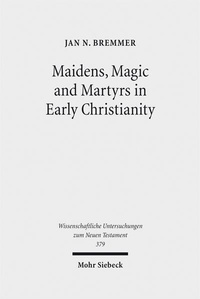
Maidens, Magic and Martyrs in Early Christianity
Collected Essays I
1. Auflage
Erschienen am 13. Juli 2017
501 Seiten
978-3-16-155438-4 (ISBN)
Beschreibung

Warum nannten sich die frühen Anhänger Jesu 'Christen'? Was war ihr soziales und religiöses Kapital? Warum zog das Christentum sowohl arme Witwen als auch reiche Frauen an? Was hielten Heiden von den frühen Christen? Indem er die wichtigen, apokryphen Apostelgeschichten in die Untersuchung der Christentums und der antiken Welt mit einbezieht, veranschaulicht Jan N. Bremmer die Bedeutung von Frauen und den, oftmals überraschenden, Einsatz von Magie, während er auch für eine neue Datierung und Lokalisierung plädiert. Er zeigt auch, dass die frühchristlichen "tours of hell" sich sowohl an jüdische als auch an griechische Deutungsmuster anlehnen und im Laufe der Zeit zunehmend "christlich" werden. Der Autor schließt, indem er die faszinierenden Visionen in der
Passion der Perpetua
dadurch entschlüsselt, dass er sie in der heutigen Zeit verortet, und bringt den Leser dadurch dazu, mit den Hoffnungen und Ängsten der jungen christlichen Märtyrer mitzufühlen. Das genaue Augenmerk auf sowohl heidnischen als auch christlichen Traditionen macht diese Aufsätze, von denen alle aktualisiert und einige überarbeitet wurden, zu einer spannenden Lektüre für Wissenschaftler und fortgeschrittene Studenten.
Weitere Details
Weitere Ausgaben
Andere Ausgaben
Buch
07/2017
1. Auflage
Mohr Siebeck
194,00 €
Artikel ist vergriffen; siehe andere Ausgabe
Person
Autor*in
Born 1944; 1979 PhD; 1978-90 Associate Professor for ancient history at the University of Utrecht; 1990-2009 Chair of Religious Studies at the Faculty of Theology and Religious Studies of the University of Groningen; 2019-20 Fellow at the Centre for Advanced Studies »Beyond Canon,« Regensburg.
Inhalt
1 - Cover [Seite 1]
2 - Preface [Seite 8]
3 - Contents [Seite 16]
4 - Abbreviations [Seite 18]
5 - Section I: Aspects of Early Christianity [Seite 20]
5.1 - Chapter 1: Why Did Jesus' Followers Call Themselves 'Christians'? [Seite 22]
5.1.1 - 1. The Importance of Christ [Seite 22]
5.1.2 - 2. Christian and pagan adhesion to one god [Seite 24]
5.1.3 - 3. Jesus' followers as 'Christians' [Seite 26]
5.2 - Chapter 2: The Social and Religious Capital of the Early Christians [Seite 32]
5.2.1 - 1. Charity [Seite 35]
5.2.2 - 2. Interconnectedness [Seite 37]
5.2.3 - 3. Family aspects [Seite 39]
5.2.4 - 4. Bonding and bridging [Seite 44]
5.2.5 - 5. Religious capital [Seite 47]
5.2.6 - Conclusion [Seite 50]
5.3 - Chapter 3: Why Did Early Christianity Attract Upper-class Women? [Seite 52]
5.4 - Chapter 4: Pauper or Patroness: the Widow in theEarly Christian Church [Seite 62]
5.4.1 - 1. Jesus and the first Palestine congregations [Seite 63]
5.4.2 - 2. The Greek world [Seite 66]
5.4.3 - 3. The Roman world [Seite 70]
5.4.4 - 4. Syria and Egypt [Seite 73]
5.4.5 - 5. The Christian Empire [Seite 75]
5.4.6 - 6. Conclusions [Seite 82]
5.5 - Chapter 5: Peregrinus' Christian Career [Seite 84]
5.6 - Chapter 6: The Domestication of Early Christian Prophecy [Seite 100]
5.6.1 - 1. The situation in Paul's time [Seite 100]
5.6.2 - 2. The situation around AD 100 [Seite 102]
5.6.3 - 3. Montanism or the revival of prophecy [Seite 106]
5.6.4 - 4. Preliminary conclusions [Seite 110]
5.6.5 - 5. The Ascension of Isaiah and ecstatic prophecy [Seite 111]
6 - Section II: Studies in the Apocryphal Acts of the Apostlesand the Pseudo-Clementines [Seite 116]
6.1 - Chapter 7: Women in the Acts of John [Seite 118]
6.1.1 - 1. Lycomedes and Cleopatra (19-29) [Seite 119]
6.1.2 - 2. Andronicus and Drusiana (63-86) [Seite 121]
6.1.3 - 3. Old women and widows (30-7) [Seite 123]
6.1.4 - 4. Conclusion [Seite 128]
6.1.5 - Appendix: date and place of composition of the Acts of John [Seite 130]
6.2 - Chapter 8: Man, Magic, and Martyrdom in the Acts of Andrew [Seite 134]
6.2.1 - 1. Males and females [Seite 139]
6.2.2 - 2. Magic and exorcism [Seite 141]
6.2.3 - 3. Martyrdom [Seite 148]
6.3 - Chapter 9: Aspects of the Acts of Peter: Women, Magic, Place and Date [Seite 152]
6.3.1 - 1. Women [Seite 152]
6.3.2 - 2. Demons and magic [Seite 159]
6.3.3 - 3. Place of origin and date of the APt [Seite 162]
6.4 - Chapter 10: Magic, Martyrdom and Women's Liberation in the Acts of Paul and Thecla [Seite 168]
6.4.1 - 1. Paul and Thecla in Iconium [Seite 169]
6.4.2 - 3. Paul and Thecla in Antioch [Seite 177]
6.4.3 - 4. Composition, name, date, place of origin, author, and aims of the AP [Seite 182]
6.5 - Chapter 11: The Acts of Thomas: Place, Date and Women [Seite 186]
6.5.1 - 1. Women [Seite 190]
6.5.2 - 2. Women and the AAA [Seite 196]
6.6 - Chapter 12: Conversion in the Oldest Apocryphal Acts [Seite 200]
6.6.1 - 1. The Acts of John [Seite 201]
6.6.2 - 2. The Acts of Peter [Seite 206]
6.6.3 - 3. The Acts of Paul [Seite 209]
6.6.4 - 4. Conclusions and general observations [Seite 212]
6.7 - Chapter 13: Magic in the Apocryphal Acts [Seite 216]
6.7.1 - 1. Realities and representations of magic [Seite 217]
6.7.2 - 2. Exorcism [Seite 221]
6.7.3 - 3. The confrontation between the apostle Peter and Simon Magus [Seite 227]
6.7.4 - 4. Conclusions [Seite 235]
6.8 - Chapter 14: The Apocryphal Acts: Authors, Place, Time and Readership [Seite 238]
6.8.1 - 1. Authorship, text and message [Seite 238]
6.8.2 - 2. The chronology and place of origin of the AAA [Seite 240]
6.8.3 - 3. Readership [Seite 244]
6.9 - Chapter 15: Pseudo-Clementines: Texts, Dates, Places, Authors and Magic [Seite 254]
6.9.1 - 1. Text [Seite 254]
6.9.2 - 2. Place and Date of the Grundschrift, Homilies and Recognitions [Seite 258]
6.9.3 - 3. The Author of the Grundschrift [Seite 260]
6.9.4 - 4. Magic [Seite 262]
6.10 - Chapter 16: Apion and Anoubion in the Homilies [Seite 270]
6.10.1 - 1. Athenodorus [Seite 270]
6.10.2 - 2. Annoubion [Seite 271]
6.10.3 - 3. Appion [Seite 275]
6.10.4 - 4. Conclusion [Seite 283]
7 - Section III: Apocalypses and Tours of Hell [Seite 286]
7.1 - Chapter 17: The Apocalypse of Peter: Greek or Jewish? [Seite 288]
7.2 - Chapter 18: The Apocalypse of Peter: Place, Date and Punishments [Seite 300]
7.2.1 - 1. The Date and Place of the Apocalypse of Peter [Seite 300]
7.2.2 - 2. Crimes and punishments [Seite 303]
7.2.3 - 3. The nature and chronology of the tours of hell [Seite 310]
7.3 - Chapter 19: Christian Hell: From the Apocalypse of Peter to the Apocalypse of Paul [Seite 314]
7.3.1 - 1. Date and place of origin [Seite 317]
7.3.2 - 2. Old and new sins and sinners [Seite 321]
7.3.3 - 3. Punishments [Seite 328]
7.3.4 - 4. Conclusion [Seite 331]
7.4 - Chapter 20: Tours of Hell: Greek, Jewish, Roman and Early Christian [Seite 332]
7.4.1 - 1. The Greeks [Seite 333]
7.4.2 - 2. Palestine [Seite 336]
7.4.3 - 3. Rome [Seite 338]
7.4.4 - 4. Early Christianity [Seite 342]
7.4.5 - 5. Conclusion [Seite 347]
7.5 - Chapter 21: Descents to Hell and Ascents to Heavenin Apocalyptic Literature [Seite 348]
7.5.1 - 1. Descents in the classical world [Seite 349]
7.5.2 - 2. An Enochic interlude [Seite 351]
7.5.3 - 3. A descent in Rome [Seite 353]
7.5.4 - 4. Descents in early Christianity [Seite 354]
7.5.5 - 5. Ascent to heaven [Seite 357]
7.5.5.1 - 5.1 The ascent of the soul to heaven: round trips and single journeys [Seite 357]
7.5.5.2 - 5.2 Roundtrips to heaven in vision or 'reality' [Seite 360]
7.5.5.3 - 5.3 Ascent to immortal heavenly life [Seite 362]
7.5.6 - 6. Conclusion [Seite 363]
8 - Section IV: The Passion of Perpetua and Felicitas [Seite 366]
8.1 - Chapter 22: Perpetua and her Diary: Authenticity, Family and Visions [Seite 368]
8.1.1 - 1. The Acta martyrum [Seite 369]
8.1.2 - 2. The text of the Passion of Perpetua [Seite 372]
8.1.3 - 3. Perpetua and her family [Seite 376]
8.1.4 - 4. Perpetua's visions [Seite 383]
8.1.4.1 - 4.1 Perpetua's Ascent to Heaven [Seite 385]
8.1.4.2 - 4.2 Perpetua and her brother Dinocrates [Seite 392]
8.1.4.3 - 4.3 The fight against the Egyptian [Seite 398]
8.1.5 - 5. Conclusion [Seite 405]
8.2 - Chapter 23: Felicitas: The Martyrdom of a Young African Woman [Seite 406]
8.3 - Chapter 24: The Motivation of Martyrs: Perpetua and the Palestinians [Seite 422]
8.3.1 - 1. The penultimate day [Seite 424]
8.3.2 - 2. The preparations for the execution [Seite 427]
8.3.3 - 3. The motivation of martyrs [Seite 435]
8.4 - Chapter 25: Passio Perpetuae 2, 16 and 17 [Seite 442]
8.4.1 - 2.1-2 [Seite 442]
8.4.2 - 2.3 [Seite 450]
8.4.3 - 16.1 [Seite 451]
8.4.4 - 16.2 [Seite 454]
8.4.5 - 17 [Seite 456]
8.5 - Chapter 26: The Vision of Saturus in the Passio Perpetuae [Seite 458]
8.5.1 - 1. Saturus and (the text of) his vision [Seite 458]
8.5.2 - 2. Saturus' welcome in heaven [Seite 461]
8.5.3 - 3. Conversation with the clergy on earth [Seite 467]
8.5.4 - 4. Conclusion [Seite 472]
8.6 - Chapter 27: Contextualising Heaven in Third-Century North Africa [Seite 474]
8.6.1 - 1. The Passio Sanctorum Mariani et Iacobi [Seite 475]
8.6.2 - 2. The court scene [Seite 476]
8.6.3 - 3. The heavenly landscape [Seite 479]
8.6.4 - 4. The fountain and the cup [Seite 481]
8.6.5 - 5. Marian's heaven [Seite 485]
9 - Acknowledgements [Seite 488]
10 - Index of names, places and passages [Seite 490]
2 - Preface [Seite 8]
3 - Contents [Seite 16]
4 - Abbreviations [Seite 18]
5 - Section I: Aspects of Early Christianity [Seite 20]
5.1 - Chapter 1: Why Did Jesus' Followers Call Themselves 'Christians'? [Seite 22]
5.1.1 - 1. The Importance of Christ [Seite 22]
5.1.2 - 2. Christian and pagan adhesion to one god [Seite 24]
5.1.3 - 3. Jesus' followers as 'Christians' [Seite 26]
5.2 - Chapter 2: The Social and Religious Capital of the Early Christians [Seite 32]
5.2.1 - 1. Charity [Seite 35]
5.2.2 - 2. Interconnectedness [Seite 37]
5.2.3 - 3. Family aspects [Seite 39]
5.2.4 - 4. Bonding and bridging [Seite 44]
5.2.5 - 5. Religious capital [Seite 47]
5.2.6 - Conclusion [Seite 50]
5.3 - Chapter 3: Why Did Early Christianity Attract Upper-class Women? [Seite 52]
5.4 - Chapter 4: Pauper or Patroness: the Widow in theEarly Christian Church [Seite 62]
5.4.1 - 1. Jesus and the first Palestine congregations [Seite 63]
5.4.2 - 2. The Greek world [Seite 66]
5.4.3 - 3. The Roman world [Seite 70]
5.4.4 - 4. Syria and Egypt [Seite 73]
5.4.5 - 5. The Christian Empire [Seite 75]
5.4.6 - 6. Conclusions [Seite 82]
5.5 - Chapter 5: Peregrinus' Christian Career [Seite 84]
5.6 - Chapter 6: The Domestication of Early Christian Prophecy [Seite 100]
5.6.1 - 1. The situation in Paul's time [Seite 100]
5.6.2 - 2. The situation around AD 100 [Seite 102]
5.6.3 - 3. Montanism or the revival of prophecy [Seite 106]
5.6.4 - 4. Preliminary conclusions [Seite 110]
5.6.5 - 5. The Ascension of Isaiah and ecstatic prophecy [Seite 111]
6 - Section II: Studies in the Apocryphal Acts of the Apostlesand the Pseudo-Clementines [Seite 116]
6.1 - Chapter 7: Women in the Acts of John [Seite 118]
6.1.1 - 1. Lycomedes and Cleopatra (19-29) [Seite 119]
6.1.2 - 2. Andronicus and Drusiana (63-86) [Seite 121]
6.1.3 - 3. Old women and widows (30-7) [Seite 123]
6.1.4 - 4. Conclusion [Seite 128]
6.1.5 - Appendix: date and place of composition of the Acts of John [Seite 130]
6.2 - Chapter 8: Man, Magic, and Martyrdom in the Acts of Andrew [Seite 134]
6.2.1 - 1. Males and females [Seite 139]
6.2.2 - 2. Magic and exorcism [Seite 141]
6.2.3 - 3. Martyrdom [Seite 148]
6.3 - Chapter 9: Aspects of the Acts of Peter: Women, Magic, Place and Date [Seite 152]
6.3.1 - 1. Women [Seite 152]
6.3.2 - 2. Demons and magic [Seite 159]
6.3.3 - 3. Place of origin and date of the APt [Seite 162]
6.4 - Chapter 10: Magic, Martyrdom and Women's Liberation in the Acts of Paul and Thecla [Seite 168]
6.4.1 - 1. Paul and Thecla in Iconium [Seite 169]
6.4.2 - 3. Paul and Thecla in Antioch [Seite 177]
6.4.3 - 4. Composition, name, date, place of origin, author, and aims of the AP [Seite 182]
6.5 - Chapter 11: The Acts of Thomas: Place, Date and Women [Seite 186]
6.5.1 - 1. Women [Seite 190]
6.5.2 - 2. Women and the AAA [Seite 196]
6.6 - Chapter 12: Conversion in the Oldest Apocryphal Acts [Seite 200]
6.6.1 - 1. The Acts of John [Seite 201]
6.6.2 - 2. The Acts of Peter [Seite 206]
6.6.3 - 3. The Acts of Paul [Seite 209]
6.6.4 - 4. Conclusions and general observations [Seite 212]
6.7 - Chapter 13: Magic in the Apocryphal Acts [Seite 216]
6.7.1 - 1. Realities and representations of magic [Seite 217]
6.7.2 - 2. Exorcism [Seite 221]
6.7.3 - 3. The confrontation between the apostle Peter and Simon Magus [Seite 227]
6.7.4 - 4. Conclusions [Seite 235]
6.8 - Chapter 14: The Apocryphal Acts: Authors, Place, Time and Readership [Seite 238]
6.8.1 - 1. Authorship, text and message [Seite 238]
6.8.2 - 2. The chronology and place of origin of the AAA [Seite 240]
6.8.3 - 3. Readership [Seite 244]
6.9 - Chapter 15: Pseudo-Clementines: Texts, Dates, Places, Authors and Magic [Seite 254]
6.9.1 - 1. Text [Seite 254]
6.9.2 - 2. Place and Date of the Grundschrift, Homilies and Recognitions [Seite 258]
6.9.3 - 3. The Author of the Grundschrift [Seite 260]
6.9.4 - 4. Magic [Seite 262]
6.10 - Chapter 16: Apion and Anoubion in the Homilies [Seite 270]
6.10.1 - 1. Athenodorus [Seite 270]
6.10.2 - 2. Annoubion [Seite 271]
6.10.3 - 3. Appion [Seite 275]
6.10.4 - 4. Conclusion [Seite 283]
7 - Section III: Apocalypses and Tours of Hell [Seite 286]
7.1 - Chapter 17: The Apocalypse of Peter: Greek or Jewish? [Seite 288]
7.2 - Chapter 18: The Apocalypse of Peter: Place, Date and Punishments [Seite 300]
7.2.1 - 1. The Date and Place of the Apocalypse of Peter [Seite 300]
7.2.2 - 2. Crimes and punishments [Seite 303]
7.2.3 - 3. The nature and chronology of the tours of hell [Seite 310]
7.3 - Chapter 19: Christian Hell: From the Apocalypse of Peter to the Apocalypse of Paul [Seite 314]
7.3.1 - 1. Date and place of origin [Seite 317]
7.3.2 - 2. Old and new sins and sinners [Seite 321]
7.3.3 - 3. Punishments [Seite 328]
7.3.4 - 4. Conclusion [Seite 331]
7.4 - Chapter 20: Tours of Hell: Greek, Jewish, Roman and Early Christian [Seite 332]
7.4.1 - 1. The Greeks [Seite 333]
7.4.2 - 2. Palestine [Seite 336]
7.4.3 - 3. Rome [Seite 338]
7.4.4 - 4. Early Christianity [Seite 342]
7.4.5 - 5. Conclusion [Seite 347]
7.5 - Chapter 21: Descents to Hell and Ascents to Heavenin Apocalyptic Literature [Seite 348]
7.5.1 - 1. Descents in the classical world [Seite 349]
7.5.2 - 2. An Enochic interlude [Seite 351]
7.5.3 - 3. A descent in Rome [Seite 353]
7.5.4 - 4. Descents in early Christianity [Seite 354]
7.5.5 - 5. Ascent to heaven [Seite 357]
7.5.5.1 - 5.1 The ascent of the soul to heaven: round trips and single journeys [Seite 357]
7.5.5.2 - 5.2 Roundtrips to heaven in vision or 'reality' [Seite 360]
7.5.5.3 - 5.3 Ascent to immortal heavenly life [Seite 362]
7.5.6 - 6. Conclusion [Seite 363]
8 - Section IV: The Passion of Perpetua and Felicitas [Seite 366]
8.1 - Chapter 22: Perpetua and her Diary: Authenticity, Family and Visions [Seite 368]
8.1.1 - 1. The Acta martyrum [Seite 369]
8.1.2 - 2. The text of the Passion of Perpetua [Seite 372]
8.1.3 - 3. Perpetua and her family [Seite 376]
8.1.4 - 4. Perpetua's visions [Seite 383]
8.1.4.1 - 4.1 Perpetua's Ascent to Heaven [Seite 385]
8.1.4.2 - 4.2 Perpetua and her brother Dinocrates [Seite 392]
8.1.4.3 - 4.3 The fight against the Egyptian [Seite 398]
8.1.5 - 5. Conclusion [Seite 405]
8.2 - Chapter 23: Felicitas: The Martyrdom of a Young African Woman [Seite 406]
8.3 - Chapter 24: The Motivation of Martyrs: Perpetua and the Palestinians [Seite 422]
8.3.1 - 1. The penultimate day [Seite 424]
8.3.2 - 2. The preparations for the execution [Seite 427]
8.3.3 - 3. The motivation of martyrs [Seite 435]
8.4 - Chapter 25: Passio Perpetuae 2, 16 and 17 [Seite 442]
8.4.1 - 2.1-2 [Seite 442]
8.4.2 - 2.3 [Seite 450]
8.4.3 - 16.1 [Seite 451]
8.4.4 - 16.2 [Seite 454]
8.4.5 - 17 [Seite 456]
8.5 - Chapter 26: The Vision of Saturus in the Passio Perpetuae [Seite 458]
8.5.1 - 1. Saturus and (the text of) his vision [Seite 458]
8.5.2 - 2. Saturus' welcome in heaven [Seite 461]
8.5.3 - 3. Conversation with the clergy on earth [Seite 467]
8.5.4 - 4. Conclusion [Seite 472]
8.6 - Chapter 27: Contextualising Heaven in Third-Century North Africa [Seite 474]
8.6.1 - 1. The Passio Sanctorum Mariani et Iacobi [Seite 475]
8.6.2 - 2. The court scene [Seite 476]
8.6.3 - 3. The heavenly landscape [Seite 479]
8.6.4 - 4. The fountain and the cup [Seite 481]
8.6.5 - 5. Marian's heaven [Seite 485]
9 - Acknowledgements [Seite 488]
10 - Index of names, places and passages [Seite 490]
