

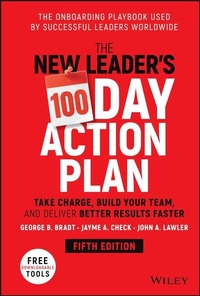
The New Leader's 100-Day Action Plan
Beschreibung

The New Leader's 100-Day Action Plan has sold over 100,000 copies because it's so practical. The author team of accomplished private equity/M&A transition leaders explains in great detail, how to succeed in new leadership roles, build high-performance teams, execute winning strategies, and achieve organizational goals. The heavily revised 5th edition explains how to your due diligence before accepting a new role, and how to lead in remote or hybrid environments and how to leverage diversity, equity, and inclusion to meet team goals, drive growth and enhance any organization.
Readers will also find:
* Roadmaps, tools and tips to understanding, improving, and leading organizational change, including digital initiatives
* New chapters focused on crisis situations, post-M&A integrations, turnarounds, and transformations
* Practical counsel on managing your Board
A critical resource for leaders in any industry, The New Leader's 100-Day Action Plan walks you through your first days, weeks, and months in any new leadership role, when stakes are high and time is of the essence.
Weitere Details
Weitere Ausgaben
Andere Ausgaben
Personen
JAYME A. CHECK is a founder and Managing Partner of PrimeGenesis and author of its executive onboarding methodology that is now deployed in hundreds of organizations worldwide. Jayme is also CEO of Quantum Global Partners, an advisory firm that provides companies worldwide with strategic planning and execution, executive coaching, and leadership development. He offers a global perspective on leadership gained from executive and advisory roles with Fortune 500, start-up, private equity, and venture capital firms.
JOHN A. LAWLER is PrimeGenesis' CEO. He and the firm have helped clients accelerate and succeed through critical transitions in markets ranging from emerging technologies, to middle market businesses, to global manufacturing, pharmaceuticals, services and consumer products. Previously, John led business and culture transformations globally as CEO of three different private equity backed companies, group President at LexisNexis and as a global executive at Dun & Bradstreet.
Inhalt
Executive Summary ix
Tools (Note the most up-to-date, full, editable versions of all tools are downloadable at primegenesis.com/tools.) xxxi
Part I The New Leader's 100- Day Action Plan 1
Chapter 1 Position Yourself for Success: Get the Job Make Sure It Is Right for You Avoid Common Land Mines 3
Chapter 2 The Job Starts When You Accept the Offer: Leverage the Fuzzy Front End 23
Chapter 3 Take Control of Day One: Make a Powerful First Impression Confirm Your Entry Message 59
Chapter 4 Evolve the Culture Leverage Diversity 69
Chapter 5 Manage Communication, Especially Digitally with Your Remote Team 83
Chapter 6 Pivot to Strategy: Co-create the Burning Imperative by Day 30 97
Chapter 7 Drive Operational Accountability: Embed Milestone Management by Day 45 117
Chapter 8 Select Early Wins by Day 60 to Deliver Within 6 Months 135
Chapter 9 Build a High- Performing Team: Realign, Acquire, Enable, and Mentor by Day 70 141
Chapter 10 Adjust and Advance Your Own Leadership, People, Practices, and Culture by Day 100 157
Part II Special Circumstances 173
Chapter 11 Manage Your New Board 175
Chapter 12 Lead Through Mergers and Acquisitions 187
Chapter 13 Lead a Turnaround 199
Chapter 14 Lead Through a Crisis: A 100- Hour Action Plan 211
Bibliography 223
About the Authors 225
Index 227
EXECUTIVE SUMMARY
Are you a veteran CEO taking the reins of your next organization? Starting a new role as a frontline supervisor? Something in between? Whether you are joining a new organization from the outside, getting promoted from within, leading a turnaround or transformation, or merging teams following an acquisition, The New Leader's 100-Day Action Plan will help you take charge, build your team, set direction, and deliver better results faster than anyone thought possible.
"We've found that 40 percent of executives hired at the senior level are pushed out, fail or quit within 18 months. It's expensive in terms of lost revenue. It's expensive in terms of the individual's hiring. It's damaging to morale." Heidrick & Struggles, internal study of 20,000 searches1
If, after 100 days, a key stakeholder is asked, "How is that new leader doing?" and the answer is, "The jury is out," what that means is, "The jury is in, and we don't like the answer."
What do these failed leaders not see, know, do, and deliver? In most cases, they dig their own holes by missing one or more crucial steps in their first 100 days, including:
- Inadvertently sending their new colleagues the wrong messages and causing the culture to reject them
- Developing a new strategy but failing to get buy-in and build trust with their new team
- Failing to operationalize their strategy and deliver results
- Being too slow to make changes to the team
- Expending energy on the wrong projects without accomplishing the one or two things that their most important stakeholders expected them to deliver
- Failing to adjust to changing circumstances once they're in the role
It's essential that you are aware of the important steps required to achieve a successful transition. No new leader wants to fail, but it happens at an alarming rate.
As an analogy, imagine you are driving from Ethiopia to Kenya. You get to the border in Moyale. You get out of your car to clear immigration. Once you clear, you get back in the car. You might think you can start the car, put your foot on the gas, and proceed to your final destination. But if you did that, you'd be sure to fail in a major way. Why?
Because the moment you've crossed the border, everything is different. In Ethiopia they drive on the right. In Kenya on the left. So, the first thing you must do is switch sides!
While there's no reason for you to have known that, you should realize that every organization drives on different sides of the road in different ways. If you don't figure out those differences and adjust for them, you're going to crash. This is why you must converge into a new organization and learn its unwritten rules and cultural realities before you pivot and lead it in a new direction.
Meanwhile, if you're operating in a business owned by a private equity firm, pressures can be even more intense. Gone are the days of delivering returns through debt and multiple arbitrages. To deliver competitive returns, you must create meaningful value through operational improvements or integration of accretive acquisitions in line with Figure 0.1.
FIGURE 0.1 Private Equity Buildup
Perhaps not surprisingly, executive failure in private equity-owned businesses is even higher than average (almost 50 percent, according to a Bain study).2 And the impact of that failure is stark and even more costly: Exits in these situations are typically delayed by 2 years, with reduced returns 46 percent of the time and longer hold periods 82 percent of the time.
Whether you are operating in a major corporation, a smaller start-up, or a midsize business, delivering value is not getting any easier, particularly where transformation and speed are musts. Failure rates are high-in addition to the 40 percent failure rate for leaders entering a new role, 83 percent of acquisitions fail to produce expected returns,3 and only 26 percent of transformations are deemed very or completely successful.4 But, this won't happen to you. Not if you let us help you.
Our fundamental, underlying concept is that onboarding is a crucible of leadership and that:
Leadership is about inspiring, enabling, and empowering others to do their absolute best together to realize a meaningful and rewarding shared purpose.
The Chinese philosopher Lao-tzu expressed this particularly well more than 2,500 years ago:
The great leader speaks little. He never speaks carelessly. He works without self-interest and leaves no trace. When all is finished, the people say, "We did it ourselves."5
With that in mind, The New Leader's 100-Day Action Plan is a practical playbook complete with the tools, action plans, timelines, and key milestones you need to reach along the way to accelerate your own and your team's success in your first 100 days and beyond.
Our insights are gleaned from our own leadership experiences and from the work of our firm, PrimeGenesis, whose sole mission is to help executives and teams deliver better results faster during critical transitions. Across all of our clients, the 100-Day Action Plan approach has reduced the failure rate for new leaders from the industry average of 40 percent to less than 10 percent. Our top 10 executive onboarding clients have deployed us more than 180 times.
Since 2003, leaders and teams in public multinationals, such as American Express and Johnson & Johnson; in midsize entities owned by private equity firms, such as MacAndrews & Forbes, Clayton, Dubilier & Rice, and Cerberus; and in not-for-profit organizations, such as the Red Cross, have implemented the 100-Day Action Plan. They have deployed it across a wide range of functions and complex transitions, including executive onboarding, turnarounds, reorganizations, transformations, and integrating leadership teams during acquisitions.
Over the years, we have noticed that many new leaders show up for a new role happy and smiling but without a plan. Neither they nor their organizations have thought things through in advance. On their first day, they are welcomed by such confidence-building remarks as: "Oh, you're here . we'd better find you an office."
Ouch!
Some enlightened organizations have a better process in place. They put people in charge of preparing for leaders' transitions. Imagine the difference when a new leader is escorted to an office that is fully set up for them, complete with computer, passwords, phones, files, information, and a 30-day schedule of orientation and assimilation meetings.
Better . but still not good enough.
Even if the company has set everything up for you, if you have waited until your first day on the job to start, you are already behind with the odds stacked against you. Paradoxically, the best way to accelerate a complex pivot like going into a new role is to pause long enough to think through a plan before you start, put it in place early, and then get a head start on implementing it.
As the leader, you must align all stakeholders around a shared purpose and set of objectives, set a compelling direction, build a cohesive leadership team, and create a culture that enables excellent execution.
As it turns out, these are some of the most difficult tasks faced by leaders entering complex situations, made even more challenging when compounded by the need for speed.
FIGURE 0.2 Converge and Evolve
Having a process and set of tools can help you use your first 100 days to meet these challenges and propel you down the path to success (Figure 0.2).
The four main ideas are:
- Get a head start. Day One is a critical pivot point for people moving into new roles or merging teams. In both situations, you can accelerate progress by hitting the ground running. Preparation in the days and weeks leading up to Day One breeds confidence, and a little early momentum goes a long way.
- Manage the message. Everything communicates. People read things into everything you say and do and don't say and don't do. You're far better off choosing and guiding what others see and hear and when they see and hear it rather than leaving things up to chance or letting others make those choices for you. Start this process with your best current thinking on a headline message before Day One and adjust steadfastly as you go along.
- Set direction. Build the team. The first 100 days are the best time to put in place the basic building blocks of a cohesive, high-performing team. You will fail if you try to create the organization's imperative yourself without the support and buy-in of your team. As team leader, your own success is inextricably linked to the success of the team as a whole.
- Sustain momentum. Deliver results. Although the first 100 days are a sprint to jump-start communication, team building, and core practices, it's all for naught if you then sit back and watch things happen. You must evolve your leadership, practices, and culture to keep fueling the fires you sparked and deliver ongoing results.
These four ideas are built on the frameworks of highly effective teams and organizations and flow through the book. It's helpful...
