

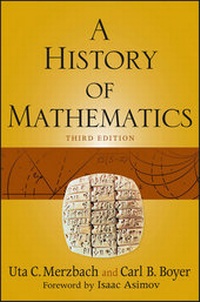
A History of Mathematics
3. Auflage
Erschienen am 10. Januar 2011
688 Seiten
978-0-470-63054-9 (ISBN)
Beschreibung

The updated new edition of the classic and comprehensive guideto the history of mathematics
For more than forty years, A History of Mathematics hasbeen the reference of choice for those looking to learn about thefascinating history of humankind's relationship with numbers,shapes, and patterns. This revised edition features up-to-datecoverage of topics such as Fermat's Last Theorem and thePoincaré Conjecture, in addition to recent advances inareas such as finite group theory and computer-aided proofs.
* Distills thousands of years of mathematics into a single,approachable volume
* Covers mathematical discoveries, concepts, and thinkers, fromAncient Egypt to the present
* Includes up-to-date references and an extensive chronologicaltable of mathematical and general historical developments.
Whether you're interested in the age of Plato and Aristotle orPoincaré and Hilbert, whether you want to know more about thePythagorean theorem or the golden mean, A History ofMathematics is an essential reference that will help youexplore the incredible history of mathematics and the men and womenwho created it.
Rezensionen / Stimmen
"the book is an essential reference that will help you explore the incredible history of mathematics and the men and women who created it." (Zentralblatt MATH 2016)the book is anessential reference that will help you explore the incredible history of mathematics and themen and women who created it.Weitere Details
Weitere Ausgaben
Andere Ausgaben
Carl B. Boyer | Uta C. Merzbach
A History of Mathematics
Buch
01/2011
3. Auflage
Wiley
39,50 €
Versand in 10-20 Tagen
Personen
UTA C. MERZBACH is Curator Emeritus of Mathematics at the Smithsonian Institution and Director of the LHM Institute.
The late CARL B. BOYER was a professor of mathematics at Brooklyn College and the author of several classic works on the history of mathematics.
Inhalt
- Intro
- A History of Mathematics
- Contents
- Foreword by Isaac Asimov
- Preface to the Third Edition
- Preface to the Second Edition
- Preface to the First Edition
- 1: Traces
- Concepts and Relationships
- Early Number Bases
- Number Language and Counting
- Spatial Relationships
- 2: Ancient Egypt
- The Era and the Sources
- Numbers and Fractions
- Arithmetic Operations
- Heap" Problems
- Geometric Problems
- Slope Problems
- Arithmetic Pragmatism
- 3: Mesopotamia
- The Era and the Sources
- Cuneiform Writing
- Numbers and Fractions: Sexagesimals
- Positional Numeration
- Sexagesimal Fractions
- Approximations
- Tables
- Equations
- Measurements: Pythagorean Triads
- Polygonal Areas
- Geometry as Applied Arithmetic
- 4: Hellenic Traditions
- The Era and the Sources
- Thales and Pythagoras
- Numeration
- Arithmetic and Logistic
- Fifth-Century Athens
- Three Classical Problems
- Quadrature of Lunes
- Hippias of Elis
- Philolaus and Archytas of Tarentum
- Incommensurability
- Paradoxes of Zeno
- Deductive Reasoning
- Democritus of Abdera
- Mathematics and the Liberal Arts
- The Academy
- Aristotle
- 5: Euclid of Alexandria
- Alexandria
- Lost Works
- Extant Works
- The Elements
- 6: Archimedes of Syracuse
- The Siege of Syracuse
- On the Equilibriums of Planes
- On Floating Bodies
- The Sand-Reckoner
- Measurement of the Circle
- On Spirals
- Quadrature of the Parabola
- On Conoids and Spheroids
- On the Sphere and Cylinder
- Book of Lemmas
- Semiregular Solids and Trigonometry
- The Method
- 7: Apollonius of Perge
- Works and Tradition
- Lost Works
- Cycles and Epicycles
- The Conics
- 8: Crosscurrents
- Changing Trends
- Eratosthenes
- Angles and Chords
- Ptolemy's Almagest
- Heron of Alexandria
- The Decline of Greek Mathematics
- Nicomachus of Gerasa
- Diophantus of Alexandria
- Pappus of Alexandria
- The End of Alexandrian Dominance
- Proclus of Alexandria
- Boethius
- Athenian Fragments
- Byzantine Mathematicians
- 9: Ancient and Medieval China
- The Oldest Known Texts
- The Nine Chapters
- Rod Numerals
- The Abacus and Decimal Fractions
- Values of Pi
- Thirteenth-Century Mathematics
- 10: Ancient and Medieval India
- Early Mathematics in India
- The Sulbasutras
- The Siddhantas
- Aryabhata
- Numerals
- Trigonometry
- Multiplication
- Long Division
- Brahmagupta
- Indeterminate Equations
- Bhaskara
- Madhava and the Keralese School
- 11: The Islamic Hegemony
- Arabic Conquests
- The House of Wisdom
- Al-Khwarizmi
- 'Abd Al-Hamid ibn-Turk
- Thabit ibn-Qurra
- Numerals
- Trigonometry
- Tenth- and Eleventh-Century Highlights
- Omar Khayyam
- The Parallel Postulate
- Nasir al-Din al-Tusi
- Al-Kashi
- 12: The Latin West
- Introduction
- Compendia of the Dark Ages
- Gerbert
- The Century of Translation
- Abacists and Algorists
- Fibonacci
- Jordanus Nemorarius
- Campanus of Novara
- Learning in the Thirteenth Century
- Archimedes Revived
- Medieval Kinematics
- Thomas Bradwardine
- Nicole Oresme
- The Latitude of Forms
- Infinite Series
- Levi ben Gerson
- Nicholas of Cusa
- The Decline of Medieval Learning
- 13: The European Renaissance
- Overview
- Regiomontanus
- Nicolas Chuquet's Triparty
- Luca Pacioli's Summa
- German Algebras and Arithmetics
- Cardan's Ars Magna
- Rafael Bombelli
- Robert Recorde
- Trigonometry
- Geometry
- Renaissance Trends
- François Viéte
- 14: Early Modern Problem Solvers
- Accessibility of Computation
- Decimal Fractions
- Notation
- Logarithms
- Mathematical Instruments
- Infinitesimal Methods: Stevin
- Johannes Kepler
- 15: Analysis, Synthesis, the Infinite, and Numbers
- Galileo's Two New Sciences
- Bonaventura Cavalieri
- Evangelista Torricelli
- Mersenne's Communicants
- René Descartes
- Fermat's Loci
- Gregory of St. Vincent
- The Theory of Numbers
- Gilles Persone de Roberval
- Girard Desargues and Projective Geometry
- Blaise Pascal
- Philippe de Lahire
- Georg Mohr
- Pietro Mengoli
- Frans van Schooten
- Jan de Witt
- Johann Hudde
- René François de Sluse
- Christiaan Huygens
- 16: British Techniques and Continental Methods
- John Wallis
- James Gregory
- Nicolaus Mercator and William Brouncker
- Barrow's Method of Tangents
- Newton
- Abraham De Moivre
- Roger Cotes
- James Stirling
- Colin Maclaurin
- Textbooks
- Rigor and Progress
- Leibniz
- The Bernoulli Family
- Tschirnhaus Transformations
- Solid Analytic Geometry
- Michel Rolle and Pierre Varignon
- The Clairauts
- Mathematics in Italy
- The Parallel Postulate
- Divergent Series
- 17: Euler
- The Life of Euler
- Notation
- Foundation of Analysis
- Logarithms and the Euler Identities
- Differential Equations
- Probability
- The Theory of Numbers
- Textbooks
- Analytic Geometry
- The Parallel Postulate: Lambert
- 18: Pre- to Postrevolutionary France
- Men and Institutions
- The Committee on Weights and Measures
- D'Alembert
- Bézout
- Condorcet
- Lagrange
- Monge
- Carnot
- Laplace
- Legendre
- Aspects of Abstraction
- Paris in the 1820s
- Fourier
- Cauchy
- Diffusion
- 19: Gauss
- Nineteenth-Century Overview
- Gauss: Early Work
- Number Theory
- Reception of the Disquisitiones Arithmeticae
- Astronomy
- Gauss's Middle Years
- Differential Geometry
- Gauss's Later Work
- Gauss's Influence
- 20: Geometry
- The School of Monge
- Projective Geometry: Poncelet and Chasles
- Synthetic Metric Geometry: Steiner
- Synthetic Nonmetric Geometry: von Staudt
- Analytic Geometry
- Non-Euclidean Geometry
- Riemannian Geometry
- Spaces of Higher Dimensions
- Felix Klein
- Post-Riemannian Algebraic Geometry
- 21: Algebra
- Introduction
- British Algebra and the Operational Calculus of Functions
- Boole and the Algebra of Logic
- Augustus De Morgan
- William Rowan Hamilton
- Grassmann and Ausdehnungslehre
- Cayley and Sylvester
- Linear Associative Algebras
- Algebraic Geometry
- Algebraic and Arithmetic Integers
- Axioms of Arithmetic
- 22: Analysis
- Berlin and Göttingen at Midcentury
- Riemann in Göttingen
- Mathematical Physics in Germany
- Mathematical Physics in English-Speaking Countries
- Weierstrass and Students
- The Arithmetization of Analysis
- Dedekind
- Cantor and Kronecker
- Analysis in France
- 23: Twentieth-Century Legacies
- Overview
- Henri Poincaré
- David Hilbert
- Integration and Measure
- Functional Analysis and General Topology
- Algebra
- Differential Geometry and Tensor Analysis
- Probability
- Bounds and Approximations
- The 1930s and World War II
- Nicolas Bourbaki
- Homological Algebra and Category Theory
- Algebraic Geometry
- Logic and Computing
- The Fields Medals
- 24: Recent Trends
- Overview
- The Four-Color Conjecture
- Classification of Finite Simple Groups
- Fermat's Last Theorem
- Poincaré's Query
- Future Outlook
- References
- General Bibliography
- Index
- EULA
