

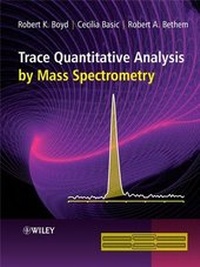
Trace Quantitative Analysis by Mass Spectrometry
Beschreibung

Rezensionen / Stimmen
"This work, well documented and easy to read, will without doubtdelight teachers and researchers in analytical chemistry,permitting them to choose apparatus best suited to their analyticalproblems, to understand how to use them, and finally to put them towork in developing and validating quantitative methods in thevlaboratory." (l'actualité chimique, October 2010)"There aremany textbooks on the general principles and applications of massspectrometry, but none of them cover these topics in such detail asthe present book. ... A valuable contribution to the massspectrometry textbooks that are currently available, and is usefulfor both the neophyte and the specialist." (Analytical andBioanalytical Chemistry, July 2009) "I highly recommend this book ... to all those readers ofthis journal involved in quantitative analysis ... Boyd, Basic,and Bethem provided us with a wealth of easy accessible informationon this subject." (Journal of Statistical Software, January2009) "Trace Quantitative Analysis by Mass Spectrometry is awonderful book for beginner and intermediate students, analysts,and scientists keen on learning more about mass spectrometry. Theauthors' discussion of history and the evolution of relevantscience make the text lively and engaging, no small achievement fora book about analytical science." (PharmTech.com, December2, 2008)Weitere Details
Weitere Ausgaben
Andere Ausgaben

Personen
Professor Robert K Boyd, National Research Council, Institute for National Measurement Standards, Ottawa, Canada
Robert Boyd obtained his B Sc and Ph D from St Andrews University. In 1962 he took a post-doctoral fellow position at NRC followed by periods at the University of Toronto & University of Guelph. In 1986 he re-joined the NRC, and since that time has served as adjunct professor at Dalhousie University (1992-2001). Since 2001 he has been Researcher Emeritus at the NRC in Ottawa.
Professor Boyd has published over 160 research papers, four book chapters & 10 NRC Technical reports. In 1002 he received the Maxxam Award for Analytical Chemistry and in 2003 the Queen Elizabeth II Gold Jubilee Medal. He is currently Chair of the Science Advisory Board for the Genome Prarie project on enabling technologies for proteomics. And a member of the NSERC Committee for Scientific & Technical review of ISTC proposals. He was an editor for Rapid Communications in Mass Spectrometry from 1990 - 1997 and from 1997 - 2005 was the journal's Editor-in-Chief.
Dr Robert A Bethem, senior VP of the Bioanalytical Group at Alta Analytical Laboratory, CA, USA and Professor Dwight Matthews of the University of Vermont, USA
Inhalt
Acknowledgements.
1 Measurement, Dimensions and Units.
1.1 Introduction.
1.2 The International System of Units (SI).
1.3 'Mass-to-Charge Ratio' in Mass Spectrometry.
1.4 Achievable Precision in Measurement of SI Base Quantities.
1.5 Molecular Mass Limit for Trace Quantitation by Mass Spectrometry.
1.6 Summary of Key Concepts.
2 Tools of the Trade I. The Classical Tools.
2.1 Introduction.
2.2 Analytical and Internal Standards: Reference Materials.
2.3 The Analytical Balance.
2.4 Measurement and Dispensing of Volume.
2.5 Preparation of Solutions for Calibration.
2.6 Introduction to Calibration Methods for Quantitative Analysis.
2.7 Summary of Key Concepts.
3 Tools of the Trade II. Theory of Chromatography.
3.1 Introduction.
3.2 General Principles of Chemical Separations.
3.3 Summary of Important Concepts.
3.4 Plate Theory of Chromatography.
3.5 Nonequilibrium Effects in Chromatography: the van Deemter Equation.
3.6 Gradient Elution.
3.7 Capillary Electrophoresis and Capillary Electrochromatography.
Appendix 3.1 Derivation of the Plate Theory Equation for Chromatographic Elution.
Appendix 3.2 Transformation of the Plate Theory Elution Equation from Poisson to Gaussian Form.
Appendix 3.3 A Brief Introduction to Snyder's Theory of Gradient Elution.
List of Symbols Used in Chapter 3.
4 Tools of the Trade III. Separation Practicalities.
4.1 Introduction.
4.2 The Analyte and the Matrix.
4.3 Extraction and Clean-Up: Sample Preparation Methods.
4.4 Chromatographic Practicalities.
4.5 Summary of Key Concepts.
Appendix 4.1 Responses of Chromatographic Detectors: Concentration vs Mass-Flux Dependence.
5 Tools of the Trade IV. Interfaces and Ion Sources for Chromatography-Mass Spectrometry.
5.1 Introduction.
5.2 Ion Sources that can Require a Discrete Interface Between Chromatograph and Source.
5.3 Ion Sources not Requiring a Discrete Interface.
5.4 Source-Analyzer Interfaces Based on Ion Mobility.
5.5 Summary of Key Concepts.
5.1 Appendix 5.1: Methods of Sample Preparation for Analysis by MALDI.
6 Tools of the Trade V. Mass Analyzers for Quantitation: Separation of Ions by m/z Values.
6.1 Introduction.
6.2 Mass Analyzer Operation Modes and Tandem Mass Spectrometry.
6.3 Motion of Ions in Electric and Magnetic Fields.
6.4 Mass Analyzers.
6.5 Activation and Dissociation of Ions.
6.6 Vacuum Systems.
6.7 Summary of Key Concepts.
Appendix 6.1 Interaction of Electric and Magnetic Fields with Charged Particles.
Appendix 6.2 Leak Detection.
Appendix 6.3 List of Symbols Used in Chapter 6.
7 Tools of the Trade VI. Ion Detection and Data Processing.
7.1 Introduction.
7.2 Faraday Cup Detectors.
7.3 Electron Multipliers.
7.4 Post-Detector Electronics.
7.5 Summary of Key Concepts.
8 Tools of the Trade VII: Statistics of Calibration, Measurement and Sampling.
8.1 Introduction.
8.2 Univariate Data: Tools and Tests for Determining Accuracy and Precision.
8.3 Bivariate Data: Tools and Tests for Regression and Correlation.
8.4 Limits of Detection and Quantitation.
8.5 Calibration and Measurement: Systematic and Random Errors.
8.6 Statistics of Sampling of Heterogeneous Matrices.
8.7 Summary of Key Concepts.
Appendix 8.1 A Brief Statistics Glossary.
Appendix 8.2 Symbols Used in Discussion of Calibration Methods.
9 Method Development and Fitness for Purpose.
9.1 Introduction.
9.2 Fitness for Purpose and Managing Uncertainty.
9.3 Issues Between Analyst and Client: Examining What's at Stake.
9.4 Formulating a Strategy.
9.5 Method Development.
9.6 Matrix Effects.
9.7 Contamination and Carryover.
9.8 Establishing the Final Method.
10 Method Validation and Sample Analysis in a Controlled Laboratory Environment.
10.1 Introduction.
10.2 Method Validation.
10.3 Conduct of the Validaton.
10.4 Examples of Methods and Validations Fit for Purpose.
10.5 Validated Sample Analysis.
10.6 Documentation.
10.7 Traceability.
11 Examples from the Literature.
11.1 Introduction.
11.2 Food Contaminants.
11.3 Anthropogenic Pollutants in Water.
11.4 GC-MS Analyses of Persistent Environmental Pollutants.
11.5 Bioanalytical Applications.
11.6 Quantitative Proteomics.
11.7 Analysis of Endogenous Analytes.
Epilog.
References.
Index.
