

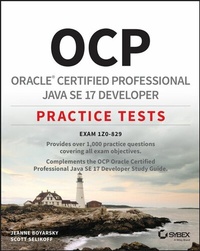
OCP Oracle Certified Professional Java SE 17 Developer Practice Tests
Beschreibung

In OCP Oracle Certified Professional Java SE 17 Developer Practice Tests: Exam 1Z0-829, a team of veteran Java developers helps you gain the confidence and knowledge you need to take the Oracle Certified Professional Java SE 17 Developer exam. Hundreds of domain-by-domain questions accompany complimentary online access to bonus questions, providing you with over 1000 practice questions and answers.
You'll also get:
* Access to Sybex's proven online interactive learning environment and test bank
* Comprehensive coverage of every domain included on the OCP Java SE 17 Developer exam
* Three complete bonus practice exams to help you gain confidence and develop proficiency in Java development
This resource is perfect for anyone preparing to take Exam 1Z0-829. It also belongs on the bookshelves of novice and veteran Java programmers hoping to improve their on-the-job coding skills.
Weitere Details
Weitere Ausgaben
Personen
Jeanne Boyarsky is a Java Champion and has worked as a Java developer for a major bank for more than 20 years. She is a senior moderator at CodeRanch, and trains and mentors students of all levels, including the programming department of a FIRST robotics team.
Scott Selikoff has been a professional Java Enterprise architect for over 20 years. He currently works as a Staff Software Engineer at Google, specializing in Architecture and Cloud Services. He is a Leader of the Garden State Java User Group, helping to facilitate discussions and exchange of ideas within the community.
Inhalt
Chapter 1 Handling Date, Time, Text, Numeric and Boolean Values 1
Chapter 2 Controlling Program Flow 25
Chapter 3 Utilizing Java Object- Oriented Approach 45
Chapter 4 Handling Exceptions 149
Chapter 5 Working with Arrays and Collections 181
Chapter 6 Working with Streams and Lambda Expressions 211
Chapter 7 Packaging and Deploying Java Code and Use the Java Platform Module System 267
Chapter 8 Managing Concurrent Code Execution 295
Chapter 9 Using Java I/O API 319
Chapter 10 Accessing Databases Using JDBC 339
Chapter 11 Implementing Localization 353
Chapter 12 Practice Exam 1 365
Chapter 13 Practice Exam 2 391
Chapter 14 Practice Exam 3 417
Appendix Answers to Review Questions 443
Chapter 1: Handling Date, Time, Text, Numeric and Boolean Values 444
Chapter 2: Controlling Program Flow 450
Chapter 3: Utilizing Java Object- Oriented Approach 455
Chapter 4: Handling Exceptions 482
Chapter 5: Working with Arrays and Collections 489
Chapter 6: Working with Streams and Lambda Expressions 498
Chapter 7: Packaging and Deploying Java Code and Use the Java Platform Module System 516
Chapter 8: Managing Concurrent Code Execution 524
Chapter 9: Using Java I/O API 530
Chapter 10: Accessing Databases Using JDBC 535
Chapter 11: Implementing Localization 538
Chapter 12: Practice Exam 1 541
Chapter 13: Practice Exam 2 548
Chapter 14: Practice Exam 3 554
Index 561
Introduction
OCP Oracle Certified Professional Java SE 17 Developer Practice Tests is intended for those who want to become a Java 17 Oracle Certified Professional (OCP) by taking the 1Z0-829 exam, as well as those who want to test their knowledge of Java 17. If you are new to Java 17, we strongly recommend you start with a study guide to learn all of the facets of the language and come back to this book once you are thinking of taking the exam.
We recommend the best-selling OCP Oracle Certified Professional Java SE 17 Developer Study Guide: Exam 1Z0-829 (Sybex, 2022), which we happen to be the authors of, to begin your studies. Unlike the questions in our study guide, which are designed to be harder than the real exam, the questions in this book mirror the exam format. All the questions in this book tell you how many answers are correct. They will say "Choose two" or "Choose three" if more than one answer is correct.
Regardless of which study guide you used to prepare, you can use this book to hone your skills, since it is based on topics on the actual exams.
Understanding the Exam
At the end of the day, the exam is a list of questions. The more you know about the structure of the exam, the better you are likely to do. For example, knowing how many questions the exam contains allows you to better manage your progress and time remaining. Table I.1 describes the overall structure of the exam.
TABLE I.1 Java 17 Professional Certification Exams
Exam Code 1Z0-829 Certification Title Oracle Certified Professional: Java SE 17 Developer Time Limit 90 minutes Question Count 50 questions Passing score 68%For those good at math, that means you need to answer approximately 34 of the 50 questions correctly to pass. We say "approximately" because Oracle may include questions that they are testing out, which are unscored.
We recommend checking our blog in case Oracle changes this or there are any changes made to the 1Z0-829 Exam after these study guides were published.
Java is now over 25 years old, celebrating being "born" in 1995. As with anything 25 years old, there is a good amount of history and variation between different versions of Java. For Java 17, Oracle has simplified things. Becoming an Oracle Certified Professional now requires passing only one exam, not two, and there are no Java 17 upgrade exams. Regardless of the previous certifications you hold, everyone takes the same, single Java 17 exam to become an Oracle Certified Professional.
Who Should Buy This Book
If you are looking to become a Java 17 Oracle Certified Professional, then this book is for you. It contains over 1,000 questions to help you prepare for the exam. We recommend using this book with our OCP Java SE 17 Developer Study Guide (Sybex, 2022). This book is about sharpening your knowledge of Java 17, while our study guide is about building it.
How This Book Is Organized
This book consists of 11 objective-based chapters followed by 3 full-length mock practice exams. There are some subtle differences between the objective-based chapters and practice exam chapters that you should be aware of while reading this book.
Using the Objective-Based Chapters
An objective-based chapter is composed of questions that correspond to an objective set, as defined by Oracle on the 1Z0-829 Exam. We designed the structure and style of each question in the objective-based chapters to reflect a more positive learning experience, allowing you to spend less time on each question but covering a broader level of material. For example, you may see two questions that look similar within a chapter but that contain a subtle difference that has drastic implications on whether the code compiles or what output it produces.
Just like the review questions in our study guide, these questions are designed so that you can answer them many times. While these questions may seem to be easier than exam questions, they will reinforce concepts if you keep taking them on a topic you don't feel strongly on.
In our study guides, we often group related topics into chapters or split them for understanding. For example, in our study guides we presented parallel streams as part of the concurrency chapter since these concepts are often intertwined, whereas the 1Z0-829 Exam splits concurrency and parallel streams across two separate objectives. In this book, though, the chapters are organized around Oracle's objectives so you can test your skills. While you don't need to read an entire study guide before using objective-based chapter in this book, you do need to study the relevant objectives.
Table I.2 shows what chapters you need to have read in our Java 17 study guide at a minimum before practicing with the questions in this book.
TABLE I.2 Oracle objectives and related study guide chapters
Chapter in This Book Objectives Study Guide Chapter 1 Handling Date, Time, Text, Numeric and Boolean Values 1, 2, 4 2 Controlling Program Flow 3 3 Utilizing Java Object-Oriented Approach 1, 3, 5, 6, 7, 8 4 Handling Exceptions 11 5 Working with Arrays and Collections 4, 9 6 Working with Streams and Lambda expressions 10, 13 7 Packaging and Deploying Java Code and Use the Java Platform Module System 12 8 Managing Concurrent Code Execution 13 9 Using Java I/O API 14 10 Accessing Databases Using JDBC 15 11 Implementing Localization 11Some of our chapters have a lot of questions. For example, Chapter 3 contains more than 200 questions. This is based on how Oracle chose to organize its objectives. We recommend doing these larger chapters in batches of 30-50 questions at a time. That way, you can reinforce your learning before doing more questions. This also lets you practice with sets of questions that are closer to the length of the exam.
Taking the Practice Exams
Chapters 12, 13, and 14 of this book contain three full-length practice exams. The questions in these chapters are quite different from the objective-based chapters in a number of important ways. These practice exam questions tend to be harder because they are designed to test your cumulative knowledge rather than reinforcing your existing skillset. In other words, you may get a question that tests two discrete topics at the same time.
Like the objective chapters, we do indicate exactly how many answers are correct in the practice exam chapters, as is done on the real exam. Both practice exam chapters are designed to be taken within 90 minutes and have a passing score of 68 percent. That means you need to answer at least 34 questions correctly. Remember not to take the practice exam until you feel ready. There are only so many practice exams available, so you don't want to waste a fresh attempt.
While an objective-based chapter can be completed over the course of a few days, the practice exam chapters were each designed to be completed in one sitting. You should try simulating the exam experience as much as possible. This means setting aside 90 minutes, grabbing a whiteboard or scrap paper, and answering every question even if you aren't sure of the answer. Remember, there is no penalty for guessing, and the more incorrect answers you can eliminate, the better.
Reviewing Exam Changes
Oracle does change the number of questions, passing score, and time limit from time-to-time. Jeanne and Scott maintain a blog that tracks updates to the real exams, as quickly as Oracle updates them.
We recommend you read this page before you take the real exam, in case any of the information has changed since the time this book was published. Although less common, Oracle does add, remove, or reword objectives. When this happens, we offer free supplemental material on our website as blog entries.
Need More Help Preparing?
Both of the authors are moderators at CodeRanch.com. This site is a quite large and active programming forum that is friendly toward Java beginners. It has a forum just for this exam called Programmer Certification.
As you read the book, feel free to ask your questions in either of those forums. It could be that you are having trouble compiling a class or are just plain confused about something. You'll get an answer from a knowledgeable Java programmer. It might even be one of...
