

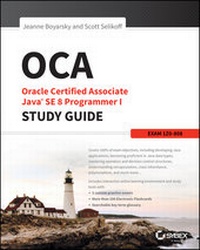
OCA
Beschreibung

Weitere Details
Weitere Ausgaben
Andere Ausgaben
Personen
Inhalt
Introduction
Java, "born" in 1995, is now just about 20 years old. As with anything 20 years old, there is a good amount of history and variation between versions of Java. Over the years, the certification exams have changed to cover different topics. The names of the exams have even changed. This book covers the Java 8 Oracle Certified Associate (OCA) exam.
If you read about "the exam" on the Web, you may see information about the older names for the exam. We've showed the changes in name. Here's what happened. Sun Microsystems used to have two exams. The SCJP (Sun Certified Java Programmer) was meant for programmers and the SCJA (Sun Certified Java Associate) was meant for those who wanted broader knowledge. When Oracle bought Sun Microsystems, they changed all the names from Sun to Oracle, giving us the OCJP and OCJA.
Then Oracle made two strategic decisions with Java 7. They decided to stop updating the OCJA exam. They also decided to cover more on in the programmer space and split it into two exams. Now you first take the OCAJP (Oracle Certified Associate Java Programmer), also known as Java Programmer I, or OCA. That's what this book is about. Then you take the OCPJP (Oracle Certified Professional Java Programmer), also known as Java Programmer II, or OCP. There's also an upgrade exam in case you took an older version of the SCJP or OCPJP and want to upgrade. Most people refer to the current exams as OCA 8, OCP 8, and the Java 8 upgrade exam. We mention when a topic is split between the OCA and OCP so you know which parts are more advanced.
We try to keep the history to a minimum in this book. There are some places on the exam where you need to know both an "old way" and a "new way" of doing things. When that happens, we will be sure to tell you what version of Java introduced it. We will also let you know about topics that are not on the exam anymore in case you see questions in the older free online mock exams.
The OCA Exam
All you need to do to earn the Oracle Certified Associate Java SE 8 Programmer certification is to pass the exam! That's it.
Oracle has a tendency to fiddle with the length of the exam and the passing score once it comes out. Since it's pretty much a guarantee that whatever we tell you here will become obsolete, we will give you a feel for the range of variation. The OCA exam has varied between 60 and 90 questions since it was introduced. The score to pass has varied between 60 percent and 80 percent. The time allowed to take the exam has varied from two hours to two-and-a-half hours.
Oracle has a tendency to "tweak" the exam objectives over time as well. They do make minor additions and removals from what is covered on the exam. Although this tends to affect the OCP exam more than the OCA exam, there are a few topics that were added to the OCA for Java 8. It wouldn't be a surprise for Oracle to make changes.
Although there will likely be minor changes to the scope of the exam, it certainly isn't a secret. We've created a book page on our blog: www.selikoff.net/oca. If there are any changes to the topics on the exam after this book is published, we will note them there.
That book page also contains a link to the official exam page so that you can check the length and passing score that Oracle has chosen for the moment.
Scheduling the Exam
The exam is administered by Pearson VUE and can be taken at any Pearson VUE testing center. To find a testing center or register for the exam, go to www.pearsonvue.com. Choose IT and then Oracle. If you haven't been to the test center before, we recommend visiting in advance. Some testing centers are nice and professionally run. Others stick you in a closet with lots of people talking around you. You don't want to be taking the test with someone complaining about their broken laptop nearby!
At this time, you can reschedule the exam without penalty until up to 24 hours before. This means that you can register for a convenient time slot well in advance, knowing that you can delay if you aren't ready by that time. Rescheduling is easy and can be done on the Pearson VUE website. This may change, so check the rules before paying.
The Day of the Exam
When you go to take the exam, remember to bring two forms of ID, including one that is government issued. See Pearson's list of what is acceptable ID at http://www.pearsonvue.com/policies/1S.pdf. Try not to bring too much extra with you as it will not be allowed into the exam room. While you will be allowed to check your belongings, it is better to leave extra items at home or in the car.
You will not be allowed to bring paper, your phone, and so forth into the exam room with you. Some centers are stricter than others. At one center, tissues were even taken away from us! Most centers allow keeping your ID and money. They watch you taking the exam, though, so don't even think about writing notes on money.
The exam center will give you writing materials to use during the exam. These are used as scratch paper during the exam to figure out answers and keep track of your thought process. The exam center will dispose of them at the end. Notice how we said "writing materials" rather than "pen and paper." Some centers still give pen and paper. Most give a small erasable board and a dry erase marker. If you have a preference to which you receive, call the testing center in advance to inquire.
Finding Out Your Score
In the past, you would find out right after finishing the exam if you passed. Now you have to wait nervously until you can check your score online.
If you go onto the Pearson VUE website, it will just have a status of "Taken" rather than your result. Oracle uses a separate system for scores. You'll need to go to http://certview.oracle.com to find out whether you passed and your score. It doesn't update immediately upon taking the test, but we haven't heard of it taking more than an hour. In addition to your score, you'll also see objectives for which you got a question wrong and instructions on how to get a hardcopy certificate.
At some point, you'll get an electronic certificate and some more time after that you'll receive your printed certificate. Sound vague? It is. The times reported to receive certificates vary widely.
Exam Questions
The OCA exam consists of multiple-choice questions. There are typically five or six possible answers. If a question has more than one answer, the question specifically states exactly how many correct answers there are. This book does not do that. We say "choose all that apply" to make the questions harder. This means the questions in this book are generally harder than those on the exam. The idea is to give you more practice so you can spot the correct answer more easily on the real exam.
Note that exam questions will sometimes have line numbers that begin with numbers higher than 1. This is to indicate that you are looking at a code snippet rather than a complete class. We follow this convention as well to get you used to it.
If you read about older versions of the exam online, you might see references to drag-and-drop questions. These questions had you do a puzzle on how to complete a piece of code. There was also a bug in the exam software that caused your answers to get lost if you reviewed them again. Luckily, these are no longer on the exam.
Getting Started
We recommend reading Appendix B, "Study Tips," before diving into the technical material in this book. Knowing how to approach studying will help you make better use of your study time.
Next, make sure you have downloaded version 8 of the JDK. If you learned Java some time ago, you might have version 7 or even earlier. There have been both big and small changes to the language. You could get a question wrong if you study with the wrong version.
Also, please check our book page to make sure Oracle hasn't changed the objectives. For example, if Oracle decided that lambdas weren't on the exam, you'd want to know that before studying. We will post any updates that you should know about at www.selikoff.net/oca.
Getting Help
Both of the authors are moderators at CodeRanch.com. CodeRanch.com is a very large and active programming forum that is very friendly toward Java beginners. It has a forum just for this exam called OCAJP. It also has a forum called Beginning Java for non-exam-specific questions. As you read the book, feel free to ask your questions in either of those forums. It could be you are having trouble compiling a class or that you are just plain confused about something. You'll get an answer from a knowledgeable Java programmer. It might even be one of us.
Who Should Buy This Book
If you want to become certified as a Java programmer, this book is definitely for you. If you want to acquire a solid foundation in Java and your goal is to prepare for the exam, this book is also for you. You'll find clear explanations of the concepts you need to grasp and plenty of help to achieve the high level of professional competency you need in order to succeed in your chosen field.
This book is intended to be understandable to...
