

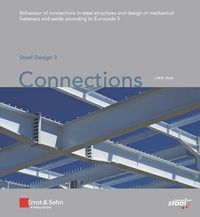
Steel Design 3 Connections
Behaviour of connections in steel structures and design of mechanical fasteners and welds according to Eurocode 3 - Jan Stark
1. Auflage
Erschienen am 29. März 2023
208 Seiten
978-3-433-61161-6 (ISBN)
Beschreibung
The book covers the behaviour of connections in steel structures and the design of mechanical fasteners and welds according to EN 1993 (Eurocode 3).
Chapter 1 is about the function of connections in a steel structure and describes the different components. It also discusses the most important aspects of design and detailing and the role of the computer in the analysis and design of a steel structure
Chapter 2 deals with the most widely used mechanical fasteners in steel structures: bolts in normal holes, oversized holes and slotted holes. The characteristics of bolts are discussed as well as the design rules for checking connections in steel structures with these type of bolts.
Chapter 3 looks at the design rules for checking mechanical fasteners when bolts in clearance holes are not allowed or not desirable. This concerns preloaded bolts, fit bolts, injection bolts and pins. The design rules for rivets are also briefly discussed.
Chapter 4 gives an overview of the most important welding processes for steel structures and of the most commonly used weld shapes. It then discusses the welding procedures to execute a good welded joint and the methods for detecting and assessing any welding defects. Finally, the design principles of fillet welds and butt welds are covered.
Chapter 5 deals with the design of complete connections that are common in building steel structures. A complete joint comprises all the individual steel parts ? such as end plates, stiffeners and angles ? and the individual connectors, which together ensure the transfer of forces and moments between the connected elements.
Chapter 1 is about the function of connections in a steel structure and describes the different components. It also discusses the most important aspects of design and detailing and the role of the computer in the analysis and design of a steel structure
Chapter 2 deals with the most widely used mechanical fasteners in steel structures: bolts in normal holes, oversized holes and slotted holes. The characteristics of bolts are discussed as well as the design rules for checking connections in steel structures with these type of bolts.
Chapter 3 looks at the design rules for checking mechanical fasteners when bolts in clearance holes are not allowed or not desirable. This concerns preloaded bolts, fit bolts, injection bolts and pins. The design rules for rivets are also briefly discussed.
Chapter 4 gives an overview of the most important welding processes for steel structures and of the most commonly used weld shapes. It then discusses the welding procedures to execute a good welded joint and the methods for detecting and assessing any welding defects. Finally, the design principles of fillet welds and butt welds are covered.
Chapter 5 deals with the design of complete connections that are common in building steel structures. A complete joint comprises all the individual steel parts ? such as end plates, stiffeners and angles ? and the individual connectors, which together ensure the transfer of forces and moments between the connected elements.
Weitere Details
Weitere Ausgaben
Person
Prof. ir. Jan Stark is professor emeritus of steel structures at TU Delft University and an experienced lecturer. As member of the Eurocode project team he was also chairman of the ECCS TC Connections and the Dutch NEN committee on steel structures.
Prof. ir. Jan Stark war Professor für Stahlbau an der TU Delft University und ist ein erfahrener Dozent. Als Mitglied des Eurocode-Projektteams war er auch Vorsitzender des EKS TC Connections und des Holländischen NEN Komitees Stahlbau.
Prof. ir. Jan Stark war Professor für Stahlbau an der TU Delft University und ist ein erfahrener Dozent. Als Mitglied des Eurocode-Projektteams war er auch Vorsitzender des EKS TC Connections und des Holländischen NEN Komitees Stahlbau.
Inhalt
Connections in steel structures
Bolts in clearance holes
Slip-resistant connections, rivets and pins
Welds
Design and detailing of connections
Bolts in clearance holes
Slip-resistant connections, rivets and pins
Welds
Design and detailing of connections
