

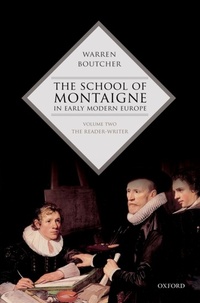
The School of Montaigne in Early Modern Europe
Volume Two: The Reader-Writer
1. Auflage
Erschienen am 9. März 2017
576 Seiten
978-0-19-106603-0 (ISBN)
Beschreibung

This major two-volume study offers an interdisciplinary analysis of Montaigne's Essais and their fortunes in early modern Europe and the modern western university. Volume one focuses on contexts from within Montaigne's own milieu, and on the ways in which his book made him a patron-author or instant classic in the eyes of his editor Marie de Gournay and his promoter Justus Lipsius. Volume two focuses on the reader-writers across Europe who used the Essais to make their own works, from corrected editions and translations in print, to life-writing and personal records in manuscript.
The two volumes work together to offer a new picture of the book's significance in literary and intellectual history. Montaigne's is now usually understood to be the school of late humanism or of Pyrrhonian scepticism. This study argues that the school of Montaigne potentially included everyone in early modern Europe with occasion and means to read and write for themselves and for their friends and family, unconstrained by an official function or scholastic institution. For the Essais were shaped by a battle that had intensified since the Reformation and that would continue through to the pre-Enlightenment period. It was a battle to regulate the educated individual's judgement in reading and acting upon the two books bequeathed by God to man. The book of scriptures and the book of nature were becoming more accessible through print and manuscript cultures. But at the same time that access was being mediated more intensively by teachers such as clerics and humanists, by censors and institutions, by learned authors of past and present, and by commentaries and glosses upon those authors. Montaigne enfranchised the unofficial reader-writer with liberties of judgement offered and taken in the specific historical conditions of his era.
The study draws on new ways of approaching literary history through the history of the book and of reading. The Essais are treated as a mobile, transnational work that travelled from Bordeaux to Paris and beyond to markets in other countries from England and Switzerland, to Italy and the Low Countries. Close analysis of editions, paratexts, translations, and annotated copies is informed by a distinct concept of the social context of a text. The concept is derived from anthropologist Alfred Gell's notion of the 'art nexus': the specific types of actions and agency relations mediated by works of art understood as 'indexes' that give rise to inferences of particular kinds. Throughout the two volumes the focus is on the particular nexus in which a copy, an edition, an extract, is embedded, and on the way that nexus might be described by early-modern people.
Weitere Details
Weitere Ausgaben
Andere Ausgaben
Buch
03/2017
Oxford University Press
182,30 €
Versand in 15-20 Tagen
Person
Warren Boutcher is Professor of Renaissance Studies in the School of English and Drama, Faculty of Humanities and Social Sciences, Queen Mary University of London. He has published extensively on Montaigne and on humanism, translation, and the history of the book and of libraries in early modern England, France, and Italy.
Inhalt
- Introduction
- 2.1 Montaigne at Paris and Blois, 1588: La Boétie, the Essais, and the robins
- 2.1.1: Montaigne at Paris and Blois, 1588
- 2.1.2: De Thou and Montaigne
- 2.1.3: Sainte-Marthe and de Thou
- 2.1.4: De Thou on La Boétie and Montaigne
- 2.1.5: De Thou's portrait of Montaigne and the fortunes of his Historiae at Rome
- 2.1.6: Montaigne in De Thou's Vita
- 2.1.7: Pasquier's Essais
- 2.1.8: Montaigne as L'Estoile's confessor
- 2.1.9: Dangers for books in circulation
- 2.2 Safe transpassage: Geneva and northeastern Italy
- 2.2.1: Censoring the Essais on their travels
- 2.2.2: Secure commercement
- 2.2.3: 'What boldness with another's writings!': Montaigne corrected for safe transpassage from Geneva to France
- 2.2.4: The man with the book in one hand, the pen in the other
- 2.2.5: The Genevan editions of 1602
- 2.2.6: The pastor who had the Essais printed at Geneva in 1602
- 2.2.7: Goulart and the Essais
- 2.2.8: The Essais in the northeastern Italian city states
- 2.2.9: Paolo Sarpi: The Venetian Socrates
- 2.2.10: Girolamo Canini's Saggi
- 2.2.11: The enfranchisement of Flavio Querenghi
- 2.2.12: Conclusion: Ginammi, Naudé and the modern re-inventers of ethics
- 2.3 Learning mingled with nobility in Shakespeare's England
- 2.3.1: The context of production of Florio's Montaigne
- 2.3.2: The institution of the English nobility
- 2.3.3: 'Lecture and advise'
- 2.3.4: Florio's 'institution and education of Children'
- 2.3.5: The charge of the tutor
- 2.3.6: Florio and Daniel on stately virtue
- 2.3.7: Learned noble conference: from private reading to public stage
- 2.3.8: Reading for Montaigne's Arcadia in Daniel and Shakespeare
- 2.4 Reading Montaigne and writing lives in the north of England and the Low Countries
- 2.4.1: The bookseller William London's catalogue of vendible books
- 2.4.2: Knowing how to use books: Florio's Montaigne and Sir Henry Slingsby's 'Commentaries'
- 2.4.3: The liberty of a subject
- 2.4.4: Pieter van Veen's copy of Paris 1602
- 2.4.5: Otto van Veen's 'Self-Portrait with Family'
- 2.4.6: Pieter van Veen's memoir
- 2.4.7: Van Ravesteyn's portrait of the institution of the Van Veens
- 2.4.8: Les Essais de Pieter van Veen
- 2.5 Recording the history of secret thoughts in early modern France
- 2.5.1: The breviary of urbane loafers and ignorant pseudointellectuals
- 2.5.2: The 'affranchisement' of amateur reader-writers
- 2.5.3: L'Estoile and the registre
- 2.5.4: L'Estoile forges a life from reading-and-writing
- 2.5.5: The Essais as registre
- 2.5.6: Montaigne on the mantelpiece in Rheims
- 2.5.7: Coda: Montaigne migrates to England
- 2.6 The Essais framed for modern intellectual life
- 2.6.1: Introduction
- 2.6.2: German idealism and the modern Montaigne
- 2.6.3: Burckhardt's inner man
- 2.6.4: After Burckhardt
- 2.6.5: Vidal as reader-writer of the Essays, 1992
- 2.6.6: Denby reads Frame's Montaigne, 1992
- 2.6.7: Indexing critical agency
- 2.6.8: The American school of Montaigne
- 2.6.9: Montaigne and the modern critical agent
- 2.6.10: The postmodern Montaigne
- 2.7 Epilogue: Enfranchising the reader-writer in late medieval and early modern Europe
- 2.7.1: Auerbach's Montaigne
- 2.7.2: Nexuses in the history of the Essais
- 2.7.3: Bishop Camus on the Essais
- 2.7.4: Two copies of Paris 1602
- 2.7.5: L'Estoile and Charron
- 2.7.6: Pierre Bayle's Montaigne
- 2.7.7: L'Estoile and the Essais as registre
- 2.7.8: The age of learning and the learned book
- 2.7.9: The battle over the enfranchisement of the reader-writer
- 2.7.10: The Essais beneath the battle
- 2.7.11: How can a book be free from servitude?
- Conclusion
- Bibliography
