

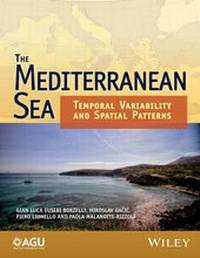
The Mediterranean Sea
Beschreibung

Weitere Details
Weitere Ausgaben
Andere Ausgaben

Personen
Inhalt
1
Introduction to The Mediterranean Sea: Temporal Variability and Spatial Patterns
Gian Luca Eusebi Borzelli1, Paola Malanotte-Rizzoli2, Miroslav Gacˇić3, and Piero Lionello4
1CERSE (Center for Remote Sensing of the Earth), Rome, Italy; OGS (Istituto Nazionale di Oceanografia e di Geofisica Sperimenta), Sgonico (TS),Italy
2Massachusetts Institute of Technology, Cambridge,MA—USA
3Istituto Nazionale di Oceanografia e di Geofisica Sperimentale—OGS, Trieste,Italy
4University of Salento, Dipartimento di Scienze e Tecnologie Biologiche ed Ambientali, Lecce,Italy
This book stems from a workshop held in Rome in November 2011 at Accademia Nazionale dei Lincei to mark the twenty-fifth anniversary of the POEM (Physical Oceanography of the Eastern Mediterranean) program. The objectives of the workshop, however, were more ambitious than a memorial. First, the workshop was meant to provide a synopsis of the state of the art of the present knowledge of the Mediterranean Sea circulation. Second, it aimed at offering the opportunity to scientists working in different areas of the sea, both in the western and eastern basins, to meet and share ideas, fostering pan-Mediterranean collaborations.
The members of the POEM program gratefully acknowledge the crucial support provided over the years by the Intergovernmental Oceanographic Commission (IOC/UNESCO Ocean Sciences) and the Mediterranean Science Commission (CIESM).
This book collects eight original research articles describing new results in the study of the Mediterranean Sea physical properties. Until the beginning of the 1980s, the Mediterranean was considered of marginal importance being characterized by specific, regional phenomena with limited interest for global processes. The second half of the 1980s represents a crossroad in the study of this basin. Four large international programs—the Gibraltar Experiment [Kinder and Bryden, 1987], the Physical Oceanography of the Eastern Mediterranean [Malanotte-Rizzoli and Robinson, 1988], which in 1990 evolved in to the fully interdisciplinary program named POEM-Biology and Chemistry (POEM-BC), the Western Mediterranean Circulation Experiment [WMCE Consortium, 1989], and PRIMO [EUROMODEL Group, 1995]—defined the major characteristics of the Mediterranean Sea. The picture of its variability emerging from these studies was complex and it showed that multiple interacting time and spatial scales (basin, subbasin, and mesoscale), representing a wide variety of physical processes, characterize the Mediterranean dynamics.
This new observational and theoretical knowledge established that the Mediterranean is a laboratory basin, where the processes characterizing the global ocean and its climate can be investigated. In fact, all major forcing mechanisms (such as surface wind forcing, buoyancy fluxes, lateral mass exchange, and deep convection) determining the global oceanic circulation are present in the Mediterranean Sea. Deep and intermediate water masses are formed in different areas and drive the Mediterranean thermohaline cells, which show important analogies with the global ocean conveyor belt. However, the Mediterranean Sea presents important advantages as temporal and spatial scales are shorter than in the global ocean, simplifying the logistics necessary for monitoring the circulation.
The aforementioned programs ended by the second half of the 1990s revealing a number of important features and opened a series of scientific questions. These can be summarized as follows:
-
The Eastern Mediterranean Transient (EMT)
The main source of dense water driving the eastern Mediterranean deep convection cell, normally localized in the Adriatic Sea, by the end of the 1980s, shifted to the Aegean and determined changes in properties of water masses in the deep layers of the eastern [Roether et al., 1996] and western Mediterranean [Schroeder et al., 2006; Gacˇić et al., 2013]. Is this effect, which determines a nonsteady picture of the entire Mediterranean thermohaline circulation, a sporadic event or a recurrent feature of the circulation?
-
The Ionian upper-layer circulation reversals
Experimental data collected during POEM surveys indicate that, by the second half of the 1980s, the Ionian upper-layer circulation reversed from cyclonic to anticyclonic [Malanotte-Rizzoli et al., 1997]. The reversal was ascribed to wind forcing, which, in the eastern Mediterranean is characterized by a prevailing anticyclonic pattern [Pinardi et al., 1997; Demirov and Pinardi, 2002; Molcard et al., 2002]. In 1997 another inversion of the Ionian near-surface circulation, from anticyclonic to cyclonic, took place in presence of an anticyclonic wind pattern. This indicates that this inversion is sustained by redistribution of water masses in the Ionian abyss [Eusebi Borzelli et al., 2009; Gacˇić et al., 2010; Gacˇić et al., 2011] and not by the wind field pattern. The question then arises: is this reversal a consequence of the redistribution of water masses in the Ionian abyss or does it trigger the shift of the eastern Mediterranean deep water formation site from the Adriatic to the Aegean and vice-versa?
-
The Mediterranean Sea salinity increase
Lacombe et al. [1985] examined historical hydrographic observations in the western Mediterranean Sea and concluded that there had been no measurable change in deep-water salinity up to 1969. Since 1969, western Mediterranean waters below 200 m depth have become progressively saltier. The increase in salinity occurs in both Levantine Intermediate Water and Western Mediterranean Deep Water and amounts to 0.07‰ over 40 years when averaged below 200 m depth. In terms of net water mass balance, such salinity increase can be related to an increase in evaporation or a decrease in precipitation or runoff larger than 10 cm/year. Can we distinguish the role of gradual changes and singular events in causing the salinity increase? Do the changes in the salinity penetrate downward from the surface due to uniform local evaporation, laterally through advection of salty intermediate water, or upward from the bottom after injection of new salty deep waters?
-
Functioning of the Gibraltar Strait (“The Gibraltar valve”)
The Mediterranean basin scale circulation is broadly described in terms of a surface flow from the Atlantic Ocean entering through the Strait of Gibraltar and proceeding to the eastern basin, and a return flow of intermediate water, originating in the Levantine basin, proceeding toward Gibraltar, and finally exiting into the Atlantic (e.g., Tsimplis et al. 2006 and Schroeder et al. 2006 for a review). This basin scale open cell is mainly driven by thermohaline forcing: an east-west density gradient, associated with enhanced heat and moisture fluxes in the Levantine sea, drives the eastward flow of surface Atlantic water. In the Levantine basin, the ocean releases buoyancy to the atmosphere through heat loss and an evaporation/precipitation deficit. The buoyancy loss reduces the stability of the water column, with loss of potential energy, which is compensated by a buoyancy gain associated with the inflow of the fresh surface Atlantic water. For this open cell, the forcing of the Mediterranean basin-scale circulation is due to the inflows through the Gibraltar and Sicily straits. The narrow and shallow sill at Gibraltar passage, however, imposes an upper bound to the flow rate of Atlantic water at this strait. How do the orography of the Gibraltar strait and variations of the Atlantic water inflow determine variations in the western Mediterranean circulation pattern?
Since the end of POEM and WMCE, although valuable studies were carried out aiming to respond to the above issues, uncoordinated research efforts, driven mainly by national interests, provided fragmented and sporadic results.
To establish the state of the art of the research in the Mediterranean and allow interested scientists to interact, the Space Academy Foundation, a nonprofit organization to promote space science and technology, CIESM, and the OGS (Istituto Nazionale di Oceanografia e di Geofisica Sperimentale), under the aegis of the Alta Presidenza della Repubblica Italiana, organized a fully interdisciplinary meeting, which was held in Rome November 7–8, 2011. More than 35 scientists convened from different countries (France, Germany, Greece, Italy, Spain, Turkey, UK, and United States) summarized the current thinking about the Mediterranean, exposed new research ideas, and agreed to propose to AGU a collection of original papers inspired by to the workshop presentations.
This book is the outcome of this common effort and is meant to be an important and original contribution to the knowledge of the phenomena that regulate the oceanography of this basin. Furthermore, this book is a valuable tool for those not directly involved in Mediterranean studies who want to use the Mediterranean as a basin for processes of interest for the global ocean and climate.
The studies in this volume can be regarded individually or as parts of an integrated dissertation on spatial patterns and temporal variability of the Mediterranean Sea. Each one has its own conclusion and is written in such a way that a general conclusion to the entire volume is not needed. Overall, these studies indicate...
