

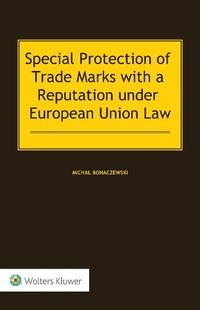
Special Protection of Trade Marks with a Reputation under European Union Law
Erschienen am 9. April 2020
280 Seiten
978-94-035-1991-3 (ISBN)
Beschreibung

When a mark acquires a reputation, it becomes a means of attracting consumers by communicating to them various messages going beyond the indication of commercial origin of goods or services. Thus, trade marks familiar to the general public enjoy a special legal protection regime above and beyond that afforded trade marks in general, allowing them to benefit from enhanced protection against reproduction or imitation detrimental to, or taking unfair advantage of, the distinctive character of the mark or its repute. This richly researched book, the first comprehensive guide to current European Union (EU) law and practice concerned with reputed trade marks, conducts an in-depth analysis of this extended protection provided by Regulation 2017/1001 on EU trade marks and Directive 2015/2436 under which it is mandatory across all Member States. Using a practical approach, focused on identifying and analysing the criteria for infringement of trade marks with a reputation in proceedings before civil courts and in administrative proceedings before the European Union Intellectual Property Office (EUIPO) or national trade mark offices, the author addresses such elements of the special protection regime as the following: prerequisites for infringement of the right to a reputed mark common to all recognised forms of infringement; how to demonstrate each type of infringement of the right to the trade mark with a reputation (blurring, tarnishment and unfair advantage); proof of reputation; distinguishing the concept of well-known trade mark; legitimate versus questionable justifications of the ';due cause' exception within the meaning of EU law provisions; use of a disputed sign falling under freedom of expression; identifying the role of likelihood of confusion under the special regime; and how to prove the existence of a link between the signs in dispute. The author pays detailed attention to the case law of the Court of Justice and General Court of the EU, as well as cases before the EUIPO and national courts. He takes into account research from a number of Member States (plus Switzerland), thus widening prior work in the field from its predominant English-language context. With this book practitioners will confidently approach cases before courts, the EUIPO and national EU trade mark offices involving enhanced protection of trade marks with a reputation. In addition, the book will help judges and trade mark offices examiners to interpret the EU provisions and assess claims regarding such reinforced protection. For scholars and students of intellectual property law, this book will prove a cornerstone volume in the field.
Weitere Details
Weitere Ausgaben
Andere Ausgaben
Michal Bohaczewski
Special Protection of Trade Marks with a Reputation under European Union Law
Buch
04/2020
Kluwer Law International
176,30 €
Versand in 15-20 Tagen
Inhalt
- Intro
- Half-Title Page
- Title Page
- Copyright Page
- Table of Contents
- Foreword
- List of Abbreviations
- Introduction
- CHAPTER 1 Special Regime of Protection of Trade Marks with a Reputation
- §1.01 EVOLUTION OF THE SPECIAL REGIME OF PROTECTION OF TRADE MARKS WITH A REPUTATION
- [A] Types of Use Falling under the Special Protection
- [1] Likelihood of Confusion Lato Sensu
- [a] Likelihood of Confusion as an Unlawful Act
- [b] Likelihood of Confusion Detrimental to the Repute of the Trade Mark
- [2] Harm to the Attractiveness of the Trade Mark in the Absence of a Likelihood of Confusion
- [a] Dilution of the Distinctive Character of the Trade Mark
- [i] Origins of the Concept of Dilution in German Jurisprudence
- [ii] Development of the Concept of Dilution by Anglo-Saxon Scholars
- [iii] Reception of the Concept of Dilution in Europe
- [b] Tarnishment of the Image of the Trade Mark
- [B] Legal Grounds for the Special Protection
- [1] General Provisions
- [a] General Provisions of Trade Mark Law
- [b] General Provisions of Civil Liability
- [2] Special Provisions
- [a] Draft Amendments to the Paris Convention
- [b] Special Provisions Adopted in Some Countries
- §1.02 CURRENT SPECIAL REGIME OF PROTECTION OF TRADE MARKS WITH A REPUTATION
- [A] Subject of the Special Protection
- [1] Concept of the Trade Mark with a Reputation
- [a] Qualitative Definition of the Trade Mark with a Reputation
- [i] Qualitative Definition Proposed by Scholars
- [ii] Qualitative Definition Rejected by the Court of Justice
- [iii] Qualitative Definition Inapplicable to All Forms of Infringement
- [b] Quantitative Definition of the Trade Mark with a Reputation
- [i] Subject of Proof of Reputation
- [ii] Means of Proving Reputation
- [2] Distinction of the Concept of the Well-Known Trade Mark
- [a] Definition of the Well-Known Trade Mark
- [b] Regime of Protection of the Well-Known Trade Mark
- [c] Practical Importance of Well-Known Trade Marks
- [B] Scope of the Special Protection
- [1] Delimitation of the Scope of Protection
- [a] Protection Against Use of Identical or Similar Signs
- [b] Protection Against Use for Any Goods or Services
- [2] Distinction of the Likelihood of Confusion
- [a] Global Assessment of the Likelihood of Confusion Within the Speciality
- [b] Complementary Role of the Special Regime
- [C] Legal Nature of the Special Protection
- CHAPTER 2 Conditions for Infringement Common to All Forms of Infringement of Trade Marks with a Reputation
- §2.01 POSITIVE CONDITIONS FOR INFRINGEMENT OF TRADE MARKS WITH A REPUTATION
- [A] Use of the Disputed Sign Likely to Cause Trade Mark Infringement
- [1] Use of the Disputed Sign in the Course of Trade
- [2] Use of the Disputed Sign as a Trade Mark
- [3] Question of Affection of Trade Mark Functions
- [B] Establishment of a Link Between the Signs in Dispute
- [1] Factors for Assessment Related to the Comparison of the Signs and of the Goods and Services
- [a] Similarity of the Signs
- [b] Existence of Relations Between the Goods or Services and Between the Relevant Groups of Public
- [i] Closeness of the Goods or Services
- [ii] Overlapping Groups of the Relevant Public
- [c] Likelihood of Confusion
- [2] Factors for Assessment Related to the Distinctive Power of the Trade Mark
- [a] Reputation of the Trade Mark
- [b] Distinctiveness of the Trade Mark
- [i] Inherent Distinctiveness
- [ii] Increased Distinctiveness in Case of Families of Trade Marks
- [c] Uniqueness of the Trade Mark
- §2.02 NEGATIVE CONDITIONS FOR INFRINGEMENT OF TRADE MARKS WITH A REPUTATION
- [A] Limitations Common to All Trade Marks
- [1] Limitations Provided by Trade Mark Law
- [2] Comparative Advertising
- [B] Due Cause
- [1] Legitimate Justifications of Due Cause
- [a] Objectively Overriding Reasons
- [i] Necessity of Use of the Disputed Sign
- [ii] Rights of the Third Party to the Disputed Sign
- [b] Prior Use of the Disputed Sign
- [2] Questionable Justifications of Due Cause
- [a] Absence of Detriment Caused by the Use of the Disputed Sign
- [b] Use of the Disputed Sign Falling under the Freedom of Expression
- CHAPTER 3 Forms of Infringement of Trade Marks with a Reputation
- §3.01 FORMS OF INFRINGEMENT RESULTING FROM USE DETRIMENTAL TO THE TRADE MARK
- [A] Detriment to the Distinctive Character (Dilution)
- [1] Subject of Protection of the Trade Mark Against Dilution
- [a] Determination of the Subject of Protection
- [i] Dilution and the Ability of the Trade Mark to Attract Consumers' Attention
- [ii] Dilution and the Distinctive Function of the Trade Mark
- [b] Distinction of Dilution from Other Trade Mark Law Concepts
- [i] Dilution and Trade Mark Degeneration
- [ii] Dilution and Tarnishment
- [2] Establishment of Dilution
- [a] Justification of the Requirement of a Change in the Economic Behaviour of the Consumer
- [b] Flexible Interpretation of the Requirement of a Change in the Economic Behaviour of the Consumer
- [i] Necessity of a Flexible Interpretation
- [ii] Method of the Flexible Interpretation
- [B] Detriment to the Repute (Tarnishment)
- [1] Subject of Protection of the Trade Mark Against Tarnishment
- [a] Repute as the Image of the Trade Mark
- [b] Legal Nature of the Repute
- [2] Establishment of Tarnishment
- [a] Tarnishment Related to the Goods or Services Bearing the Disputed Sign
- [i] Use of the Disputed Sign for Goods or Services of Bad Quality
- [ii] Use of the Disputed Sign for Goods or Services Incompatible with the Image Conveyed by the Trade Mark
- [b] Tarnishment Independent of the Goods or Services Bearing the Disputed Sign
- [i] Alteration of the Sign Constituting the Trade Mark
- [ii] Degrading Conditions of Use of the Disputed Sign for the Image of the Trade Mark
- §3.02 FORMS OF INFRINGEMENT RESULTING FROM TAKING UNFAIR ADVANTAGE OF THE TRADE MARK
- [A] Autonomous Nature of the Unfair Advantage
- [1] Absence of Interdependence Between the Forms of Infringement of Trade Marks with a Reputation
- [2] Rationale for Condemning Unfair Advantage
- [B] Establishment of the Unfair Advantage
- [1] Unfair Advantage Taken of the Repute
- [2] Unfair Advantage Taken of the Distinctive Character
- Conclusion
- Bibliography
- Index
