

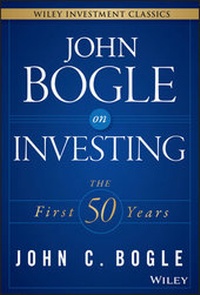
John Bogle on Investing
Beschreibung
Rezensionen / Stimmen
"Throughout the book Bogle elaborates on what he considers his most important contribution to the investing community: "the majesty of simplicity in an empire of parsimony." I can't think of a better legacy." - Investing.com "Mr Bogle is also a noted proponent of index funds and everyone should read, mark, learn and inwardly digest his arguments." (Financial Advisor, October 2015)Weitere Details
Weitere Ausgaben
Person
Inhalt
2015 INTRODUCTION TO THE CLASSIC EDITION OF JOHN BOGLE ON INVESTING: THE FIRST 50 YEARS
Has The First 50 Years Become a Classic?
Let me tell you the story, and then you can decide. First, you should know that John Bogle on Investing: The First 50 Years had an unusual conception. Following the 1993 publication of my first book, Bogle on Mutual Funds: New Perspectives for the Intelligent Investor, by Irwin Professional Publishing, that firm was acquired by the McGraw-Hill Companies, Inc.
When I decided to write a second book, I chose John Wiley & Sons as my publisher. That book, published in 1999, was titled Common Sense on Mutual Funds: New Imperatives for the Intelligent Investor, playing on the Benjamin-Graham-like theme of its predecessor. (In 2009, a fully updated 10th Anniversary Edition was published.)
McGraw-Hill's senior editor, Jeffrey A. Krames, was eager to earn back his firm's role as my publisher. In late 2000, Jeff came to me with a proposal to publish an anthology of some of the essays and speeches that I had written earlier in my mutual fund career, going all the way back, as it turned out, to 1971. The capstone of the proposed book would be the publication of my 1951 senior thesis at Princeton University, "The Economic Role of the Investment Company," a study of the past, present, and future of the then-infant U.S. mutual fund industry. Hence, John Bogle on Investing: The First 50 Years.
It was no easy task to select the essays for inclusion in the anthology. Some were focused on investment advice, some on history; some were irreverent; and there were some that I hoped would offer inspiration to readers. (There were more than 100 essays from which to choose.) But with the help of Jeff Krames, I selected 25 essays that seemed to be out-of-the-ordinary. I then organized the papers into five distinct parts:
- I. INVESTMENT STRATEGIES FOR THE INTELLIGENT INVESTOR, focused on the returns, risks, and costs borne by participants in our stock and bond markets; and the selection of equity and bond mutual funds, with a focus on index funds.
- II. TAKING ON THE MUTUAL FUND INDUSTRY, describing past trends and future prospects for the now-giant fund industry, including a discussion of the proper role of mutual funds in the corporate governance of the companies in which they invest. (Hint: I didn't much like what I saw happening in the industry.)
- III. ECONOMICS AND IDEALISM, including "The Vanguard Experiment," reflections on the challenges I faced in 1974 when I created a mutual fund complex with a unique, heretofore untested, truly mutual structure; the building of the new firm; and the investment strategies and human values that would constitute its heart and soul.
- IV. PERSONAL PERSPECTIVES, including five essays and speeches for general audiences, including my 1999 lecture at Princeton, "Changing the Mutual Fund Industry: The Hedgehog and the Fox." I also included my reflections on the heart transplant I received in 1999; and the three idealistic addresses that I delivered at academic commencements.
- V. THE PRINCETON THESIS, the full text of my 1951 senior thesis, describing the role that I envisioned for a better mutual fund industry.
I did not ask others to comment my manuscript prior to publication (i.e., no "blurbs"). Rather, I decided to ask two of the most respected men that I knew-one in finance, one in law-to introduce the book to readers. One of these titans was Paul A. Volcker, long-time chairman of the Federal Reserve Board, international statesman, and (more recently) adviser to President Barack Obama. The other titan was William T. Allen, director of the Center for Law and Business, New York University, eminent jurist, then recently-retired Chancellor of the Delaware Court of Chancery; and chairman of the Independence Standards Board that was established by the Securities and Exchange Commission in 1997.
Their reactions were overwhelmingly positive. Paul Volcker agreed to write a foreword, and Bill Allen offered an introduction. The words that they wrote suggested that maybe, just maybe, The First 50 Years could become a classic.
Paul Volcker:
[John Bogle's] great contribution-his single-minded mission-has been to insist that mutual funds should be managed, first and foremost, in a way truly to serve the interests of the investing public . . . I have enormously admired the force and eloquence with which he has set forth his thinking. It is thinking that I find fully persuasive as an analytic matter and entirely consistent with the public interest.
This new volume happily makes that thinking easily available to a wider audience. John Bogle writes with unusual clarity and simplicity, clarity of the vision and simplicity of the written word. He has a rare ability to set out concisely and effectively the evidence to support his argument. A wry sense of humor can't quite disguise, and shouldn't disguise, his sense of frustration-even outrage-about some practices that permeate the industry that has been his life's work and personal passion.
. . . the strong sense of fiduciary responsibility, the objectivity of analysis, and the willingness to take a stand-qualities that permeate all his writings-set high standards for all those concerned with the growth and integrity of our open and competitive financial system.
William Allen:
. . . John Bogle's life reflects such a deep commitment to the concepts of duty, honor, candor, diligence, and service to others that the most complete summarization of the man is to say that he is a man of high virtue. In an age that sometimes seems to have tried to raise gratification of the self to the status of a virtue, his life reminds us that the value of a life is measured by how one affects the lives of others, not by either celebrity or by balance sheet.
The speeches that are collected in this volume capture in vivid outline the core concepts of Jack's vision and inevitably disclose as well the outstanding character of the man. That these two elements-vision and character-are inextricably linked is possibly the most fundamental and basic lesson that Jack Bogle's career teaches those of us interested in finance and investing.
John Bogle on Investing was published with little fanfare. It was aimed only tangentially at educating investors to the hard realities of investing, and developing strategies to optimize their chances for the successful accumulation of wealth. At its core, the book's principal purpose was to offer reflections on investment philosophy, on idealism, and on human values. The editors of Amazon's vast library of books placed it in the "Mutual Funds" category, not necessarily where it belonged, and its ranking was undistinguished. However, three of my other books clearly belong there, and continue to hold dominant positions in this category. (Ever since its publication in March 2007, The Little Book of Common Sense Investing has been the #1 mutual fund book.)
While the readers' reviews on Amazon for John Bogle on Investing were hardly rife (seventeen in all), they were enthusiastic to a fault-my only book to average a 5-star rating. (My other books have generally been rated at 4¾-stars by readers.) But there was also something different about these reviews: they were long. The first was 49 lines, the second 15 lines, the third 21 lines, and the fourth, a hefty 92 lines!
The high appraisal of the readers was made vivid by the words that they used. A few excerpts:
Let John Bogle-a legend of American finance-illuminate and inspire your [investment] journey . . . Exceptionally well written and amazingly informative and entertaining . . . A remarkable book from a remarkable man . . . Bogle reflects integrity in a sea of doubt . . . One of the brightest minds of our century . . . His writing contains a deft mastery of mathematics [with] prose that is simple, concise, and often funny . . . No-nonsense book by one of the greats . . . The guardian angel to small investors, a man of integrity and wisdom.
Heady wine indeed! With such a sendoff from titans Volcker and Allen-reviews from the top-and such a reception by readers-reviews from investors who seek candor and unbiased advice-who, really, is to say that, like Bogle on Mutual Funds before it, John Bogle on Investing: The First 50 Years is not destined to become an investment classic?
A Retrospective on The First 50 Years
This classic edition of The First 50 Years gives its author the opportunity, almost 15 years after its original publication, to appraise his work in retrospect. Despite the recent era of wildly fluctuating markets, economic challenges faced by nations around the globe, continued violent warfare (fortunately, for those of us in the U.S., far from our shores), and deteriorating values in our financial system, my views have largely met the test of time. To the extent that any of the ideas in The First 50 Years went astray, I correct them here,...
