

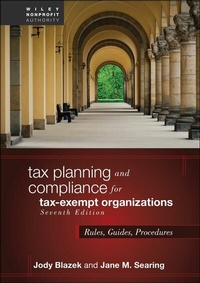
Tax Planning and Compliance for Tax-Exempt Organizations
Beschreibung

A hands-on roadmap to navigating the complicated maze of tax-exempt rules and regulations
In the newly revised seventh edition of Tax Planning and Compliance for Tax-Exempt Organizations: Rules, Checklists, Procedures, a team of celebrated tax and nonprofit specialists delivers a critical update to their widely read and authoritative series on nonprofit organization taxation. It's an essential guide to making sense of the complexities of nonprofit tax rules and regulations.
Packed with checklists and suggestions, this book tells you exactly how to understand-and comply with-the complicated maze of tax-exempt organization rules and regulations administered by the Internal Revenue Service.
In the book, you'll find:
- Extensive, quick-use checklists for determining tax-exempt eligibility, reporting to the IRS, and tax compliance
- Detailed instructions for submitting exemption applications and tax forms
- Sample documents, including organizational bylaws, letters of application, and completed IRS forms
- Tools and practice aids, like a comparison chart explaining the differences between public and private charities
Written by two of the leading authorities in a rapidly evolving field, Tax Planning and Compliance for Tax-Exempt Organizations dives deep into the most recent changes to the tax code, new case law and IRS rulings, and regulations promulgated since 2020. It's perfect for tax and accounting professionals everywhere.
Weitere Details
Weitere Ausgaben
Andere Ausgaben
Personen
JODY BLAZEK was a founder and partner in Blazek & Vetterling, a Houston-based CPA firm focused on tax, auditing, and financial planning for exempt organizations and the people who create, fund, and work with them. She is the author of six books in the Wiley Nonprofit Series, including Financial Planning for Nonprofit Organizations Made Easy and The Tax Law of Private Foundations, Sixth Edition. She is a frequent speaker at nonprofit symposia.
JANE M. SEARING is a managing director in Deloitte Tax's Private Wealth practice, and the Global Center for Excellence in Philanthropy. She specializes in tax-exempt organizations, specifically private foundations, and philanthropic planning, and focuses on helping family offices and ultra-high-net-worth individuals execute their philanthropic vision. Searing is a frequent speaker and writer, a certified public accountant in Washington, Hawaii, and Colorado, and a member of the American Institute of Certified Public Accountants.
Inhalt
Introduction: An Indispensable Roadmap for the Complex Maze of Tax-Exempt Rules and Regulations xiii
Chapter 1 Distinguishing Characteristics of Tax-Exempt Organizations 1
1.1 Differences between Exempt and Nonexempt Organizations 8
1.2 Nomenclature 10
1.3 Control 11
1.4 Role of the Internal Revenue Service 12
1.5 Suitability as an Exempt Organization 12
1.6 Start-Up Costs, Governance, Tax, and Financial Considerations 15
1.7 Choosing a Form for the New Exempt Organization 18
Chapter 2 Qualifying Under IRC §501(c)(3) 23
2.1 Organizational Test 25
2.2 Operational Test 31
Chapter 3 Public Charities 57
3.1 Distinctions Between Public and Private Charities 58
3.2 "Inherently Public Activity" and Broad Public Support: §509(a)(1) 59
3.3 Community Foundations 72
3.4 Service-Providing Organizations: §509(a)(2) 81
3.5 Difference Between §509(a)(1) and §509(a)(2) 83
3.6 Supporting Organizations: §509(a)(3) 91
3.7 Testing for Public Safety: §509(a)(4) 106
Chapter 4 Religious Organizations 107
4.1 Characteristics of Religious Organizations 108
4.2 Churches 112
4.3 Religious Orders 125
4.4 Religious and Apostolic Associations 126
Chapter 5 Charitable Organizations 129
5.1 Relief of the Poor 131
5.2 Promotion of Social Welfare 136
5.3 Lessening the Burdens of Government 146
5.4 Advancement of Religion 149
5.5 Advancement of Education and Science 149
5.6 Promotion of Health 150
5.7 Cooperative Hospital Service Organizations 170
Chapter 6 Other Charitable Organizations Qualifying Under IRC §501(c)(3) Charitable Purposes 171
6.1 Educational Purposes 172
6.2 Literary Purposes 186
6.3 Scientific Purposes 187
6.4 Testing for Public Safety 191
6.5 Fostering National or International Amateur Sports Competition (But Only If No Part of Its Activities Involves the Provision of Athletic Facilities or Equipment) 192
6.6 Prevention of Cruelty to Children or Animals 194
Chapter 7 Civic Leagues, Other Nonprofits, and Social Welfare Organizations Exempt Under IRC §501(c)(4) 195
7.1 Comparison of (c)(3) and (c)(4) Organizations 197
7.2 Qualifying and Nonqualifying Civic Organizations 204
7.3 Local Associations of Employees 211
7.4 Neighborhood and Homeowner's Associations 212
7.5 Disclosures of Nondeductibility 216
Chapter 8 Governmental Units, Component-Created Entities, and Title-Holding Corporations 225
8.1 Governmental Units 225
8.2 Political Subdivisions 228
8.3 Integral Parts 229
8.4 Eligibility for Obtaining and Benefits/Detriments of Holding IRC §501(c)(3) Tax-Exempt Status 231
8.5 Instrumentalities 233
8.6 Affiliates 237
8.7 IRC §501(c)(2) Title-Holding Corporations 238
8.8 IRC §501(c)(25) Title-Holding Corporations 243
Chapter 9 Private Inurement and Intermediate Sanctions 245
9.1 Defining Inurement 248
9.2 Salaries and Other Compensation 250
9.3 Setting Salary 253
9.4 Housing and Meals 255
9.5 Purchase, Lease, or Sale of Property or Services 256
9.6 Loans and Guarantees 258
9.7 For-Profit to Nonprofit and Vice Versa 258
9.8 Services Rendered for Individuals 259
9.9 Joint Ventures 261
9.10 Intermediate Sanctions 262
Chapter 10 Private Foundations-General Concepts 277
10.1 Why Private Foundations Are Special 277
10.2 Special Rules Pertaining to Private Foundations 279
10.3 Application of Taxes to Certain Nonexempt Trusts 291
10.4 Termination of Private Foundation Status 293
Chapter 11 Excise Tax Based on Investment Income: IRC §4940 317
11.1 Formula for Taxable Income 318
11.2 Net Capital Gains 327
11.3 Deductions from Gross Investment Income 333
11.4 Tax-Planning Considerations 338
11.5 Foreign Foundations 341
11.6 Timely Payment of Excise Tax 343
11.7 Tax on Private Colleges and Universities 344
11.8 Exempt Operating Foundations 345
Chapter 12 Self-Dealing: IRC §4941 347
12.1 Definition of Self-Dealing 348
12.2 Sale, Exchange, or Lease of Property 352
12.3 Loans 362
12.4 Compensation 365
12.5 Transactions That Benefit Disqualified Persons 372
12.6 Payments to Government Officials 380
12.7 Sharing Space, People, and Expenses 381
12.8 Indirect Self-Dealing 384
12.9 Property Held by Fiduciaries 385
12.10 Issues Once Self-Dealing Occurs 389
Chapter 13 Minimum Distribution Requirements: IRC §4942 395
13.1 Assets Used to Calculate Minimum Investment Return 397
13.2 Measuring Fair Market Value 404
13.3 Distributable Amount 410
13.4 Qualifying Distributions 412
13.5 Private Operating Foundations 433
13.6 Satisfying the Distribution Test 443
Chapter 14 Excess Business Holdings and Jeopardizing Investments: IRC §§4943 and 4944 451
14.1 Excess Business Holdings 451
14.2 Jeopardizing Investments 462
14.3 Program-Related Investments 467
14.4 Penalty Taxes 473
Chapter 15 Taxable Expenditures: IRC §4945 479
15.1 Lobbying 481
15.2 Voter Registration Drives 486
15.3 Grants to Individuals 486
15.4 Grants to Public Charities 498
15.5 Grants to Foreign Organizations 509
15.6 Expenditure Responsibility Grants 512
15.7 Noncharitable Expenditures 525
15.8 Excise Taxes Payable 526
Chapter 16 IRS Filings, Procedures, and Policies 529
16.1 IRS Tax Exempt and Government Entities Division 530
16.2 IRS Determination Process 534
16.3 Annual Filing of Forms 990 545
16.4 Reporting Organizational Changes to the IRS 555
16.5 Weathering an IRS Examination 559
16.6 When an Organization Loses Its Tax-Exempt Status 566
Chapter 17 Unrelated Business Income 567
17.1 IRS Scrutiny of Unrelated Business Income 572
17.2 History of the Unrelated Business Income Tax 572
17.3 Consequences of Receiving UBI 573
17.4 Definition of Trade or Business 575
17.5 What Is Unrelated Business Income? 579
17.6 "Regularly Carried On" 580
17.7 "Substantially Related" 582
17.8 Unrelated Activities 587
17.9 The Exceptions 609
17.10 Income Modifications 616
17.11 Calculating and Minimizing Taxable Income 627
17.12 Debt-Financed Property 635
17.13 Museums 642
17.14 Travel Tours 644
17.15 Publishing 645
Chapter 18 Relationships with Other Organizations and Businesses 649
18.1 Creation of a (c)(3) by a (c)(4), (5), or (6) 650
18.2 Alliances with Investors 655
18.3 Corporate Subsidiary 660
18.4 Active Business Relationships 665
Chapter 19 Electioneering and Lobbying 669
19.1 Election Campaign Involvement 670
19.2 Voter Education vs. Candidate Promotion 676
19.3 Tax on Political Expenditures 681
19.4 Lobbying Activity of §501(c)(3) Organizations 691
19.5 Permissible Amounts of Lobbying 697
19.6 Lobbying Limits for §501(c)(4), (5), (6), and Other Exempt Organizations 701
19.7 Advocacy and Nonpartisan Analysis 702
Chapter 20 Mergers, Reorganizations, and Terminations 705
20.1 Mergers and Other Combinations 705
20.2 Reorganizations 711
20.3 Terminations 714
Chapter 21 Deductibility and Disclosures 717
21.1 Overview of Deductibility 718
21.2 The Substantiation and Quid Pro Quo Rules 731
21.3 Valuing Donor Benefits 742
21.4 Unrelated Business Income Aspects of Fund-Raising 746
Appendix 1: Labor, Agricultural, and Horticultural Organizations: §501(c)(5) 749
Appendix 2: Business Leagues: §501(c)(6) 761
Appendix 3: Social Clubs: §501(c)(7) 781
Appendix 4: Guides for Maintaining Exempt Status 799
Appendix 5: Brief Description of Tax Sanctions Applicable to Private Foundations 833
List of Exhibits 837
About the Authors 839
Index 841
CHAPTER 1
Distinguishing Characteristics of Tax-Exempt Organizations
- 1.1 Differences between Exempt and Nonexempt Organizations
- 1.2 Nomenclature
- 1.3 Control
- 1.4 Role of the Internal Revenue Service
- 1.5 Suitability as an Exempt Organization
- 1.6 Start-Up Costs, Governance, Tax, and Financial Considerations
- 1.7 Choosing a Form for the New Exempt Organization
The world of tax-exlempt (or simply exempt) organizations includes a broad range of nonprofit institutions: churches, schools, charities, business leagues, political parties, schools, country clubs, and united giving campaigns-all conducting a wide variety of pursuits intended to serve the public, or common, good. All exempt organizations (EOs) share the common attribute of being organized for the advancement of a group of persons, rather than the private interests of individuals or businesses. Most EOs are afforded special tax and legal status precisely because of the selfless motivation behind their formation.
The common thread running through the various types of EOs is the lack of private ownership and profit motive. A broad definition of an EO is a nonprofit entity operated without self-interest to serve a societal or group mission that pays over none of the income or profit to private individuals-its members and governing officials.
Federal and state governments view nonprofits as relieving their burdens by performing certain functions of government. Thus, many nonprofits are exempted from many of the levies that finance government, including income, sales, ad valorem, and other local taxes. This special status recognizes the work these entities perform essentially on behalf of the public. In addition, for charitable nonprofits, labor unions, business leagues, and other types of exempt organizations, the tax deductibility of contributions, and dues paid to them, provides further evidences of the government's willingness to forgo revenue in favor of the benefit of the value these organizations provide. At the same time, deductibility of the amounts provided to exempt organizations whether through contributions, dues, or other program revenue, provides a major source of funds for exempt organizations. For complex reasons, some of which are not readily apparent, all nonprofits are not equal for tax deduction purposes, and not all "donations" are deductible.1 Similarly, that portion of the dues a civic association or business league spends on lobbying activity may not be deductible by the members.2
On the federal level, Internal Revenue Code (IRC) §501 exempts some 30 specific types of nonprofit organizations, plus pension plans (§401), political organizations (§527), homeowner's associations (§528), and qualified state tuition programs (§529), from income tax. Although exempt organizations are often perceived as charitable, many other types of nonprofits are classified as tax-exempt under the federal income tax code. Labor unions, business leagues, community associations, cemeteries, employee benefit societies, social clubs, and many other types of organizations are listed in IRC §501. Exhibit 1.1 contains the Internal Revenue Service (IRS) reference chart listing all categories of exempt organizations and illustrates the wide variety.
The schedule of nonprofit organizations that qualify to receive tax deductible donations are listed in Exhibit 1.1. Guidance in regulations for many IRC §501 exempt nonprofits specifically require that the organization devote itself exclusively to achieving its defined purpose. Exclusively for this purpose does not necessarily mean 100 percent. Whether legislative and election activities, for example, further exempt purpose is based on its educational purpose and facts in which it is conducted.
Additional lists can be found in the following publications on the IRS website on the Internet:
- Publication 78-IRS.Gov Online Tax Exempt Organization Search Tool allows for a search by either name or employer ID number (EIN) of organizations eligible to receive tax-deductible charitable contributions. The list does not include churches, group ruling subordinates, and governmental units that are also eligible to receive deductible donations.
EXHIBIT 1.1 Organization Reference Chart
Section of 1986 Code Description of Organization General Nature of Activities Application Form No. Annual Return to Be Filed Contributions Allowable? §501(c)(1) Corporations Organized Under Act of Congress (including Federal Credit Unions) Instrumentalities of the United States No form None Yes, if made for exclusively public purposes §501(c)(2) Title Holding Corporations for Exempt Organization Holding title to property of an exempt organization 1024 9901 or 990-EZ8 No2 §501(c)(3) Religious, Educational, Charitable, Scientific, Literary, Testing for Public Safety, to Foster National or International Amateur Sports Competition, or Prevention of Cruelty to Children or Animals Organizations Activities of nature implied by description of class of organization 1023, 1023-EZ 9901 or 990-EZ,8 or 990-PF Yes, generally §501(c)(4) Civic Leagues, Social Welfare Organizations, and Local Associations of Employees Promotion of community welfare; charitable, educational, or recreational 1024-A and/or 897611 9901 or 990-EZ8 No, generally2,3 §501(c)(5) Labor, Agricultural, and Horticultural Organizations Educational or instructive, the purpose being to improve conditions of work, and to improve products and efficiency 1024 9901 or 990-EZ8 No2 §501(c)(6) Business Leagues, Chambers of Commerce, Real Estate Boards, etc. Improvement of business conditions of one or more lines of business 1024 9901 or 990-EZ8 No2 §501(c)(7) Social and Recreation Clubs Pleasure, recreation, social activities 1024 9901 or 990-EZ8 No2 §501(c)(8) Fraternal Beneficiary Societies and Associations Lodge providing for payment of life, sickness, accident, or other benefits to members 1024 9901 or 990-EZ8 Yes, if for certain §501(c)(3) purposes §501(c)(9) Voluntary Employees' Beneficiary Associations Providing for payment of life, sickness, accident, or other benefits to members 1024 9901 or 990-EZ8 No2 §501(c)(10) Domestic Fraternal Societies and Associations Lodge devoting its net earnings to charitable, fraternal, and other specified purposes. No life, sickness, or accident benefits to members 1024 9901 or 990-EZ8 Yes, if for certain §501(c)(3) purposes §501(c)(11) Teachers' Retirement Fund Associations Teachers' association for payment of retirement benefits 1024 9901 or 990-EZ8 No2 §501(c)(12) Benevolent Life Insurance Associations, Mutual Ditch or Irrigation Companies, Mutual or Cooperative Telephone Companies, etc. Activities of a mutually beneficial nature similar to those implied by the description of class of organization 1024 9901 or 990-EZ8 No2 §501(c)(13) Cemetery Companies Burials and incidental activities 1024 9901 or 990-EZ8 Yes, generally §501(c)(14) State Chartered Credit Unions, Mutual Reserve Funds Loans to members 1024 9901 or 990-EZ8 No2 §501(c)(15) Mutual Insurance Companies or Associations Providing...
