

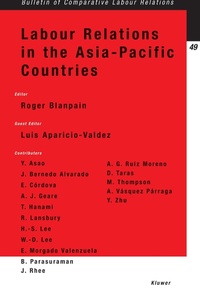
Labour Relations in the Asia-Pacific Countries
Erschienen am 18. Dezember 2003
188 Seiten
978-90-411-5701-0 (ISBN)
Beschreibung
Important issues concerning labour and industrial relations necessarily arise as markets among the countries around the Pacific Ocean become more integrated. With economic activity levels as different as that of the United States and that of Papua New Guinea, and with labour forces ranging in size from that of China to that of the Sultanate of Brunei¿not to mention a vast spectrum of diverse cultural standards and customs¿this important regional grouping demands the attention of labour law specialists if trade integration is to proceed amicably and to the benefit of all.
In this valuable book sixteen academics and other professionals in the field present informed and insightful essays on aspects of labour and industrial relations law in ten countries (Australia, Canada, Chile, China, Japan, Korea, Mexico, New Zealand, Peru, and the United States) as well as under the ASEAN regime. Among the imperative issues these authors elucidate are the following:
collaboration within the firm to raise productivity;
the need for competitiveness among firms;
the importance of human relations and social responsibility;
the development of social security policy; and
reducing the risk and absorbing the benefits of integration under conditions of rapid social and industrial change.
These papers were originally presented in 2001 in a report by the Peruvian labour journal Análisis Laboral, in response to a request by the Regional Office of the International Labour Organisation for a study of employment conditions, labour relations, and social security in the APEC countries as seen from a Latin American perspective. It was immediately apparent that many of the papers in this report were of great value to the international labour law community, and accordingly those papers are collected and reprinted here.
In this valuable book sixteen academics and other professionals in the field present informed and insightful essays on aspects of labour and industrial relations law in ten countries (Australia, Canada, Chile, China, Japan, Korea, Mexico, New Zealand, Peru, and the United States) as well as under the ASEAN regime. Among the imperative issues these authors elucidate are the following:
collaboration within the firm to raise productivity;
the need for competitiveness among firms;
the importance of human relations and social responsibility;
the development of social security policy; and
reducing the risk and absorbing the benefits of integration under conditions of rapid social and industrial change.
These papers were originally presented in 2001 in a report by the Peruvian labour journal Análisis Laboral, in response to a request by the Regional Office of the International Labour Organisation for a study of employment conditions, labour relations, and social security in the APEC countries as seen from a Latin American perspective. It was immediately apparent that many of the papers in this report were of great value to the international labour law community, and accordingly those papers are collected and reprinted here.
Weitere Details
Weitere Ausgaben
Personen
Inhalt
- Cover
- Half Title Page
- Title Page
- Copyright Page
- Table of Contents
- Editorial
- List of Contributors
- 1. Employment Law in the Context of the Changing Pattern of Employment Relations in Australia
- I. RECENT CHANGES IN THE STURCTURE OF COLLECTIVE BARGAINING IN AUSTRALIA
- II. FROM CENTRALIZTAION TO COORDIANTED OR MAAGNED DECENTRALIZATION OF BARGAINING
- III. FROM COORDIANTED DECENTRALIZTAION TO COORDINATED FLEXIBILITY
- IV. FROM COORDIANTED TO FRGAMENTED FLEXIBILITY
- V. POLICY IMPLICATIONS OF TH E CHANGING PATPERN OF EMPLOYMENT RELATIONS IN AUSTRALIA
- A. Winners and losers from recent changes
- B. The role of government in relation to deficiencies of the prevailing structure of collective bargaining
- C. Proposals for changes in the structure of collective bargaining and social partnership
- VI. CONCLUSION
- REFERENCES
- 2. Canadian Industrial Relations
- I. INTRODUCTION
- II. THE HISTORICAL, POLITICAL AND SOCIO-ECONOMIC CONTEXT
- III. THE PARTIES IN EMYPLOMENT RELATIONS
- A. Unions
- B. Management
- C. Government
- IV. THE PROCESSES OF INDUSTRIAL RELATIONS
- A. Collective bargaining
- B. Strike and settlement methods
- C. Issues of current and future importance
- D. Management and collective bargaining
- E. Labour disputes
- V. PUBLIC SECTOR EMPLYOMENT RELATIONS
- VI. POLITICAL ROLE OF TH E LABOUR MOVEMENT
- VII. CONCLUSIONS
- 3. Chile: Labour Relations at the Beginning of the Twenty-first Century
- I. ECONOMY AND LABOUR MARKET
- II. LABOUR RELATIONS
- III. SOCIAL DIALOGUE
- IV. SOCIAL COSTS
- 4. Labour Law and Industrial Relations in China
- I. INTRODUCTION
- II. THE DEVELOPMENT OF THE CHINESE LABOUR MARKET SINCE 1978
- III. LEGAL REFORM AND LEGAL CULTURE IN CHINA
- A. Legal reform in China
- B. Economic development and labour market regulation
- C. Legal culture in China
- IV. THE DEVELOPMENT OF CHINESE LABOUR LAW AND INDUSTRIAL RELATIONS SYSTEM
- A. Labour market regulation in the 1980s
- B. Labour market regulation in the 1990s
- V. KEY FEATURES OF THE 1994 LABOUR LAW
- A. Labour contracts
- B. Trade unions
- VI. REMUNERATION, BENEFITS AND WORKING CONDITIONS
- VII. LABOUR DISPUTES, MEDTIAION AND ARBITRATION
- VIII. THE TRANSFORMATION OF LABOUR MARKET REGULATION
- IX.CONCLUSION
- APPENDIX: CHAPTER I: GENERAL PROVISIONS OF THE 1994 LABOUR LAW
- REFERENCES
- 5. The Labour Situation in Japan (2001)
- I. THE ECONOMY AND THE LABOUR MARKETS: CURRENT SITUATION
- II. DEVELOPMENTS OF INDUSTRIAL RELATIONS
- A. Historical overview of industrial relations
- B. Shunto: spring wage offensive
- C. Recent trend of union organization
- III. SOCIAL DIALOGUE
- IV. LABOUR COST
- V. SOCIAL SECURITY SYSTEMS
- 6. 2001 Annual Review for Japan
- I. ECONOMIC DEVELOPMENTS
- II. POLITICAL DEVELOPMENTS
- III. COLLECTIVE BARGAINING
- A. General
- B. Pay
- C. Working time
- IV. JOB SECURITY, TRAINING AND SKILL DEVELOPMENT
- V. LEGISLATIVE DEVELOPMENTS
- VI. THE ORGANISATION AND ROLE OF THE SOCIAL PARTPNERS
- VII. INDUSTRIAL ACTION
- VIII. NEW FORMS OF WORK
- IX. OUTLOOK
- 7. Industrial Relations in Korea
- I. HISTORICAL BACKGROUND
- II. FEATURES OF THE MAJOR ACTORS IN INDUSTRIAL RELATIONS
- III. INSTITUTIONALIZED STRUCTURE OF INDUSTRIAL RELATIONS
- IV. CURRENT ISSUES OF INDUSTRIAL RELATION IN KOREA
- REFERENCES
- 8. PDR Systems Theory Perspective on Employment Relations in a Globalizing Asia
- I. INTRODUCTION
- II. WHY IS THE PDR SYSTEMS THEORY?
- A. The PDR systems theory
- B. The role of the environment, actors' values, power positions, and strategies
- C. Significance of the human-ware system and the synthesis of the PDR systems
- D. The message and the application of the PDR systems theory
- III. THE TRANSFORMATION OF EMPLOYMENT RELATIONS IN KOREA
- A. Authoritarian to paternalistic HR practices
- IV. NEW ENVIRONMENTAL CHANGES AND THREE OPTIONS
- A. Back to the authoritarian employment relations?
- B. Adopting Western systems and similar alternatives
- C. Improving paternalistic employment relations
- V. A CASE STUDY OF HEG: MODIFIED PATERNALISTIC APPROACH TO ENHANCE HUMANWARE
- VI. CONCLUSIONS
- REFERENCES
- 9. Social Security in México
- 10. Employment and work Culture in Mexico under the Shadow of NAFTA, 1994-2002
- I. EMPLOYMENT AND OCCUPATIONAL PROFILE
- II. UNEMPLOYMENT: RATES, MOTIVATIONS AND CHARACTERISTICS
- III. COMPENSATION
- IV. SOCIAL SECURITY
- V. COLLECTIVE BARGAINING AND UNIONISM
- VI. NEW WORK CULTURE
- REFERENCES
- 11. Labour in New Zealand
- I. INTRODUCTION
- II. ARBITRATION ERA
- III. COLLECTIVE BARGAINING ERA
- IV. LAISSEZ-FAIRE ERA
- V. LABOUR IN NEW ZEALAND TODAY
- VI. UNIONS AND COLLECTIVE BARGAINING
- VII. CENTRAL UNION ORGANIZATION
- VIII. MULTI-EMPLOYER AGREEMENTS
- IX. STRIKE ACTIVITY
- X. CONCLUSION
- REFERENCES
- 12. 2002: The Peruvian Labour Field
- I. AN ONEROUS HERITAGE
- II. A DEPRESSED LABOUR MARKET
- III. THE OUSTANDING CHARACTERISTICS OF THE NEW EMPLOYMENT SITUATION
- IV. WAGES AND INCOMES, DECLINE AND INEQUALITY
- V. THE LABOUR MODEL IN CRISIS
- VI. PROTECTION AND SOCIAL SECURITY
- VII. A NEW LABOUR MARKET AND THE CHALLENGES OF COMPETITIVENESS
- VIII. SOCIAL DIALOGUE, DEMOCRACY AND A NEW LABOUR MODEL
- 13. The Labour Relations System of United States
- I. THE ROLE OF COLLECTIVE BARGAINING
- II. CAUSES FOR THE DECLINE OF TRADE UNIONISM
- III. DIVERSIFICATION OF EMPLOYMENT MODES
- IV. THE PRESENT ECONOMIC PICTURE
- 14. Industrial Relations in ASEAN
- I. INTRODUCTION
- II. SIMILARITIES
- III. DIFFERENCES
- IV. OVERALL OBSEVRED PATTERN
- V. CONCLUSION
- REFERENCES
- Back Cover
