

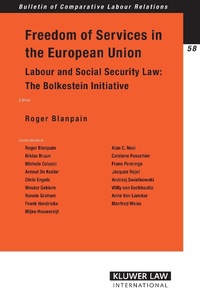
Freedom of Services in the European Union
Labour and Social Security Law: The Bolkestein Initiative
Erschienen am 18. Januar 2006
412 Seiten
978-90-411-5742-3 (ISBN)
Beschreibung

In June 2005, on the heels of the resounding no given by France and the Netherlands to a proposed European constitution, a panel of seventeen distinguished experts including not only academics but also officials of the European Commission, the European Parliament, the European Court of Justice, the European Trade Union Confederation, and the European Committee of Social Rights of the Council of Europe met to reopen discussion of freedom of services in the context of the new social Europe that is clearly now called for.
The panel members discussed many crucial issues, including the following:
the notion of service, including the meaning of the so-called definite period;
the sectors, including the temporary work sector;
applicable labour law and social security standards;
acceptable administrative conditions;
required documents and languages;
the country of origin principle and labour conditions in the work land;
collaboration between member states and social partners;
the possibility of extension of collective agreements;effective control of the black market and illegal work; and
the self-employed coming from low wage countries.
As the definitive text representing this groundbreaking forum (European Forum organised by the Society for International and Social Cooperation, Brussels, 16-17 June 2005), this book offers students, lawyers, policymakers, and other professionals a richly detailed survey of where the European project now stands. It pushes us to look anew at at the balance between fair market competition on the one hand and adequate social protection of workers on the other.
The book also reprints the text of Directive 96/71/EC, along with a Commission Communication on its implementation, as well as a Euro-CIETT position paper and a Commission Proposal of 13 January 2004 for a new directive on the internal market.
The panel members discussed many crucial issues, including the following:
the notion of service, including the meaning of the so-called definite period;
the sectors, including the temporary work sector;
applicable labour law and social security standards;
acceptable administrative conditions;
required documents and languages;
the country of origin principle and labour conditions in the work land;
collaboration between member states and social partners;
the possibility of extension of collective agreements;effective control of the black market and illegal work; and
the self-employed coming from low wage countries.
As the definitive text representing this groundbreaking forum (European Forum organised by the Society for International and Social Cooperation, Brussels, 16-17 June 2005), this book offers students, lawyers, policymakers, and other professionals a richly detailed survey of where the European project now stands. It pushes us to look anew at at the balance between fair market competition on the one hand and adequate social protection of workers on the other.
The book also reprints the text of Directive 96/71/EC, along with a Commission Communication on its implementation, as well as a Euro-CIETT position paper and a Commission Proposal of 13 January 2004 for a new directive on the internal market.
Weitere Details
Weitere Ausgaben
Andere Ausgaben
Roger Blanpain
Freedom of Services in the European Union
Labour and Social Security Law: The Bolkestein Initiative
Buch
03/2006
Kluwer Law International
240,00 €
Versand in 10-20 Tagen
Inhalt
- Cover
- Half Title Page
- Title Page
- Copyright Page
- Table of Contents
- Notes on contributors
- FOREWORD
- PART I. THE SERVICES DIRECTIVE
- 1. The Proposal of the European Commission for a Directive on Services in the Internal Market : An Overview of its Main Features and Critical Reflections
- 1. Introduction
- 2. Main Features of the Proposal
- 2.1. Scope
- 2.2. Freedom of Establishment
- 2.3. Freedom to Provide Services
- 2.4. Measures Enhancing Mutual Confidence
- 3. Critical Reflections
- 3.1. Scope and Legal Basis
- 3.2. Relationship with Fundamental Community Principles
- 3.3. Country of Origin Principle and Minimum Harmonisation
- 3.4. Recognition of Regional Competences
- 3.5. Relationship with Other Secondary Community Initiatives
- 3.5.1. Posting of Workers
- 3.5.2. What if the Posting of Workers Directive Does Not Apply?
- 4. Conclusion
- 2. The Proposed Directive on Services and Labour Law
- 1. Introduction
- 2. Treaty provisions
- 3. The present legal situation
- 4. The labour law aspects of the proposed Services Directive
- 4.1. The Country of Origin Principle and Labour Law
- 4.1.1. The Proposed Services Directive and Member States' Labour Law
- 4.1.2. The Proposed Services Directive and EU Labour Law
- 4.1.3. Council Documents on Labour Law
- 4.1.4. Member State Labour Law: Conflicts with Rome I
- 4.1.5. EU Labour Law (1): Transforming Directive 96/71/EC from a Minimum to a Maximum Standard
- 4.1.6. EU Labour Law (2): Terms of Employment of Posted Workers Safeguarded
- 4.1.7. EU Labour Law (3): The Problem of Self-employed Posted Workers
- 4.1.8. EU Labour Law (4): Conditions for Hiring-out of Workers
- 4.2. The Country of Origin Principle and the Acquis Communautaire
- 4.2.1. Directive 91/383: Health and Safety
- 4.2.2. Directive 80/987/EEC: Insolvency Protection
- 4.2.3. Public Procurement Rules
- 4.2.4. Posted Workers: Directive 96/71/EC
- 4.2.5. Agency Workers
- 4.2.6. Recognition of Professional Qualifications
- 4.2.7. Collective Agreements
- 4.2.8. Privatisation and Outsourcing of Services
- 4.2.9. Collective Rights under the EU Charter
- 4.2.10. Summary
- 5. Current proposals in the European parliament
- 5.1. The Starting Point
- 5.2. The Concept of Labour Law
- 5.3. A Possible Way Forward
- 3. Mutual Recognition and Country of Origin in the case law of the European Court of Justice
- 1. Introduction
- 2. The Principle of Mutual Recognition
- 3. The principle of country of origin
- 4. Previous application of home state rules under Article 49 EC
- 4. The Country of Origin Principle and Labour Law in the Framework of the European Social Model
- 1. Introduction
- 2. A Directive on Services in the European Union
- 3. The Country of Origin Principle: Completing the Internal Market for goods and Services
- 3.1. The "Principle"
- 3.2. The Problem
- 3.3. The Response of the Proposed Services Directive
- 4. "Labour is not a Commodity" - The Particular Problem of Labour Law and the Country of Origin Principle
- 4.1. Perceptions of "Abuse"
- 4.2. The Posted Workers Directive
- 4.3. The "Model" Adopted by the Draft Services Directive
- 4.4. Another Agenda: Where the "Economic Dimension" Takes Priority over the "Social Dimension"?
- 5. A European "Model" to Address the Particular Problems of Labour in the Context of the Provision of Services?
- 6. "Social Dumping": The "Real" Threat?
- 5. The implementation of the proposed directive on services in the internal Market - A French Perspective
- 6. The Implications of the Services Directive on Labour Law - A German Perspective
- 1. Introduction
- 2. The German Experience
- 2.1. The Period before Directive 96/71/EC
- 2.2. The Implementation of Directive 96/71/EC
- 2.3. The Actual Situation
- 2.4. The Problem of Self-Employment
- 3. Conclusion
- 7. Problems of Surveillance and Control of Labour Standards - Lessons from the European Social Charter
- 8 Monitoring of Labour Standards in Case of Posting: Some Trouble some Issues under the Proposed Services Directive
- 1. Introduction
- 2. State Control as a Basis for Compliance
- 2.1. The ILO Concept
- 2.2. The Posting Directive
- 2.3. Responsible Authority
- 2.4. Adequate Monitoring
- 3. Pre-conditions or a Road of Trust: Proposed Services Directive
- 3.1. Principles with regard to Monitoring of Labour Law
- 3.2. Exceptions
- 3.3. Comments
- 9. Surveillance and Control of Labour Standards at EU Level
- 1. Introduction
- 2. The Proposal for a Services Directive: the country of origin principle and some key points
- 3. Scope of the Proposal
- 4. The feared risks linked to the Directive
- 4.1. Social Dumping
- 4.2. Legal Dumping
- 4.3. Race to the Bottom?
- 5. A combination of techniques to guarantee supervision
- 5.1. Supervision "at Source"
- 5.2. Mutual Assistance between National Authorities
- 6. The Services Proposal and the existing Community rules on posting of workers
- 6.1. Labour Standards under Directive 96/71/EC
- 6.2. Control on Labour Standards
- 7. Enforcement and control of protection of temporary workers
- 8. Conclusion
- 10. The Point of View of the Federation of Belgian Enterprises on the Services Directive
- 1. THE BENEFITS OF THE SERVICES DIRECTIVE
- 1.1. Creation of a Genuine Internal Market in Services
- 1.2. Reinvigorating the European Economy
- 1.3. Concrete Benefits for all European Economic Players
- 1.3.1. Benefits for the Service Providers
- 1.3.1.1. Accelerate the Authorisation Process for EU Companies
- 1.3.1.2. An opportunity to test a market without the establishment burden
- 1.3.2. Benefits for the consumers
- 1.3.3. Benefits for employment
- 1.3.4. Benefits for Governments
- 2. REMARKS
- 2.1. Specific Remarks on the Directive Bolkestein - Provisions
- 2.1.1. Scope
- 2.1.2. Definitions of the Notion Establishment
- 2.2. Freedom of Establishment for Service Providers - Authorisations
- 2.2.1. Authorisation Schemes
- 2.2.2. Conditions for the Granting of Authorisation and the Duration of Authorisation
- 2.3. Free Movement of Services
- 2.3.1. Country of Origin Principle and Derogations
- 2.3.2. Rights of Recipients of Services
- 2.3.2.1. Prohibited Restrictions
- 2.3.2.2. Assumption of Healthcare Costs
- 2.3.3. Posting of workers
- 2.4. Quality of Services
- 2.4.1. Professional Insurance and Guarantees
- 11. The Point of View of the ETUC
- 1. General (non-exhaustive) remarks
- 1.1. The Broader Framework of the Lisbon Agenda: A Balance between Economic, Social and Environmental Interests
- 1.2. Services of General Interest, Health Services and Social Services should not be Covered
- 1.2.1. A Positive Legal Framework on SGI Is Needed
- 1.3. The Country of Origin Principle Causes a Race to the Bottom, and Will Lead to "Less Europe" Instead of More
- 2. On Labour Law
- 2.1. Labour Law and the Country of Origin Principle: An Impossible Combination
- 2.2. Exclusion of the Posting Directive: Not Clear, and Not Enough
- 2.3. Labour Law Can Only Be Effectively Enforced at the Workplace and in the Country where the Work is Performed
- 2.4. Temporary Agency Work Deserves Its Own Directive
- 2.5. Collective Bargaining: A Fundamental Right
- 3. Conclusion
- 4. Examples
- 4.1. Long-term Provision of Cross-border Services
- 4.2. Foreign Service Providers Hiring Local Workers
- 4.3. Letter-box Companies
- 4.4. Limited Protection with regard to Collective Bargaining
- 12. Euro-CIETT Position Paper on Required Amendments to the Directive on Services in the Internal Market
- 1. General Comments
- 2. Country of Origin Principle
- 3. Posting of Workers
- 4. Final Assessment
- 5. About Euro-CIETT
- 13. The Services Directive needs to be "Socially" Adjusted - A Political View from the European Parliament
- 1. Introduction
- 2. Scope of the proposal
- 3. Establishment
- 4. Country of Origin Principle
- 5. Posting of workers
- 6. Conclusion
- PART II. APPLICABLE LAW
- 14. The Rome Convention on the Law applicable to Contractual Obligations and Labour Law (1980)
- 1. Choice of Law
- 2. Objective Conflicts Rule
- 2.1. The Law of the Country of Employment
- 2.2. The Law of the Country in which the Place of Business, through which the Worker was Engaged, is Situated
- 2.3. Seeking the Closest Connection
- 3. Restrictions on Free Choice of Law - Prevention of Evasion of Law
- 3.1. Minimal Protection from the Mandatory Rules of the Objectively Applicable Law
- 3.2. Mandatory Rules in a Third Country or of the Forum
- 3.2.1. International Public Order
- 15. Towards a More Effective Posting Directive
- 1. Introduction
- 2. Posted Workers "Shifted" from the Free Movement of Workers to Services
- 2.1. Posted Workers and the Free Movement of Workers
- 2.2. Posted Workers and the Free Movement of Services
- 2.3 Posted Workers and the Law of Conflicts
- 2.4 Legal Base of the Posting Directive and its Consequences
- 3 Assessment of Contents and Implementation of the Posting Directive
- 3.1. Personal Scope and Definitions
- 3.1.1. Three Situations of Posting
- 3.1.2. Definition of Posting
- 3.1.3. Definition of a Worker
- 3.2. Terms and Conditions of Employment
- 3.2.1. Article 3(1) - Equal treatment
- 3.2.2. Article 3(7) - The Favour Principle
- 3.2.3. Minimum Wage
- 3.3. Measures to Ensure Cooperation on Information and Compliance with the Directive
- 3.3.1. Provisions on Information and Compliance in the Posting Directive
- 3.3.2. Implementation in the Member States
- 4. Final remarks
- 16. Implementation of the Posting Directive in Belgium
- 1. Genesis
- 2. European case law
- 2.1. Adequate Protection
- 2.2. Starting Points
- 3. Implementation of Directive 96/71
- 3.1. Definition of a Posted Worker
- 3.2. Terms and Conditions of Employment Applicable to a Worker Posted in Belgium
- 3.3. Exemptions
- 3.4. More Favourable Conditions
- 4. The Posting Declaration and the Simplified System for Keeping Belgian Social Documents
- 4.1. Postings of up to Six Months
- 4.2. After a Period of Six Months
- 4.3. The Posting Declaration
- 4.4. The Equivalent Pay Documents
- 4.5. When the Posting Ends
- 5. Follow up: Belgian Liaison Office
- 6. Experience and practice: problems of abuse and lack of adequate control
- Annex I.
- Annex II. Liaison offices in the European Union
- 17. The Implementation of the Posting Directive in Italy
- 1. Introduction
- 2. The Italian regulatory framework
- 3. The legal position of posted workers
- 4. Workers in the construction industry
- 5. Administration cooperation and Jurisdiction
- 6. The role of social partners and collective bargaining agreements
- 7. Conclusion
- 18. Implementation of the Posting Directive in the Netherlands
- 1. Introduction
- 2. Definition of posting, worker and period of work
- 2.1. Definition of Posting
- 2.2. Definition of a Worker
- 2.3. Posted Workers from Third Countries
- 2.4. What is Temporary?
- 3. Terms and Conditions of Employment
- 3.1. Statutory Terms and Conditions for Posted Workers
- 3.2. Terms and Conditions Laid down in (Extended) Collective Agreements
- 3.3. The Favour Principle and the Method of Comparison
- 4. Administrative cooperation and measures aimed at compliance
- 4.1. Cooperation on Information
- 4.2. Measures Aimed at Compliance
- 5. Conclusion
- 19. Implementation of the Posting Directive in Poland
- 20. Posting and Social Security Coordination
- 1. Introduction
- 2. The Principles Underlying the Rules for Determining the Legislation Applicable
- 3. The Rules for Determining the Legislation Applicable
- 4. Posting of Employees
- 4.1. Introduction
- 4.2. Conditions for Posting: Article 14
- 4.3. The Effects of Posting
- 4.4. Posting by a Temporary Employment Agency
- 4.5. Posting of Self-employed Persons
- 4.6. The Relevance of a Posting Certificate
- 5. Posting on the Basis of Article 17
- 6. Regulation 883/2004 and Posting
- 7. Comparison with Directive 96/71
- 8. Services Directive
- 9. Conclusions
- 21. The Principles of the Freedom of Movement and Equal Treatment in the Context of the Discussion on the Draft Services Directive
- 1. Introduction
- 2. The freedom of movement of workers and the prohibition of discrimination on the basis of nationality
- 2.1. General Principles
- 2.2. Direct and Indirect Discrimination
- 2.2.1. Introductory Remarks
- 2.2.1.1. Direct Discrimination
- 2.2.1.2. Indirect Discrimination
- 2.3. Rule of Reason - Non-discriminatory Impediments to the Freedom of Movement
- 3. Personal scope of the freedom of movement
- 3.1. Concept of Worker
- 3.2. Situations Not Purely Internal in One Member State
- 4. The general inapplicability of Article 39 of the EC Treaty to the situations envisaged by the draft Services Directive
- 5. Concluding remarks
- 22. Directive 96/71/EC of the European Parliament and of the Council of 16 December 1996 concerning the Posting of Workers in the Framework of the Provision of Services
- 23. Communication from the Commission to the Council, the European Parliament, the Economic and Social Committee and the Committee of the Regions - the Implementation of Directive 96/71/EC in the Member States
- 1. Introduction
- 2 Directive 96/71/EC - its Context in Community Law, its Key Content and its Added Value
- 2.1. The Context of the Directive
- 2.2. The Key Content of the Directive
- 2.3. The Added Value of the Directive
- 2.3.1. What Does This Directive Add as regards Private International Law?
- 2.3.1.1. The Rome Convention
- 2.3.1.2. Jurisdiction
- 2.3.1.3. What Does This Directive Add as regards the Court's Case Law?
- 3. THE IMPLEMENTATION OF THE DIRECTIVE IN THE MEMBER STATES
- 3.1. The Key Legislative Provisions (Articles 1 to 3)
- 3.2. The Implementation of Cooperation on Information (Article 4)
- 3.3. Measures Designed to Ensure Compliance with the Directive (Articles 5 and 6)
- 4. Assessment of the Situation
- 4.1. Transposition of the Directive in the Member States
- 4.1.1. The Method
- 4.1.2. The Nature of the Standards Applicable
- 4.1.2.1. Collective Agreements
- 4.1.2.2. The Nature of the Legislative Standards Applicable concerning Matters Other than Those Explicitly Referred to in the Directive
- 4.2. Practical Application
- 4.2.1. Difficulties Encountered by the Member States' Authorities
- 4.2.2. Difficulties Encountered by Service Provider Undertakings and Posted Workers
- 4.3. The Acceding Countries
- 5. Conclusion
- Annex Proposal for a Directive of the European Parliament and of the Council on services in the internal market [SEC(2004) 21]
- EXPLANATORY Memorandum
- 1. NECESSITY AND Objective
- 2. BACKGROUND
- 3. MAIN Features OF THE Directive
- 4. PREPARATORY Work
- 5. COHERENCE WITH Other Community Policies
- 6. LEGAL Aspects
- 7. SPECIFIC Questions
- Proposal for a DIRECTIVE OF THE EUROPEAN PARLIAMENT AND OF THECOUNCIL of [.] on services in the internal market [SEC(2004) 21]
- Chapter I - General Provisions
- Article 1 - Subject-Matter
- Article 2 - Scope
- Article 3 - Relationship with Other Provisions of Community Law
- Article 4 - Definitions
- Chapter II - Freedom of Establishment for Service Providers
- Section 1 - Administrative Simplification
- Article 5 - Simplification of Procedures
- Article 6 - Single Points of Contact
- Article 7 - Right to Information
- Article 8 - Procedures by Electronic Means
- Section 2 - Authorisations
- Article 9 - Authorisation Schemes
- Article 10 - Conditions for the Granting of Authorisation
- Article 11 - Duration of Authorisation
- Article 12 - Selection from Among Several Candidates
- Article 13 - Authorisation Procedures
- Section 3 - Requirements Prohibited or Subject to Evaluation
- Article 14 - Prohibited Requirements
- Article 15 - Requirements to be Evaluated
- Chapter III - Free Movement of Services
- Section 1 - Country of Origin Principle and Derogations
- Article 16 - Country of Origin Principle
- Article 17 - General Derogations from the Country of Origin Principle
- Article 18 - Transitional Derogations from the Country of Origin Principle
- Article 19 - Case-by-case Derogations from the Country of Origin Principle
- Section 2 - Rights of Recipients of Services
- Article 20 - Prohibited Restrictions
- Article 21 - Non-discrimination
- Article 22 - Assistance for Recipients
- Article 23 - Assumption of Healthcare Costs
- Section 3 - Posting of Workers
- Article 24 - Specific Provisions on the Posting of Workers
- Article 25 - Posting of Third Country Nationals
- Chapter IV - Quality of Services
- Article 26 - Information on Providers and Their Services
- Article 27 - Professional Insurance and Guarantees
- Article 28 - After-sales Guarantees
- Article 29 - Commercial Communications by the Regulated Professions
- Article 30 - Multidisciplinary Activities
- Article 31 - Policy on Quality of Services
- Article 32 - Settlement of Disputes
- Article 33 - Information on the Good Repute of Providers
- Chapter V - Supervision
- Article 34 - Effectiveness of Supervision
- Article 35 - Mutual Assistance
- Article 36 - Mutual Assistance in the Event of the Temporary Movement of the Provider
- Article 37 - Mutual Assistance in the Event of Case-by-case Derogations from the Country of Origin Principle
- Article 38 - Implementing Measures
- Chapter VI - Convergence Programme
- Article 39 - Codes of Conduct at Community Level
- Article 40 - Additional Harmonisation
- Article 41 - Mutual Evaluation
- Article 42 - Committee
- Article 43 - Committee Report
- Article 44 - Amendment of Directive 1998/27/EC
- Chapter VII - Final Provisions
- Article 45
- Article 46
- Article 47
- 5. DESCRIPTION AND Grounds
- 5.1. Need for Community Intervention
- 5.1.1. Objectives Pursued
- 5.1.2. Measures Taken in Connection with Ex Ante Evaluation
- 5.2. Action Envisaged and Budget Intervention Arrangements
- 5.3. Methods of Implementation
- 8. FOLLOW-UP AND Evaluation
- 8.1. Follow-up Arrangements
- 8.2. Arrangements and Schedule for the Planned Evaluation
- Back Cover
