

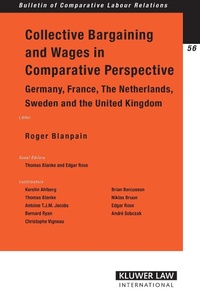
Collective Bargaining and Wages in Comparative Perspective
Germany, France, The Netherlands, Sweden and the United Kingdom
Erschienen am 1. Juli 2005
188 Seiten
978-90-411-5736-2 (ISBN)
Beschreibung

Remarkably, the core element of labour relations¿wage determination¿has been excluded from the European social dialogue about harmonisation of working conditions and national systems of social security. The present study responds by analysing the prospects of building up structures of wage formation in Europe through a reevaluation of collective bargaining and collective agreements as they exist under the law of the most industrialized Member States.
The impetus for the study is the widely debated crisis of the system of concluding regional collective agreements on wages. Social partners seem to have been trapped in fruitless conflicts on how the system must be reformed. It has become obvious that no party concerned employers, trade unions, the state has the capacity to resolve the growing difficulties of collective wage formation.
In an introductory essay by the distinguished editors, this important study takes the situation in Germany, the most prominent manifestation of this European crisis, as its starting point. Then, academic experts from France, the United Kingdom, the Netherlands, and Sweden describe comparable problems in their own countries, detail approaches to dealing with them, and provide a critical commentary, including judgements and suggestions in relation to the German case. Then follows a reexamination of the situation in Germany in the light of the experience of the other countries. A final chapter outlines some preliminary interpretations of European prospects.
Salient issues investigated include the following:
the erosion of such ideological and legal categories and concepts as `dependent work, `solidarity', `subsidiarity' and `social self-regulation' as preconditions of traditional collective bargaining structures at national level;
the decreasing membership of the bargaining partners on both sides;
the shrinking rate of employees covered by collective agreements;
attempts to establish a national social pact;
increasing competition on global markets;
decentralizing management strategies, including the abandonment of collective bargaining; and,
individualized employees.
The authors examine the various state structures to determine if the legal and institutional developments of the different national systems of collective bargaining constitute starting points for mutual learning in order to meet the new challenges. This leads to a discussion of which practices are successful in their original environment, and how these practices might adapt to other systems in other countries.
The impetus for the study is the widely debated crisis of the system of concluding regional collective agreements on wages. Social partners seem to have been trapped in fruitless conflicts on how the system must be reformed. It has become obvious that no party concerned employers, trade unions, the state has the capacity to resolve the growing difficulties of collective wage formation.
In an introductory essay by the distinguished editors, this important study takes the situation in Germany, the most prominent manifestation of this European crisis, as its starting point. Then, academic experts from France, the United Kingdom, the Netherlands, and Sweden describe comparable problems in their own countries, detail approaches to dealing with them, and provide a critical commentary, including judgements and suggestions in relation to the German case. Then follows a reexamination of the situation in Germany in the light of the experience of the other countries. A final chapter outlines some preliminary interpretations of European prospects.
Salient issues investigated include the following:
the erosion of such ideological and legal categories and concepts as `dependent work, `solidarity', `subsidiarity' and `social self-regulation' as preconditions of traditional collective bargaining structures at national level;
the decreasing membership of the bargaining partners on both sides;
the shrinking rate of employees covered by collective agreements;
attempts to establish a national social pact;
increasing competition on global markets;
decentralizing management strategies, including the abandonment of collective bargaining; and,
individualized employees.
The authors examine the various state structures to determine if the legal and institutional developments of the different national systems of collective bargaining constitute starting points for mutual learning in order to meet the new challenges. This leads to a discussion of which practices are successful in their original environment, and how these practices might adapt to other systems in other countries.
Weitere Details
Weitere Ausgaben
Andere Ausgaben
Roger Blanpain
Collective Bargaining and Wages in Comparative Perspective
Germany, France, The Netherlands, Sweden and the United Kingdom
Buch
07/2005
Kluwer Law International
251,86 €
Versand in 10-20 Tagen
Personen
Inhalt
- Cover
- Half Title Page
- Title Page
- Copyright Page
- Table of Contents
- List of Contributors
- Foreword
- Introduction: Transnational perspectives on the law of wage bargaining
- 1. Erosion or renewal? The crisis of collective wage formation in Germany
- 1. INTRODUCTION
- 2. INDUSTRIAL RELATIONS IN GERMANY
- 2.1 Duality
- 2.2 Juridification
- 2.3 Centralisation
- 2.4 Conclusion
- 3. LEGAL FRAMEWORK OF COLLECTIVE WAGE FORMATION IN GERMANY
- 3.1 Collective bargaining
- 3.2 Works council rights
- 3.3 Beyond collective wage formation
- 4. CURRENT CHALLENGES TO THE GERMAN SYSTEM
- 4.1 Megatrends
- 4.2 Declining acceptance of collective wage formation
- 5. REACTIONS OF THE STATE, SOCIAL PARTNERS, AND ENTERPRISES IN GERMANY
- 5.1 State
- 5.2 Social partners: flexibility by collective bargaining
- 5.3 Wage flexibility at the company level
- 5.4 Results
- 6. CONCLUSIONS
- REFERENCES
- 2. France: The helping hand of the state
- 1. INTRODUCTION
- 2. INDUSTRIAL RELATIONS IN FRANCE
- 2.1 The actors
- 2.2 Content
- 2.3 Legal effect
- 3. LEGAL FRAMEWORK OF COLLECTIVE WAGE FORMATION IN FRANCE
- 3.1 Collective wage formation and the favourability principle
- 3.2 Wage flexibility and principle of equal treatment
- 4. CURRENT CHALLENGES TO THE FRENCH SYSTEM
- 5. REACTIONS OF THE STATE, SOCIAL PARTNERS AND ENTERPRISES IN FRANCE
- 5.1 Changes introduced by state intervention
- 5.2 Changes due to collective bargaining
- 6. FRANCE AND GERMANY: DIFFERENCES AND SIMILARITIES IN COLLECTIVE WAGE FORMATION
- 6.1 Important differences
- 6.2 Important similarities
- 7. STRENGTHS AND VULNERABILITIES OF THE GERMAN SYSTEM FROM A FRENCH POINT OF VIEW
- 8. DECENTRALIZATION AND GROWING FLEXIBILITY IN GERMANY FROM A FRENCH POINT OF VIEW
- 9. CONCLUSIONS
- REFERENCES
- 3. The British case: before and after the decline of collective wage formation
- PART 1: THE BRITISH SYSTEM OF COLLECTIVE WAGE FORMATION
- 1. INTRODUCTION
- 2. INDUSTRIAL RELATIONS
- 3. THE LEGAL FRAMEWORK OF COLLECTIVE WAGE FORMATION
- 4. CURRENT CHALLENGES AND REACTIONS
- PART II: THE GERMAN SYSTEM OF COLLECTIVE WAGE FORMATION FROM A BRITISH PERSPECTIVE
- 5. INTRODUCTION
- 6. COMPARING THE BASIC FEATURES OF THE GERMAN AND BRITISH SYSTEMS
- 7. VULNERABILITIES AND STRENGTHS OF THE GERMAN SYSTEM FROM A BRITISH PERSPECTIVE
- 8. CHALLENGES TO THE GERMAN SYSTEM
- 9. RESPONSES TO THE CHALLENGE
- 10. COLLECTIVE WAGE FORMATION AND WAGE FLEXIBILITY
- 11. COLLECTIVE WAGE FORMATION AND SOCIETAL CONTROL
- APPENDIX
- 4. The Netherlands: In the tradition of intersectoral pacts
- 1. INTRODUCTION
- 2. THE DUTCH SYSTEM OF INDUSTRIAL RELATIONS AND COLLECTIVE WAGE FORMATION
- 2.1 The social partners
- 2.2 Works councils
- 2.3 The pattern of collective wage formation
- 2.4 Strikes
- 2.5 The system of intersectoral regulation and concertation
- 3. THE LEGAL FRAMEWORK OF COLLECTIVE WAGE FORMATION
- 3.1 Trade union law
- 3.2 Statutes on the collective agreement
- 3.3 Industrial democracy
- 3.4 The law on strikes
- 3.5 The concepts of the 'just wage' and the minimum wage
- 3.6 Equal pay
- 4. CURRENT CHALLENGES TO DUTCH COLLECTIVE WAGE DETERMINATION
- 5. REACTIONS: STATE, SOCIAL PARTNERS AND ENTERPRISES
- 6. THE NETHERLANDS AND GERMANY: DIFFERENCES AND SIMILARITIES IN THE SYSTEMS OF COLLECTIVE WAGE FORMATION
- 6.1 Similarities
- 6.2 Differences
- 7. STRENGTHS AND VULNERABILITIES OF THE GERMAN SYSTEM FROM A DUTCH POINT OF VIEW.
- 8. DECENTRALIZATION AND THE GROWING FLEXIBILITY OF THE GERMAN SYSTEM FROM A DUTCH POINT OF VIEW
- 9. CONCLUSIONS
- 5. Sweden: Transition through collective bargaining
- 1. INTRODUCTION
- 2. INDUSTRIAL RELATIONS IN SWEDEN
- 3. LEGAL FRAMEWORK OF COLLECTIVE WAGE FORMATION
- 3.1 Private law approach
- 3.2 Concept of 'just wages'
- 3.3 Legal effect of collective agreements
- 3.4 Enforcement of collective agreements
- 4. CURRENT CHALLENGES
- 5. REACTIONS OF THE STATE, SOCIAL PARTNERS AND ENTERPRISES
- 5.1 State intervention
- 5.2 Changes in the organization and procedure of bargaining
- 5.3 Changes in the contents of collective agreements
- 5.4 The Agreement between the Swedish Metalworkers' Union and the Swedish Association of Engineering Employers
- 5.5 The Agreement between the Municipal Workers' Union and the Swedish Association of Local Authorities
- 5.6 Effects of decentralization
- 5.7 Fundamental change in contents but not in form
- 6. SWEDEN AND GERMANY: DIFFERENCES AND SIMILARITIES IN THEIR SYSTEMS OF COLLECTIVE WAGE FORMATION FROM A SWEDISH PERSPECTIVE
- 7. STRENGTHS AND VULNERABILITIES OF THE GERMAN SYSTEM FROM A SWEDISH POINT OF VIEW
- 8. DECENTRALIZATION AND GROWING FLEXIBILITY OF THE GERMAN SYSTEM FROM A SWEDISH POINT OF VIEW
- 9. CONCLUSIONS
- 6. Ideas and suggestions Input for the German debate
- 1. INTRODUCTION
- 2. FRANCE
- 3. NETHERLANDS
- 4. UNITED KINGDOM
- 5. SWEDEN
- 6. RESULTS
- 7. FINAL EVALUATION
- REFERENCES
- 7. Outlook - Chances of European harmonization or coordination of collective wage formation
- 1. INTRODUCTION: EUROPE NEEDS A SOCIAL POLICY INCLUDING TRANSNATIONAL WAGE POLICIES
- 2. TENDENCIES OF CONVERGENCE
- 3. TRANSNATIONAL COORDINATION OF WAGE POLICIES
- 4. EUROPEAN SOCIAL DIALOGUE
- 5. A CONSTITUTION FOR EUROPE
- 6. THE OPEN METHOD OF COORDINATION
- REFERENCES
- Annex
- Back Cover
