

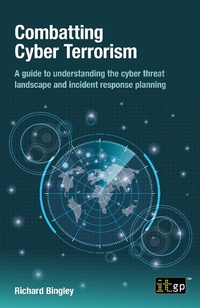
Combatting Cyber Terrorism
A guide to understanding the cyber threat landscape and incident response planning
1. Auflage
Erschienen am 9. Mai 2024
315 Seiten
978-1-78778-521-2 (ISBN)
Beschreibung

In his second book with IT Governance Publishing, Richard Bingley's Combatting Cyber Terrorism - A guide to understanding the cyber threat landscape and incident response planning analyses the evolution of cyber terrorism and what organisations can do to mitigate this threat.
This book discusses:
Definitions of cyber terrorism;
Ideologies and idealisations that can lead to cyber terrorism;
How threat actors use computer systems to diversify, complicate and increase terrorist attack impacts;
The role of Big Tech and social media organisations such as X (formerly Twitter) and Instagram within the cyber threat landscape; and
How organisations can prepare for acts of cyber terrorism via security planning and incident response strategies such as ISO 31000, ISO 27001 and the NIST Cybersecurity Framework.
Increasingly, cyber security practitioners are confronted with a stark phrase: cyber terrorism. For many, it conveys fear and hopelessness. What is this thing called 'cyber terrorism' and what can we begin to do about it?
Malicious-minded ICT users, programmers and even programs (including much AI-powered software) have all been instrumental in recruiting, inspiring, training, executing and amplifying acts of terrorism. This has resulted in the loss of life and/or life-changing physical injuries that could never have occurred without support and facilitation from the cyber sphere. These types of attacks can be encapsulated by the phrase 'cyber terrorism'.
This book recounts case studies to show the types of threats we face and provides a comprehensive coverage of risk management tactics and strategies to protect yourself against such nefarious threat actors. These include key mitigation and controls for information security or security and HR-related professionals.
This book discusses:
Definitions of cyber terrorism;
Ideologies and idealisations that can lead to cyber terrorism;
How threat actors use computer systems to diversify, complicate and increase terrorist attack impacts;
The role of Big Tech and social media organisations such as X (formerly Twitter) and Instagram within the cyber threat landscape; and
How organisations can prepare for acts of cyber terrorism via security planning and incident response strategies such as ISO 31000, ISO 27001 and the NIST Cybersecurity Framework.
Increasingly, cyber security practitioners are confronted with a stark phrase: cyber terrorism. For many, it conveys fear and hopelessness. What is this thing called 'cyber terrorism' and what can we begin to do about it?
Malicious-minded ICT users, programmers and even programs (including much AI-powered software) have all been instrumental in recruiting, inspiring, training, executing and amplifying acts of terrorism. This has resulted in the loss of life and/or life-changing physical injuries that could never have occurred without support and facilitation from the cyber sphere. These types of attacks can be encapsulated by the phrase 'cyber terrorism'.
This book recounts case studies to show the types of threats we face and provides a comprehensive coverage of risk management tactics and strategies to protect yourself against such nefarious threat actors. These include key mitigation and controls for information security or security and HR-related professionals.
Weitere Details
Sprache
Englisch
Verlagsort
Ely
Großbritannien
Zielgruppe
Für Beruf und Forschung
Editions-Typ
Digitale Ausgabe
Dateigröße
1,49 MB
ISBN-13
978-1-78778-521-2 (9781787785212)
Copyright in bibliographic data and cover images is held by Nielsen Book Services Limited or by the publishers or by their respective licensors: all rights reserved.
Schweitzer Klassifikation
Weitere Ausgaben
Andere Ausgaben
Richard Bingley
Combatting Cyber Terrorism
A guide to understanding the cyber threat landscape and incident response planning
Buch
05/2024
IT Governance Publishing
46,50 €
Versand in 10-20 Tagen
Richard Bingley
Combatting Cyber Terrorism
A guide to understanding the cyber threat landscape and incident response planning
E-Book
05/2024
1. Auflage
IT Governance Publishing
34,95 €
Als Download verfügbar
Personen
Richard Bingley has led and operated a number of vital security projects including the London 2012 Olympics and Sochi 2014, as well as serving as executive director of London First's security and resilience division. He's the co-founder and director of the business security briefing service CSARN.org.
His book publications to date include:
The Security Consultant's Handbook (ITGP: 2015);
Terrorism: Just the Facts (Heinemann: 2003); and
Arms Trade: Just the Facts (Heinemann: 2003).
Richard was senior lecturer for security and resilience at Buckinghamshire New University (2012-15) and director of the BNU Business School. He is CEO and principal of the CSARN Global Cyber Academy and a frequent media commentator on cyber security and future technology issues, including recently for the London Evening Standard and Sunday Express.
His book publications to date include:
The Security Consultant's Handbook (ITGP: 2015);
Terrorism: Just the Facts (Heinemann: 2003); and
Arms Trade: Just the Facts (Heinemann: 2003).
Richard was senior lecturer for security and resilience at Buckinghamshire New University (2012-15) and director of the BNU Business School. He is CEO and principal of the CSARN Global Cyber Academy and a frequent media commentator on cyber security and future technology issues, including recently for the London Evening Standard and Sunday Express.
Inhalt
Chapter 1: Introduction
Chapter 2: Cyber terrorism - Ideologies and idealisations
Chapter 3: Role of social media organisations
Chapter 4: Business, infrastructure and advanced technologies
Chapter 5: Security planning and incident response
Chapter 6: Concluding remarks
Further reading
Chapter 2: Cyber terrorism - Ideologies and idealisations
Chapter 3: Role of social media organisations
Chapter 4: Business, infrastructure and advanced technologies
Chapter 5: Security planning and incident response
Chapter 6: Concluding remarks
Further reading
