

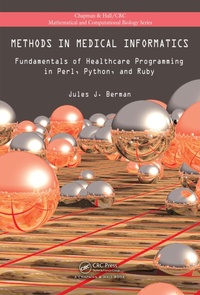
Methods in Medical Informatics
Fundamentals of Healthcare Programming in Perl, Python, and Ruby
1. Auflage
Erschienen am 22. September 2010
413 Seiten
978-1-4398-4184-6 (ISBN)
Beschreibung

Too often, healthcare workers are led to believe that medical informatics is a complex field that can only be mastered by teams of professional programmers. This is simply not the case. With just a few dozen simple algorithms, easily implemented with open source programming languages, you can fully utilize the medical information contained in clini
Rezensionen / Stimmen
As subspecialty board certification in clinical informatics has finally become a reality, Jules Berman's Methods in Medical Informatics could not be more timely. This well-written and informative text combines Dr. Berman's expertise in programming with his vast knowledge of publicly available data sets and everyday healthcare programming needs to result in a book which ... should become a staple in health informatics education programs as well as a standard addition to the personal libraries of informaticists.-Alexis B. Carter, Journal of Pathology Informatics, October 2011
This book provides an introduction to processing clinical and population health data using rigorous methods and widely available, low cost, but very capable tools. The inclusion of the three leading dynamic programming languages broadens the appeal ... bridges the gap from programming instruction to dealing with specialized medical data, making it possible to teach a relevant programming course in a biomedical environment. I would have loved to have a copy of this when I was teaching introductory programming for medical informatics.
-Professor James H. Harrison, Jr., Director of Clinical Informatics, University of Virginia
... presents students and professionals in the healthcare field (who have some working knowledge of the open-source programming languages Perl, Python, or Ruby) with instruction for applying basic informatics algorithms to medical data sets. He [the author] provides algorithm scripts for each of the languages, along with step-by-step explanations of the algorithms used for retrieving, organizing, merging, and analyzing such data sources as the National Cancer Institute's Surveillance Epidemiology and End Results project, the National Library of Medicine's PubMed service, the mortality records of the US Centers for Disease Control and Prevention, the US Census, and the Online Mendelian Inheritance in Man data set on inherited conditions.
-SciTech Book News, February 2011
Weitere Details
Reihe
Auflage
1. Auflage
Sprache
Englisch
Verlagsort
London
Großbritannien
Verlagsgruppe
Taylor & Francis Ltd
Zielgruppe
Für Beruf und Forschung
Biomedical researchers, healthcare informaticians, policy makers and regulators, and other professionals involved in healthcare.
Dateigröße
8,97 MB
ISBN-13
978-1-4398-4184-6 (9781439841846)
Copyright in bibliographic data and cover images is held by Nielsen Book Services Limited or by the publishers or by their respective licensors: all rights reserved.
Schweitzer Klassifikation
Weitere Ausgaben
Andere Ausgaben
Jules J. Berman
Methods in Medical Informatics
Fundamentals of Healthcare Programming in Perl, Python, and Ruby
Buch
09/2018
1. Auflage
CRC Press
99,00 €
Versand in 10-20 Tagen
Jules J. Berman
Methods in Medical Informatics
Fundamentals of Healthcare Programming in Perl, Python, and Ruby
Buch
09/2010
1. Auflage
Chapman & Hall/CRC
260,90 €
Versand in 15-20 Tagen
Person
Jules Berman, Ph.D., M.D., received two bachelor of science degrees (mathematics and earth sciences) from MIT, a Ph.D. in pathology from Temple University, and an M.D. from the University of Miami School of Medicine. His postdoctoral research was conducted at the National Cancer Institute. His medical residence in pathology was completed at the George Washington University School of Medicine. He became board certified in anatomic pathology and in cytopathology, and served as the chief of Anatomic Pathology, Surgical Pathology and Cytopathology at the Veterans Administration (VA) Medical Center in Baltimore, Maryland.
While at the Baltimore VA, Dr. Berman held appointments at the University of Maryland Medical Center and at theJohns Hopkins Medical Institutions. In 1998, he became the program director for pathology informatics in the Cancer Diagnosis Program at the U.S. National Cancer Institute. In 2006, he became president of the Association for Pathology Informatics. Over the course of his career, he has written, as first author, more than 100 publications, including five books in the field of medical informatics. Today, Dr. Berman is a full-time freelance writer.
While at the Baltimore VA, Dr. Berman held appointments at the University of Maryland Medical Center and at theJohns Hopkins Medical Institutions. In 1998, he became the program director for pathology informatics in the Cancer Diagnosis Program at the U.S. National Cancer Institute. In 2006, he became president of the Association for Pathology Informatics. Over the course of his career, he has written, as first author, more than 100 publications, including five books in the field of medical informatics. Today, Dr. Berman is a full-time freelance writer.
Inhalt
FUNDAMENTAL ALGORITHMS AND METHODS OF MEDICAL INFORMATICS: Parsing and Transforming Text Files. Utility Scripts. Viewing and Modifying Images. MEDICAL DATA RESOURCES: The National Library of Medicine's Medical Subject Headings (MeSH ). The International Classification of Diseases. SEER: The Cancer Surveillance, Epidemiology, and End Results Program. OMIM: The Online Mendelian Inheritance in Man. PubMed. Taxonomy. Developmental Lineage Classification and Taxonomyof Neoplasms. U.S. Census Files. Centers for Disease Control and Prevention Mortality Files. PRIMARY TASKS OF MEDICAL INFORMATICS: Autocoding. Text Scrubber for Deidentifyin g Confidential Text. Web Pages and CGI Scripts. Image Annotation. Describing Data with Data, Using XML. MEDICAL DISCOVERY: Case Study: Emphysema Rates. Case Study: Cancer Occurrence Rates. Case Study: Germ Cell Tumor Rates across Ethnicities. Case Study: Ranking the Death-Certifying Process, by State. Case Study: Data Mashups for Epidemics. Case Study: Sickle Cell Rates. Case Study: Site-Specific Tumor Biology. Case Study: Bimodal Tumors. Case Study: The Age of Occurrence of Precancers. . Appendix. How to Acquire Ruby. How to Acquire Perl. How to Acquire Python. How to Acquire RMagick. How to Acquire SQLite. How to Acquire the Public Data Files Used in This Book. Other Publicly Available Files, Data Sets, and Utilities.
