

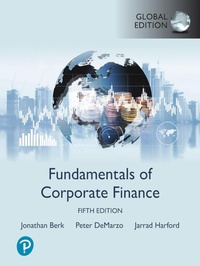
Fundamentals of Corporate Finance, Global Edition
Global Edition
5. Auflage
Erschienen am 10. Februar 2022
801 Seiten
978-1-292-43714-9 (ISBN)
Beschreibung

For undergraduate courses in corporate finance or financial management.
Help students practice and connect to real-world financial decisions
Fundamentals of Corporate Finance offers a practical introduction to modern-day core principles, arming students with a problem-solving methodology, real-life financial management practices, and an overarching valuation framework that they can apply in their future careers. Updated with new data, examples, and exercises, the 5th Edition gives students the opportunity to practice and apply course concepts, while connecting them to the latest financial issues and policy in today's world of business.
Also available with MyLab Finance
By combining trusted author content with digital tools and a flexible platform, MyLab personalizes the learning experience and improves results for each student.
Help students practice and connect to real-world financial decisions
Fundamentals of Corporate Finance offers a practical introduction to modern-day core principles, arming students with a problem-solving methodology, real-life financial management practices, and an overarching valuation framework that they can apply in their future careers. Updated with new data, examples, and exercises, the 5th Edition gives students the opportunity to practice and apply course concepts, while connecting them to the latest financial issues and policy in today's world of business.
Also available with MyLab Finance
By combining trusted author content with digital tools and a flexible platform, MyLab personalizes the learning experience and improves results for each student.
Weitere Details
Auflage
5th edition
Sprache
Englisch
Verlagsort
Harlow
Großbritannien
Zielgruppe
Für höhere Schule und Studium
Dateigröße
23,80 MB
ISBN-13
978-1-292-43714-9 (9781292437149)
Copyright in bibliographic data and cover images is held by Nielsen Book Services Limited or by the publishers or by their respective licensors: all rights reserved.
Schweitzer Klassifikation
Weitere Ausgaben
Nachauflagen

Jonathan Berk | Peter DeMarzo | Jarrad Harford
Fundamentals of Corporate Finance, Global Edition
E-Book
09/2024
6. Auflage
Pearson Education Limited
58,99 €
Als Download verfügbar
Andere Ausgaben
Jonathan Berk | Peter DeMarzo | Jarrad Harford
Fundamentals of Corporate Finance
Buch
03/2022
5. Auflage
Pearson Education Limited
80,24 €
Versand in 10-20 Tagen
Personen
About our authors Jonathan Berk, Stanford University, is the A.P. Giannini Professor of Finance at the Graduate School of Business, Stanford University and is a Research Associate at the National Bureau of Economic Research. Prior to earning his PhD, he worked as an Associate at Goldman Sachs (where his education in finance really began). Professor Berk's research interests in finance include corporate valuation, capital structure, mutual funds, asset pricing, experimental economics and labor economics.
Peter DeMarzo, Stanford University, is the Mizuho Financial Group Professor of Finance and former Senior Associate Dean for Academic Affairs at the Stanford Graduate School of Business. He is also a Research Associate at the National Bureau of Economic Research. He currently teaches MBA and PhD courses in corporate finance and financial modeling. In addition to his experience at the Stanford Graduate School of Business, Professor DeMarzo has taught at the Haas School of Business and the Kellogg Graduate School of Management, and he was a National Fellow at the Hoover Institution.
Jarrad Harford, University of Washington, is the Marion B. Ingersoll Professor of Finance at the University of Washington. Prior to Washington, Professor Harford taught at the Lundquist College of Business at the University of Oregon. He received his PhD in Finance with a minor in Organizations and Markets from the University of Rochester. Harford has taught the core undergraduate finance course, Business Finance, for over 16 years, as well as an elective in mergers and acquisitions, and "Finance for Non-financial Executives" in the executive education program.
Peter DeMarzo, Stanford University, is the Mizuho Financial Group Professor of Finance and former Senior Associate Dean for Academic Affairs at the Stanford Graduate School of Business. He is also a Research Associate at the National Bureau of Economic Research. He currently teaches MBA and PhD courses in corporate finance and financial modeling. In addition to his experience at the Stanford Graduate School of Business, Professor DeMarzo has taught at the Haas School of Business and the Kellogg Graduate School of Management, and he was a National Fellow at the Hoover Institution.
Jarrad Harford, University of Washington, is the Marion B. Ingersoll Professor of Finance at the University of Washington. Prior to Washington, Professor Harford taught at the Lundquist College of Business at the University of Oregon. He received his PhD in Finance with a minor in Organizations and Markets from the University of Rochester. Harford has taught the core undergraduate finance course, Business Finance, for over 16 years, as well as an elective in mergers and acquisitions, and "Finance for Non-financial Executives" in the executive education program.
Inhalt
PART 1: INTRODUCTION
Corporate Finance and the Financial Manager
Introduction to Financial Statement Analysis
PART 2: INTEREST RATES AND VALUING CASH FLOWS
Time Value of Money: An Introduction
Time Value of Money: Valuing Cash Flow Streams
Interest Rates
Bonds
Stock Valuation
PART 3: VALUATION AND THE FIRM
Investment Decision Rules
Fundamentals of Capital Budgeting
Stock Valuation: A Second Look
PART 4: RISK AND RETURN
Risk and Return in Capital Markets
Systematic Risk and the Equity Risk Premium
The Cost of Capital
PART 5: LONG-TERM FINANCING
Raising Equity Capital
Debt Financing
PART 6: CAPITAL STRUCTURE AND PAYOUT POLICY
Capital Structure
Payout Policy
PART 7: FINANCIAL PLANNING AND FORECASTING
Financial Modeling and Pro Forma Analysis
Working Capital Management
Short-Term Financial Planning
PART 8: SPECIAL TOPICS
Option Applications and Corporate Finance
Mergers and Acquisitions
International Corporate Finance
CHAPTERS ON THE WEB
Leasing
Insurance and Risk Management
Corporate Governance
Corporate Finance and the Financial Manager
Introduction to Financial Statement Analysis
PART 2: INTEREST RATES AND VALUING CASH FLOWS
Time Value of Money: An Introduction
Time Value of Money: Valuing Cash Flow Streams
Interest Rates
Bonds
Stock Valuation
PART 3: VALUATION AND THE FIRM
Investment Decision Rules
Fundamentals of Capital Budgeting
Stock Valuation: A Second Look
PART 4: RISK AND RETURN
Risk and Return in Capital Markets
Systematic Risk and the Equity Risk Premium
The Cost of Capital
PART 5: LONG-TERM FINANCING
Raising Equity Capital
Debt Financing
PART 6: CAPITAL STRUCTURE AND PAYOUT POLICY
Capital Structure
Payout Policy
PART 7: FINANCIAL PLANNING AND FORECASTING
Financial Modeling and Pro Forma Analysis
Working Capital Management
Short-Term Financial Planning
PART 8: SPECIAL TOPICS
Option Applications and Corporate Finance
Mergers and Acquisitions
International Corporate Finance
CHAPTERS ON THE WEB
Leasing
Insurance and Risk Management
Corporate Governance
