

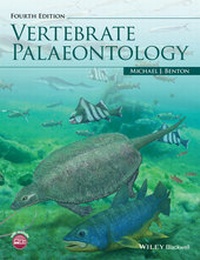
Vertebrate Palaeontology
Beschreibung

Rezensionen / Stimmen
"The book is a main textbook for vertebrate palaeontology and aimed at students and anyone with an interest in the evolution of vertebrates. It meets its five aims and is excellent value." (Proceedings of the Open University Geological Society, 1 April 2015)Weitere Details
Weitere Ausgaben
Andere Ausgaben
Person
Inhalt
Preface x
About the companion website xii
1 Vertebrates Originate 1
Key questions in this chapter 2
Introduction 2
1.1 Sea squirts and the lancelet 2
1.2 Ambulacraria: echinoderms and hemichordates 4
1.3 Deuterostome relationships 6
1.4 Chordate origins 8
1.5 Vertebrates and the head 14
1.6 Further reading 14
Questions for future research 15
1.7 References 15
2 How to Study Fossil Vertebrates 18
Key questions in this chapter 19
Introduction 19
2.1 Digging up bones 19
2.2 Publication and professionalism 24
2.3 Geology and fossil vertebrates 29
2.4 Biology and fossil vertebrates 33
2.5 Discovering phylogeny 36
2.6 The quality of the fossil record 39
2.7 Macroevolution 41
2.8 Further reading 43
2.9 References 43
3 Early palaeozoic fishes 45
Key questions in this chapter 46
Introduction 46
3.1 cambrian vertebrates 46
3.2 vertebrate hard tissues 49
3.3 the jawless fishes 51
3.4 origin of jaws and gnathostome relationships 59
3.5 placoderms: armour-plated monsters 60
3.6 chondrichthyes: the first sharks 65
3.7 acanthodians: the 'spiny skins' 65
3.8 devonian environments 67
3.9 osteichthyes: the bony fishes 70
3.10 early fish evolution and mass extinction 79
3.11 further reading 79
Questions for future research 80
3.12 References 80
4 Early tetrapods and amphibians 84
Key questions in this chapter 85
Introduction 85
4.1 Problems of life on land 85
4.2 Devonian tetrapods 88
4.3 The Carboniferous world 96
4.4 Diversity of Carboniferous tetrapods 98
4.5 Temnospondyls and reptiliomorphs after the Carboniferous 106
4.6 E volution of the modern amphibians 109
4.7 Further reading 114
Questions for future research 114
4.8 References 114
5 Evolution of early amniotes 118
Key questions in this chapter 119
Introduction 119
5.1 Hylonomus and Paleothyris - biology of the first amniotes 119
5.2 Amniote evolution 121
5.3 The Permian world 125
5.4 The parareptiles 125
5.5 The eureptiles 128
5.6 Basal synapsid evolution 132
5.7 The Permo-Triassic mass extinction 142
5.8 Further reading 143
Questions for future research 143
5.9 References 143
6 Bounceback: tetrapods of the Triassic 147
Key questions in this chapter 148
Introduction 148
6.1 The Triassic world and its effect on the recovery of life 148
6.2 Triassic marine reptiles 150
6.3 E volution of the archosauromorphs 154
6.4 O rigin of the dinosaurs 161
6.5 Reptile evolution in the Triassic 164
6.6 Further reading 168
Questions for future research 168
6.7 References 168
7 Evolution of fishes after the devonian 172
Key questions in this chapter 173
Introduction 173
7.1 The early sharks and chimaeras 173
7.2 Post-Palaeozoic chondrichthyan radiation 178
7.3 The early bony fishes 181
7.4 Radiation of the teleosts 191
7.5 Post-Devonian evolution of fishes 198
7.6 Further reading 199
Questions for future research 199
7.7 References 199
8 The age of dinosaurs 204
Key questions in this chapter 205
Introduction 205
8.1 Biology of Plateosaurus 205
8.2 The Jurassic and Cretaceous world 206
8.3 The diversity of saurischian dinosaurs 207
8.4 The diversity of ornithischian dinosaurs 221
8.5 Were the dinosaurs warm-blooded or not? 232
8.6 Pterosauria 236
8.7 Testudinata: the turtles 241
8.8 Crocodylomorpha 247
8.9 Lepidosauria: lizards and snakes 250
8.10 The great sea dragons 256
8.11 The Cretaceous-Paleogene mass extinction 259
8.12 Further reading 263
Questions for future research 264
8.13 References 264
9 The birds 273
Key questions in this chapter 274
Introduction 274
9.1 The origin of birds 274
9.2 The origin of bird flight 282
9.3 Cretaceous birds, with and without teeth 287
9.4 The radiation of modern birds: explosion or long fuse? 296
9.5 Flightless birds: palaeognathae 299
9.6 Neognathae 300
9.7 The three-phase diversification of birds 311
9.8 Further reading 312
Questions for future research 313
9.9 References 313
10 Mammals 318
Key questions in this chapter 319
Introduction 319
10.1 Cynodonts and the acquisition of mammalian characters 319
10.2 The first mammals 328
10.3 The Mesozoic mammals 332
10.4 Evolution of modern mammals 343
10.5 Marsupials down under 346
10.6 South American mammals - a world apart 349
10.7 Afrotheria and the break-up of Gondwana 355
10.8 Boreoeutherian beginnings: the Palaeocene in the northern hemisphere 361
10.9 Basal laurasiatherians: Lipotyphla 366
10.10 Cetartiodactyla: cattle, pigs and whales 366
10.11 Pegasoferae: bats, horses, carnivores and pangolins 375
10.12 Glires: rodents, rabbits and relatives 383
10.13 Archonta: primates, tree shrews and flying lemurs 388
10.14 Ice age extinction of large mammals 389
10.15 Further reading 390
Questions for future research 390
10.16 References 391
11 Human evolution 400
Key questions in this chapter 401
Introduction 401
11.1 What are the primates? 401
11.2 The fossil record of early primates 402
11.3 Anthropoidea: monkeys and apes 407
11.4 Hominoidea: the apes 411
11.5 E volution of human characteristics 414
11.6 The early stages of human evolution 416
11.7 The past two million years of human evolution 421
11.8 Further reading 428
Questions for future research 428
11.9 References 429
Appendix: Classification of the vertebrates 433
Glossary 448
Index 453
The colour plate section can be found between pp. 244-245
Preface
To many, palaeontology in general, and vertebrate palaeontology in particular, might be seen as devoted to discovering new fossils. After all, we read lavish press reports of each new species of dinosaur, fossil bird, or early human fossil that is recorded in the scientific literature. Discoveries from all continents attract attention, and none moreso than the continuing rich haul of remarkable new fossils from China. Our understanding of fossil vertebrate evolution has been much enriched by continuing discoveries of basal chordates from the Chengjiang and associated exceptional faunas of South China, as well as the feathered birds and dinosaurs from the Jehol assemblages in North China. But, as any young palaeobiologist knows, the discovery of new species is a minor concern. Much more exciting has been the blossoming of new numerical techniques that extend the reach of studies in macroevolution and palaeobiology further than might have been imagined even ten years ago.
When I wrote the first edition of this book in 1989, I felt that there was a need for an up-to-date account of what is known about the history of vertebrates, but also for a thorough phylogenetic framework throughout, then something of a novelty. The first edition was published in 1990. The second edition, substantially modified, appeared in 1997, and the third, further extensively rewritten in 2005. These new editions offered extensive coverage of new discoveries and new interpretations through the previous 15 years. Between 1990 and 2005, the book hopped from publisher to publisher: it was commissioned by Unwin Hyman, who were soon after acquired by Harper Collins, and their science list was in turn acquired by Chapman & Hall, so the first edition appeared under three publishers’ logos, in 1990, 1991 and 1995. The second edition appeared with Chapman & Hall, but they were then taken over by Kluwer, and this book was marketed by their Stanley Thornes subsidiary for a while, before passing to Blackwell Science in 2000, which is now part of the larger John Wiley & Sons consortium. I hope these wandering days are now over.
The first edition appeared in Spanish in 1995 (Paleontología y evolución de los vertebrados, Edition Perfils, Lleida), the second in Italian in 2000 (Paleontologia dei Vertebrati, Franco Lucisano Editore, Milano), and the third in German in 2007 (Paläontologie der Wirbeltiere, Dr Friedrich Pfeil, München). This is a measure of the international appeal of vertebrate palaeontology and the demand from students and instructors for up-to-date information.
The story of the evolution of the vertebrates, the animals with backbones, is fascinating. There is currently an explosion of new research ideas in the field concerning all the major evolutionary transitions, the origin of the vertebrates, dramatic new fish specimens unlike anything now living, adaptations to life on land, the origin and radiation of dinosaurs and Mesozoic marine reptiles, the evolution and palaeobiology of dinosaurs, the role of mass extinctions in vertebrate evolution, the origin and diversification of birds, the earliest mammals, ecology and mammalian diversification, the Paleogene radiation of modern mammalian clades, reconciling morphological and molecular evidence on bird and mammal evolution,and the origins and evolution of human beings.
I have five aims in writing this book. First, I want to present a readable narrative of the history of the vertebrates that is accessible to everyone, with either a professional or an amateur interest in the subject. The book broadly follows the time-sequence of major events in the sea and on land, so that it can be read as a continuous narrative, or individual chapters may be read on their own. I have tried to show the adaptations of all major extinct groups, both in words and in images.
The second aim is to highlight major evolutionary anatomical changes among vertebrate groups. This book is not a classic anatomy text and there is no space to give a complete account of all aspects of the hard-part and soft-part anatomy of the major groups. However, I have selected certain evolutionary anatomical topics, such as the vertebrate brain, tetrapod vertebral evolution, posture and gait in archosaurs, and endothermy in mammals, to present an overview of current thinking, including evolutionary and developmental aspects, where appropriate.
The third aim is to show how palaeobiological information is obtained. It is important to understand the methods and debates, and not simply to assume that all knowledge is fixed and immutable. Further, science is about testing hypotheses against evidence, not about who shouts loudest, and it is important to realize that even historical sciences such as palaeontology, can work through hypothesis testing. Science is not all mathematics or chemistry! To do this, I summarize in Chapter 2 the methods used by vertebrate palaeontologists in collecting and preparing the fossils, in using them to learn about ancient environments, biomechanics and palaeobiology, and as evidence for discovering parts of the great evolutionary tree of life. Then, throughout the text, I present box features that are divided into three categories: tree of life controversies (deuterostome relationships, jawless fishes, osteichthyans, sarcopterygians, basal tetrapods, amniotes, dinosaurs and the origin of birds, molecular information on mammalian phylogeny, hominin relationships), exceptional fossils or faunas (new exceptionally preserved basal chordates from China, a rich fossil deposit of early tetrapods, exceptional fishes and marine reptiles from the Triassic of China, dramatic new discoveries of Cretaceous birds, fossil mammals with hair, new basal humans from Africa, the Flores ‘hobbit’) and palaeobiology of selected unusual ancient vertebrates (limb mechanics of the first tetrapods, jaw action and diet of dicynodonts, archosaur locomotion, hadrosaur chewing adaptations, locomotion of the largest pterosaurs, giant penguins, horse-eating birds, rodents as large as rhinos).
The fourth aim is to survey the present state of discovery of the tree of life of vertebrates. The cladograms are set apart from the body of the text and comprehensive lists of the key diagnostic characters are given. In some cases, there are controversies among palaeontologists, or between the morphological and the molecular results, and these are explored. In many cases it was a difficult task to represent current views fairly, yet incisively. Some parts of the tree appear to have been relatively stable for ten years or more, whereas others are changing rapidly – these aspects are indicated. The cladograms throughout the book may be linked to provide an overview of the vertebrate tree of life, and this is replicated in the classification (Appendix 1).
The fifth aim, which has always been embedded in earlier editions, is to highlight career development for aspiring palaeontologists. This is done partly by the emphasis on method: the young palaeontologist, progressing through Bachelors, Masters, and Doctoral degrees, must keep an open and enquiring mind. Learning in detail about the occurrence, anatomy, systematics, and function of a particular group of sharks, dinosaurs, or rodents is clearly crucial, as ever, but now the enthusiastic student must also master reasonably advanced numerical protocols in phylogenetic, macroevolutionary, palaeoecological, taphonomic, or biomechanical analysis. Interdisciplinarity is key. The message about career development is stressed also by the choice of current research highlights in the box features: many of these are based on recent publications by young researchers.
I am indebted to many people. I thank †Roger Jones and Clem Earle of Unwin Hyman who commissioned the first edition 25 years ago, Ward Cooper of Chapman & Hall who steered the second edition through, and Ian Francis and Delia Sandford who worked hard on the third edition. The following people read parts of the first, second, and third editions, or made other valuable contributions: Dick Aldridge, Peter Andrews, Kenneth Angielczyk, David Archibald, Chris Beard, David Berman, Derek Briggs, Henri Cappetta, Bob Carroll, Luis Chiappe, Jenny Clack, Mike Coates, Liz Cook, Joel Cracraft, Eric Delson, David Dineley, Phil Donoghue, Gareth Dyke, Andrzej Elzanowski, Susan Evans, Jens Franzen, Nick Fraser, Brian Gardiner, Alan Gentry, David Gower, Lance Grande, †Bev Halstead, †Jim Hopson, Axel Hungerbühler, Christine Janis, Philippe Janvier, Dick Jefferies, Tom Kemp, Zofia Kielan-Jaworowska, Gillian King, Jürgen Kriwet, Adrian Lister, Liz Loeffler, Luo Zhe-Xi, John Maisey, Andrew Milner, Sean Modesto, Kevin Padian, †Alec Panchen, Mike Parrish, †Colin Patterson, Kevin Peterson, Mark Purnell, Jeremy Rayner, Robert Reisz, Olivier Rieppel, Bruce Rubidge, †Bob Savage, Paul Sereno, Glen Storrs, Chris Stringer, Pascal Tassy, Mike Taylor, Nigel Trewin, David Unwin, †Cyril Walker, Peter Wellnhofer, Bernard Wood, and Adam Yates. For the fourth edition, I thank Phil Anderson, Chris Beard, Roger Benson, Donald Benton, Martin Brazeau, Steve Brusatte, Richard Butler, Brian Choo, Jenny Clack, Ted Daeschler, Brian Davis, Phil Donoghue, Greg Edgecombe, Susan Evans, Valentin Fischer, Matt Friedman, Jörg Fröbisch, Keqin Gao, David Hone, Christine Janis, Gerald Mayr, Johannes Müller, Jingmai O’Connor, Davide Pisani, Emily Rayfield, Lauren Sallan, Rob Sansom, Rainer Schoch, Koen Stein, Ian Tattersall,...
