

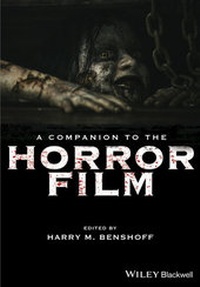
A Companion to the Horror Film
Erschienen am 31. Juli 2014
608 Seiten
978-1-118-88349-5 (ISBN)
Beschreibung

This cutting-edge collection features original essays by eminent scholars on one of cinema's most dynamic and enduringly popular genres, covering everything from the history of horror movies to the latest critical approaches.
* Contributors include many of the finest academics working in the field, as well as exciting younger scholars
* Varied and comprehensive coverage, from the history of horror to broader issues of censorship, gender, and sexuality
* Covers both English-language and non-English horror film traditions
* Key topics include horror film aesthetics, theoretical approaches, distribution, art house cinema, ethnographic surrealism, and horror's relation to documentary film practice
* A thorough treatment of this dynamic film genre suited to scholars and enthusiasts alike
Rezensionen / Stimmen
"Historically comprehensive while refreshingly up-to-date, HarryM. Benshoff's A Companion to the Horror Film provides amuch-needed, state-of-the-art overview of an endlessly mutatinggenre and its ever-evolving criticism. A must-have volume for anypopular culture studies bookshelf." David J. Skal, author of The Monster Show: A CulturalHistory of Horror "Benshoff's Companion, like his previouswork, is an all encompassing look at the changing definition ofhorror and inclusive of cult and camp's greatest hits. A newmust-have for theory-goers!" Jeffrey Schwarz, Director of I Am Divine, Vitoand Spine Tingler! The William Castle StoryWeitere Details
Weitere Ausgaben
Andere Ausgaben
Harry M. Benshoff
A Companion to the Horror Film
Buch
12/2016
1. Auflage
Wiley
56,50 €
Versand in 15-20 Tagen

HM Benshoff
A Companion to the Horror Film
Software
01/2015
Wiley
99,18 €
Vom Verlag/Hersteller zurückgezogen
Harry M. Benshoff
A Companion to the Horror Film
Buch
09/2014
Wiley
Preis leider unbekannt
Artikel ist vergriffen; siehe Neuauflage
HM Benshoff
A Companion to the Horror Film
Software
08/2014
Wiley
85,99 €
Keine Lieferinformation verfügbar
Person
Harry M. Benshoff is Professor of Radio, TV, and Film at theUniversity of North Texas, USA. His research interests includetopics in film genre, film history, film theory, andmulticulturalism. The author of several books on cinema, he is bestknown for work that explores sexuality in relation to the horrorfilm, including Monsters in the Closet: Homosexuality and theHorror Film (1997). He is also co-author of QueerImages: A History of Gay and Lesbian Film in America (2006),and America on Film: Representing Race, Class, Gender, andSexuality at the Movies, Second edition (Wiley Blackwell,2009).
Inhalt
Notes on Contributors viii
Preface xiii
Part I Approaches and Contexts 1
1 Cognitive and Philosophical Approaches to Horror 3
Aaron Smuts
2 Horror and Psychoanalysis: An Introductory Primer 21
Chris Dumas
3 Gender and Sexuality Haunt the Horror Film 38
Daniel Humphrey
4 The Horror Film as Social Allegory (And How it Comes Undone) 56
Christopher Sharrett
5 Avenging the Body: Disability in the Horror Film 73
Travis Sutton
6 Horror Reception/Audiences 90
Matt Hills
7 A's, B's, Quickies, Orphans, and Nasties: Horror Films in the Context of Distribution and Exhibition 109
Kevin Heffernan
8 Horror and the Censors 130
Julian Petley
Part II The Form of Horror 149
9 Carl Dreyer's Corpse: Horror Film Atmosphere and Narrative 151
Robert Spadoni
10 Horror Sound Design 168
William Whittington
11 Mellifluous Terror:The Discourse of Music and Horror Films 186
Joe Tompkins
Part III A History of the (Western) Horror Film 205
12 Horror Before "The Horror Film" 207
Harry M. Benshoff
13 Classical Hollywood Horror 225
John Edgar Browning
14 Horror in the 1940s 237
Mark Jancovich
15 Science Fiction and Horror in the 1950s 255
Steffen Hantke
16 The Gothic Revival (1957-1974) 273
Rick Worland
17 International Horror in the 1970s 292
Peter Hutchings
18 Slasher Films and Gore in the 1980s 310
James Kendrick
19 Millennial Fears: Abject Horror in a Transnational Context 329
Adam Charles Hart
20 Torture Porn: 21st Century Horror 345
Isabel C. Pinedo
Part IV Selected International Horror Cinemas 363
21 Spanish Horror Cinema 365
Ian Olney
22 The Return of the Rural Repressed: Italian Horror and the Mezzogiorno Giallo 390
Xavier Mendik
23 Recent Trends in Japanese Horror Cinema 406
Jay McRoy
24 South Korean Horror Cinema 423
Daniel Martin
25 Sisterhood of Terror:The Monstrous Feminine of Southeast Asian Horror Cinema 442
Andrew Hock Soon Ng
Part V Selected Archetypes, Hybrids, and Crossovers 461
26 Vampires and Transnational Horror 463
Dale Hudson
27 Trash Horror and the Cult of the Bad Film 483
I. Q. Hunter
28 "MoodyThree": Revisiting Ken Russell's The Devils 501
Joan Hawkins
29 Horror's Otherness and Ethnographic Surrealism:The Case of The Shout 519
Adam Lowenstein
30 The Documentary Impulse and Reel/Real Horror 536
Caroline Joan S. Picart
Index 554
Notes on Contributors
- Harry M. Benshoff is a Professor of Radio, Television, and Film at the University of North Texas. Among his books are Monsters in the Closet: Homosexuality and the Horror Film, Dark Shadows, America on Film: Representing Race, Class, Gender, and Sexuality at the Movies, and Queer Images: A History of Gay and Lesbian Film in America.
- John Edgar Browning is a Marion L. Brittain Postdoctoral Fellow in the Writing and Communication Program at the Georgia Institute of Technology. He is a Ph.D. from the Department of Transnational Studies at the University at Buffalo (SUNY), where he was an Arthur A. Schomburg Fellow in the American Studies Program. Browning has contracted, co-/edited, or co-/written 12 academic and popular trade books and 40 articles, book chapters, and reviews on subjects that cluster around Cultural Studies, horror, the un-dead, Bram Stoker, and the Gothic. His books include Speaking of Monsters: A Teratological Anthology, with Caroline J. S. Picart (Palgrave Macmillan, 2012), The Forgotten Writings of Bram Stoker (Palgrave Macmillan, 2012), and two forthcoming volumes, The Palgrave Literary Dictionary of Bram Stoker and a book on Dracula for Cornell University Press.
- Chris Dumas is the author of Un-American Psycho: Brian De Palma and the Political Invisible. His work has appeared in Critical Inquiry, Cinema Journal, and Camera Obscura.
- Steffen Hantke is author of Conspiracy and Paranoia in Contemporary Literature (1994) and editor of Caligari's Heirs: The German Cinema of Fear after 1945 (2007) and American Horror Film: The Genre at the Turn of the Millennium (2010). He teaches at Sogang University in Seoul.
- Adam Charles Hart received his PhD from the University of Chicago, where his dissertation was titled A Cinema of Wounded Bodies: Spectacular Abjection and the Spaces of Modern Horror.
- Joan Hawkins is an Associate Professor in the Department of Communication and Culture at Indiana University Bloomington. She is the author of Cutting Edge: Art-Horror and the Horrific Avant-garde (2000; University of Minnesota Press) and numerous articles on horror, experimental, and independent cinema.
- Kevin Heffernan is Associate Professor in the Division of Film and Media Arts at Southern Methodist University. He is currently writing a book on contemporary East Asian cinema tentatively titled A Wind From the East and another book tentatively titled Porn in the USA: Hidden Empires of American Popular Culture.
- Matt Hills is Professor of Film and TV studies at Aberystwyth University. He is the author of five books, including Fan Cultures (Routledge 2002), The Pleasures of Horror (Continuum 2005), and Triumph of a Time Lord (IB Tauris 2010). He is also the editor of New Dimensions of Doctor Who (IB Tauris, 2013). Matt has published widely on cult media and fandom, and his recent horror-related work includes contributions to the edited volumes Horror Zone (2010), and Horror After 9/11 (2012).
- Dale Hudson teaches at New York University Abu Dhabi, specializing in transnational and postcolonial frameworks for understanding contemporary media. His work has appeared in Afterimage, American Studies, Cinema Journal, French Cultural Studies, Screen, and other journals and anthologies. With Patricia R. Zimmermann, he is coauthor of Thinking through Digital Media: Transnational Environments and Locative Places (Palgrave, forthcoming in 2015).
- Daniel Humphrey is Associate Professor of Film Studies and Women's and Gender Studies at Texas A&M University. He is the author of the book Queer Bergman: Gender, Sexuality and the European Art Film and articles published in Screen, GLQ, Post Script, and Criticism.
- I.Q. Hunter is Reader in Film Studies at De Montfort University, Leicester. His publications include British Trash Cinema (BFI/Palgrave, 2013).
- Peter Hutchings is Professor of Film Studies at Northumbria University. He is the author of Hammer and Beyond: The British Horror Film, Terence Fisher, The British Film Guide to Dracula, The Horror Film, and The Historical Dictionary of Horror Cinema.
- Mark Jancovich is Professor of Film and Television Studies at the University of East Anglia, UK. His books include Rational Fears: American Horror in the 1950s (MUP, 1996) and Horror, The Film Reader (Routledge, 2001). He is currently writing a history of horror in the 1940s.
- James Kendrick is an associate professor of Film & Digital Media at Baylor University. He is the author of Darkness in the Bliss-Out: A Reconsideration of the Films of Steven Spielberg, Hollywood Bloodshed: Screen Violence and 1980s American Cinema, and Film Violence: History, Ideology, Genre. He is also the film and video critic for the website Qnetwork.com.
- Adam Lowenstein is Associate Professor of English and Film Studies at the University of Pittsburgh, where he also directs the Film Studies Program. He is the author of Shocking Representation: Historical Trauma, National Cinema, and the Modern Horror Film (2005) and Dreaming of Cinema: Spectatorship, Surrealism, and the Age of Digital Media (forthcoming).
- Daniel Martin is Assistant Professor of Film Studies in the Department of Humanities and Social Sciences at the Korea Advanced Institute of Science and Technology (KAIST) and Honorary Researcher in the Institute of Contemporary Arts at Lancaster University. He is the co-editor of Korean Horror Cinema (Edinburgh University Press, 2013).
- Jay McRoy is Associate Professor of English and Cinema Studies at the University of Wisconsin—Parkside. He is the author of Nightmare Japan: Contemporary Japanese Horror Cinema (Rodopi, 2008), the editor of Japanese Horror Cinema (Edinburgh University Press, 2005), and the co-editor, with Richard Hand, of Monstrous Adaptations: Generic and Thematic Mutations in Horror Cinema (Manchester University Press, 2007).
- Xavier Mendik is Director of the Cine-Excess International Film Festival and DVD label at Brighton University. He has written extensively on cult and horror traditions, and his publications include the books Peep Shows: Cult Film and the Cine-Erotic (2012), 100 Cult Films (with Ernest Mathijs, 2011), The Cult Film Reader (2008), Alternative Europe: Eurotrash and Exploitation Cinema Since 1945 (2004), Underground USA: Filmmaking Beyond the Hollywood Canon (2002), Shocking Cinema of the Seventies (2002) and Dario Argento's Tenebrae (2000). Beyond his academic writing, Xavier Mendik also has an established profile as a documentary filmmaker and is currently developing a feature film remake of The House on the Edge of the Park with director Ruggero Deodato.
- Andrew Hock Soon Ng is Senior Lecturer in Literary Studies at Monash University Malaysia. He is the author of Dimensions of Monstrosity in Contemporary Narratives (2004), Interrogating Interstices (2008) and Intimating the Sacred (2011).
- Ian Olney is an Associate Professor of English at York College of Pennsylvania, where he teaches film studies. He is the author of Euro Horror: Classic European Horror Cinema in Contemporary American Culture (Indiana University Press, 2013), as well as several articles on European cinema and the horror film.
- Julian Petley is the co-editor (with Steve Chibnall) of British Horror Cinema, and the author of Censorship: a Beginner's Guide, and Film and Video Censorship in Modern Britain. He is the chair of the Campaign for Press and Broadcasting Freedom, a member of the advisory board of Index on Censorship, and of the editorial board of Porn Studies. He is Professor of Screen Media at Brunel University.
- Caroline Joan S. Picart, graduated, with honors, with a joint Juris Doctor in Law and M.A, in Women's Studies in 2013 from the University of Florida, where she was the Tybel Spivack (Teaching) Fellow in Women's Studies (2012–2013); she is now a practicing attorney and currently a University of Florida Levin College of Law Postdoctoral Public Interest Fellow at the 8th Judicial Circuit in Florida. Before law school, she was a tenured Associate Professor at Florida State University. Her books on film include: Cinematic Rebirths of Frankenstein; Remaking the Frankenstein Myth on Film: Between Laughter and Horror; (with David Frank), Frames of Evil: Holocaust as Horror in American Film; (with Cecil Greek), Monsters In and Among Us: Towards a Gothic Criminology; and (with John Browning), Speaking of Monsters and Dracula in Visual Media.
- Isabel C. Pinedo is Associate Professor of Film and Media Studies at Hunter College, CUNY. She is the author of Recreational Terror: Women and the Pleasures of Horror Film Viewing (SUNY Press, 1997). Other publications address the fallout of 9/11 in relation to blowback, torture, and affective strategies in commemoration programming.
- Christopher Sharrett is Professor...
