

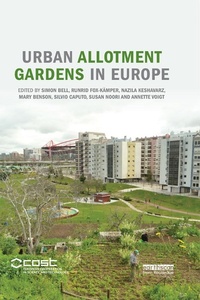
Urban Allotment Gardens in Europe
Erschienen am 10. März 2016
406 Seiten
978-1-317-41564-0 (ISBN)
Beschreibung
Although urban allotment gardening dates back to the nineteenth century, it has recently undergone a renaissance of interest and popularity. This is the result of greater concern over urban greenspace, food security and quality of life. This book presents a comprehensive, research-based overview of the various features, benefits and values associated with urban allotment gardening in Europe.
The book is based on a European COST Action project, which brings together researchers and practitioners from all over Europe for the first detailed exploration of the subject on a continent-wide scale. It assesses the policy, planning and design aspects, as well as the social and ecological benefits of urban allotment gardening. Through an examination of the wide range of different traditions and practices across Europe, it brings together the most recent research to discuss the latest evolutions of urban allotment gardening and to help raise awareness and fill knowledge gaps.
The book provides a multidisciplinary perspective, including insights from horticulture and soil science, ecology, sociology, urban geography, landscape, planning and design. The themes are underpinned by case studies from a number of European countries which supply a wide range of examples to illustrate different key issues.
The book is based on a European COST Action project, which brings together researchers and practitioners from all over Europe for the first detailed exploration of the subject on a continent-wide scale. It assesses the policy, planning and design aspects, as well as the social and ecological benefits of urban allotment gardening. Through an examination of the wide range of different traditions and practices across Europe, it brings together the most recent research to discuss the latest evolutions of urban allotment gardening and to help raise awareness and fill knowledge gaps.
The book provides a multidisciplinary perspective, including insights from horticulture and soil science, ecology, sociology, urban geography, landscape, planning and design. The themes are underpinned by case studies from a number of European countries which supply a wide range of examples to illustrate different key issues.
Weitere Details
Sprache
Englisch
Verlagsort
London
Großbritannien
Verlagsgruppe
Taylor & Francis Ltd
Zielgruppe
Für höhere Schule und Studium
Illustrationen
100 s/w Abbildungen, 25 s/w Tabellen, 120 s/w Photographien bzw. Rasterbilder, 17 s/w Zeichnungen
25 Tables, black and white; 17 Line drawings, black and white; 120 Halftones, black and white; 100 Illustrations, black and white
Dateigröße
28,34 MB
ISBN-13
978-1-317-41564-0 (9781317415640)
Copyright in bibliographic data and cover images is held by Nielsen Book Services Limited or by the publishers or by their respective licensors: all rights reserved.
Schweitzer Klassifikation
Weitere Ausgaben
Personen
Simon Bell is Professor of Landscape Architecture at the Estonian University of Life Sciences, Tartu, Estonia, and Director of the OPENspace Research Centre, Edinburgh School of Architecture and Landscape Architecture, University of Edinburgh, UK.
Runrid Fox-Kaemper is an architect and Head of the research group 'Built Environment' at the ILS Research Institute for Regional and Urban Development, Aachen, Germany, and Chair of COST Action TU1201 Urban Allotment Gardens in European Cities.
Nazila Keshavarz is a landscape architect and a research fellow at ILS Research Institute for Regional and Urban Development, Aachen, Germany.
Mary Benson is a lecturer in the Department of Sociology at Maynooth University, National University of Ireland Maynooth, Co. Kildare, Ireland.
Silvio Caputo is Senior Lecturer in the School of Architecture, University of Portsmouth, UK.
Susan Noori is a social research consultant and an affiliated researcher with Birmingham School of Architecture, Birmingham City University, UK.
Annette Voigt is Visiting Professor in the Department of Geography and Regional Studies at the University of Klagenfurt, Austria.
Runrid Fox-Kaemper is an architect and Head of the research group 'Built Environment' at the ILS Research Institute for Regional and Urban Development, Aachen, Germany, and Chair of COST Action TU1201 Urban Allotment Gardens in European Cities.
Nazila Keshavarz is a landscape architect and a research fellow at ILS Research Institute for Regional and Urban Development, Aachen, Germany.
Mary Benson is a lecturer in the Department of Sociology at Maynooth University, National University of Ireland Maynooth, Co. Kildare, Ireland.
Silvio Caputo is Senior Lecturer in the School of Architecture, University of Portsmouth, UK.
Susan Noori is a social research consultant and an affiliated researcher with Birmingham School of Architecture, Birmingham City University, UK.
Annette Voigt is Visiting Professor in the Department of Geography and Regional Studies at the University of Klagenfurt, Austria.
Inhalt
Foreword
Maluo Weirich, General Secretary of the Office International du Coin de Terre et des Jardins Familiaux
Preface
David Crouch
Introduction
Simon Bell
1. A History of Urban Gardens in Europe
Nazila Keshavarz and Simon Bell
Part 1: Urban Allotment Gardens in the European Political, Planning and Legal Sphere
2. The Idea of Allotment Gardens and the Role of Spatial and Urban Planning
Matthias Drilling, Renata Giedych, Lidia Ponizy
3. Grassroots Gardening Movements: Towards Cooperative Forms of Green Urban Development?
Byron Ioannou, Nerea Moran, Martin Sondermann, Chiara Certoma and Michael Hardman
4. Political-Economic Urban Restructuring: Urban Allotment Gardens in the Entrepreneurial City
Efrat Eizenberg, Simone Tappert, Nicola Thomas and Andis Zilans
Part 2: The Ecology of Urban Allotment Gardens
5. Ecosystem Services from Urban Gardens
Andrew S. Hursthouse, Teresa E. Leitao, Annette Voigt, Avigail Heller, Beatrice Bechet and Paulo Brito da Luz
6. Environmental Pressures on and the Status of Urban Allotments
Andrew S. Hursthouse and Teresa E. Leitao
7. Lessons Learned: Indicators and Good Practice for an Environmentally Friendly Urban Garden
Annette Voigt, Teresa E. Leitao, Andrew S. Hursthouse, Ari Jokinen, Avigail Heller, Monika Latkowska, Paulo Brito da Luz, Yvonne Christ, Beatrice Bechet, Mart Kuelvik and Johannes Langemeyer
Part 3: Spatial Design Aspects of Urban Allotment Gardens
8. The Position of Urban Allotment Gardens within the Urban Fabric
Sandra Costa, Runrid Fox-Kaemper, Russell Good and Ivana Sentic
9. Emergent Approaches to Urban Gardening
Silvio Caputo, Eva Schwab and Kostas Tsiambaos
10. Allotment Gardens as a Challenge for an Urban Designer
Antoine Zammit and Ina Suklje-Erjavec
Part 4: The Social Sphere of Urban Allotment Gardens
11. Urban Allotment Garden: A Case for Place-Making
Susan Noori and Mary Benson
12. Motivations behind Urban Gardening: "Here I Feel Alive"
Laura Calvet-Mir, Hug March, Helena Nordh, Jeanne Pourias and Barbora Cakovska
13. Urban Allotment Gardens Built for and by Means of Trust
Tim Delshammar, Maria Partalidou and Rhys Evans
Concluding Remarks
Runrid Fox-Kaemper
Maluo Weirich, General Secretary of the Office International du Coin de Terre et des Jardins Familiaux
Preface
David Crouch
Introduction
Simon Bell
1. A History of Urban Gardens in Europe
Nazila Keshavarz and Simon Bell
Part 1: Urban Allotment Gardens in the European Political, Planning and Legal Sphere
2. The Idea of Allotment Gardens and the Role of Spatial and Urban Planning
Matthias Drilling, Renata Giedych, Lidia Ponizy
3. Grassroots Gardening Movements: Towards Cooperative Forms of Green Urban Development?
Byron Ioannou, Nerea Moran, Martin Sondermann, Chiara Certoma and Michael Hardman
4. Political-Economic Urban Restructuring: Urban Allotment Gardens in the Entrepreneurial City
Efrat Eizenberg, Simone Tappert, Nicola Thomas and Andis Zilans
Part 2: The Ecology of Urban Allotment Gardens
5. Ecosystem Services from Urban Gardens
Andrew S. Hursthouse, Teresa E. Leitao, Annette Voigt, Avigail Heller, Beatrice Bechet and Paulo Brito da Luz
6. Environmental Pressures on and the Status of Urban Allotments
Andrew S. Hursthouse and Teresa E. Leitao
7. Lessons Learned: Indicators and Good Practice for an Environmentally Friendly Urban Garden
Annette Voigt, Teresa E. Leitao, Andrew S. Hursthouse, Ari Jokinen, Avigail Heller, Monika Latkowska, Paulo Brito da Luz, Yvonne Christ, Beatrice Bechet, Mart Kuelvik and Johannes Langemeyer
Part 3: Spatial Design Aspects of Urban Allotment Gardens
8. The Position of Urban Allotment Gardens within the Urban Fabric
Sandra Costa, Runrid Fox-Kaemper, Russell Good and Ivana Sentic
9. Emergent Approaches to Urban Gardening
Silvio Caputo, Eva Schwab and Kostas Tsiambaos
10. Allotment Gardens as a Challenge for an Urban Designer
Antoine Zammit and Ina Suklje-Erjavec
Part 4: The Social Sphere of Urban Allotment Gardens
11. Urban Allotment Garden: A Case for Place-Making
Susan Noori and Mary Benson
12. Motivations behind Urban Gardening: "Here I Feel Alive"
Laura Calvet-Mir, Hug March, Helena Nordh, Jeanne Pourias and Barbora Cakovska
13. Urban Allotment Gardens Built for and by Means of Trust
Tim Delshammar, Maria Partalidou and Rhys Evans
Concluding Remarks
Runrid Fox-Kaemper
