

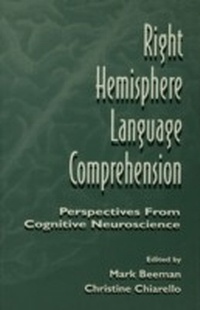
Right Hemisphere Language Comprehension
Perspectives From Cognitive Neuroscience
1. Auflage
Erschienen am 1. Februar 2013
424 Seiten
978-1-134-79429-4 (ISBN)
Beschreibung

The statement, "The Right Hemisphere (RH) processes language"--while not exactly revolutionary--still provokes vigorous debate. It often elicits the argument that anything the RH does with language is not linguistic but "paralinguistic." The resistance to the notion of RH language processing persists despite the fact that even the earliest observers of Left Hemisphere (LH) language specialization posited some role for the RH in language processing, and evidence attesting to various RH language processes has steadily accrued for more than 30 years. In this volume, chapters pertain to a wide, but by no means, exhaustive set of language comprehension processes for which RH contributions have been demonstrated. The sections are organized around these processes, beginning with initial decoding of written or spoken input, proceeding through semantic processing of single words and sentences, up to comprehension of more complex discourse, as well as problem solving. The chapters assembled here should begin to melt this resistance to evidence of RH language processing.
This volume's main goal is to compile evidence about RH language function from a scattered literature. The editorial commentaries concluding each section highlight the relevance of these phenomena for psycholinguistic and neuropsychological theory, and discuss similarities and apparent discrepancies in the findings reported in individual chapters. In the final chapter, common themes that emerge from the enterprise of studying RH language and future challenge for the field are reviewed. Although all chapters focus only on "typical" laterality of right handed people, this work provides a representative sample of the current state of the art in RH language research.
Important features include:
* a wide range of coverage from speech perception and reading through complex discourse comprehension and problem-solving;
* research presented from both empirical and theoretical perspectives; and
* commentaries and conclusions integrating findings and theories across sub-domains, and speculating on future directions of the field.
This volume's main goal is to compile evidence about RH language function from a scattered literature. The editorial commentaries concluding each section highlight the relevance of these phenomena for psycholinguistic and neuropsychological theory, and discuss similarities and apparent discrepancies in the findings reported in individual chapters. In the final chapter, common themes that emerge from the enterprise of studying RH language and future challenge for the field are reviewed. Although all chapters focus only on "typical" laterality of right handed people, this work provides a representative sample of the current state of the art in RH language research.
Important features include:
* a wide range of coverage from speech perception and reading through complex discourse comprehension and problem-solving;
* research presented from both empirical and theoretical perspectives; and
* commentaries and conclusions integrating findings and theories across sub-domains, and speculating on future directions of the field.
Rezensionen / Stimmen
"The editors should be commended for the selection of high level work, and for their effort to integrate it with an excellent introduction, comments on each section and summary. This is an enjoyable and current text in an important area, which can be read by the novice and expert alike. It provides useful references in addition to serving as an important educational resource."-The Canadian Journal of Neurological Sciences
"The chapters are uniformly excellent and the commentaries following each section summarize and provide additional food for thought. This is a text that would be appropriate for advanced graduate and post-graduate students as well as cognitive and affective neuroscientists willing to accept the challenges of an expanded view of right hemisphere language function."
-Journal of the International Neuropsychological Society
Weitere Details
Sprache
Englisch
Verlagsort
London
Großbritannien
Verlagsgruppe
Taylor & Francis Ltd
Zielgruppe
Für Beruf und Forschung
Produkt-Hinweis
Reflowable
Dateigröße
9,29 MB
ISBN-13
978-1-134-79429-4 (9781134794294)
Copyright in bibliographic data and cover images is held by Nielsen Book Services Limited or by the publishers or by their respective licensors: all rights reserved.
Schweitzer Klassifikation
Weitere Ausgaben
Andere Ausgaben
Mark Jung Beeman | Christine Chiarello
Right Hemisphere Language Comprehension
Perspectives From Cognitive Neuroscience
Buch
10/1997
Psychology Press
208,90 €
Versand in 10-20 Tagen
Mark Jung Beeman | Christine Chiarello
Right Hemisphere Language Comprehension
Perspectives From Cognitive Neuroscience
Buch
10/1997
Psychology Press
104,00 €
Versand in 10-20 Tagen
Personen
Mark Jung Beeman, Christine Chiarello
Inhalt
Contents: C. Chiarello, M. Beeman, Introduction to the Cognitive Neuroscience of Right Hemisphere Language Comprehension. Part I:Decoding Speech Sounds and Individual Words.R. Ivry, P.C. Lebby, The Neurology of Consonant Perception: Specialized Module or Distributed Processors? J.M. Clarke, C.M. McCann, E. Zaidel, The Corpus Callosum and Language: Anatomical-Behavioral Relationships. M.T. Banich, C.D. Nicholas, Integration of Processing Between the Hemispheres in Word Recognition. K. Baynes, J.C. Eliassen, The Visual Lexicon: Its Access and Organization in Commissurotomy Patients. H.B. Coslett, E.M. Saffran, Reading and the Right Hemisphere: Evidence From Acquired Dyslexia. C. Chiarello, M. Beeman, Commentary: Right Hemisphere Linguistic Decoding--More Than Meets the Eye and Ear? Part II:Lexical and Sentence-Level Semantics.C. Chiarello, On Codes of Meaning and the Meaning of Codes: Semantic Access and Retrieval Within and Between Hemispheres. M. Faust, Obtaining Evidence of Language Comprehension From Sentence Priming. J.W. King, G.G. Ganis, M. Kutas, Potential Asymmetries in Language Comprehension: In Search of the Electrical Right. C. Burgess, K. Lund, Modeling Cerebral Asymmetries in High-Dimensional Space. C. Chiarello, M. Beeman, Commentary: Getting the Right Meaning From Words and Sentences. Part III:Discourse Processing and Problem Solving.M. Beeman, Coarse Semantic Coding and Discourse Comprehension. J.C. Borod, R.L. Bloom, C. Santschi-Haywood, Verbal Aspects of Emotional Communication. H. Brownell, G. Martino, Deficits in Inference and Social Cognition: The Effects of Right Hemisphere Brain Damage on Discourse. B. Stemmer, Y. Joanette, The Interpretation of Narrative Discourse of Brain-Damaged Individuals Within the Framework of a Multilevel Discourse Model. S.M. Fiore, J.W. Schooler, Right Hemisphere Contributions to Creative Problem Solving: Converging Evidence for Divergent Thinking. M. Beeman, C. Chiarello, Commentary: Getting the Right Meaning From Discourse. M. Beeman, C. Chiarello, Concluding Remarks: Getting the Whole Story Right.
