

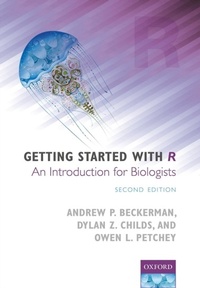
Getting Started with R
An Introduction for Biologists
2. Auflage
Erschienen am 23. Februar 2017
240 Seiten
978-0-19-109193-3 (ISBN)
Beschreibung
R is rapidly becoming the standard software for statistical analyses, graphical presentation of data, and programming in the natural, physical, social, and engineering sciences. Getting Started with R is now the go-to introductory guide for biologists wanting to learn how to use R in their research. It teaches readers how to import, explore, graph, and analyse data, while keeping them focused on their ultimate goals: clearly communicating their data in oral presentations, posters, papers, and reports. It provides a consistent workflow for using R that is simple, efficient, reliable, and reproducible.
This second edition has been updated and expanded while retaining the concise and engaging nature of its predecessor, offering an accessible and fun introduction to the packages dplyr and ggplot2 for data manipulation and graphing. It expands the set of basic statistics considered in the first edition to include new examples of a simple regression, a one-way and a two-way ANOVA. Finally, it introduces a new chapter on the generalised linear model.
Getting Started with R is suitable for undergraduates, graduate students, professional researchers, and practitioners in the biological sciences.
Weitere Details
Weitere Ausgaben
Personen
Andrew leads a research team studying community and evolutionary ecology. He has been using R and teaching quantitative methods for over 16 years.
Owen leads a research team studying ecological forecasting. He has been using R and teaching quantitative methods for over 16 years.
Dylan leads a research team studying population biology. He has been using R and teaching quantitative methods for over 15 years.
Inhalt
- Preface
- 1: Getting and getting acquainted with R
- 2: Getting your data into R
- 3: Data management, manipulation, and exploration with dplyr
- 4: Visualising your data
- 5: Introducing statistics in R
- 6: Advancing your statistics in R
- 7: Getting started with generalised linear models
- 8: Pimping your plots: scales and themes in ggplot2
- 9: Closing remarks
- Appendices
