

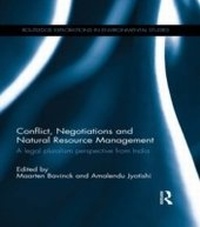
Conflict, Negotiations and Natural Resource Management
A legal pluralism perspective from India
1. Auflage
Erschienen am 17. Oktober 2014
214 Seiten
978-1-135-04899-0 (ISBN)
Beschreibung

Conflicts over natural resources abound in India, where much of the population is dependent on these resources for their livelihoods. Issues of governance and management are complicated by the competing claims of parallel legal systems, including state, customary, religious, project and local laws.
Whereas much has been written about property rights, this unique collection takes a legal anthropological perspective to explore how the coexistence and interaction between multiple legal orders provide bases for claiming property rights. It examines how hybrid legal institutions have developed over time in India and how these impact on justice in the governance and distribution of natural resources. The book brings together original case studies that offer fresh perspectives on the governance of forests, water, fisheries and agricultural land in a diverse range of social and spatial contexts.
This brand new research provides a timely and persuasive overview of the fundamental role of parallel legal systems in shaping how people manage natural resources. It will be of interest to scholars and practitioners of environmental law, property law, environmental politics, anthropology, sociology and geography.
Whereas much has been written about property rights, this unique collection takes a legal anthropological perspective to explore how the coexistence and interaction between multiple legal orders provide bases for claiming property rights. It examines how hybrid legal institutions have developed over time in India and how these impact on justice in the governance and distribution of natural resources. The book brings together original case studies that offer fresh perspectives on the governance of forests, water, fisheries and agricultural land in a diverse range of social and spatial contexts.
This brand new research provides a timely and persuasive overview of the fundamental role of parallel legal systems in shaping how people manage natural resources. It will be of interest to scholars and practitioners of environmental law, property law, environmental politics, anthropology, sociology and geography.
Rezensionen / Stimmen
"Looking at natural resources from the perspective of legal pluralism provides important insights into the possibilities and constraints of governance. Showing how actors navigate through the confusing webs of law in their struggles for land, water, forest, and fisheries, the book is a must for anyone interested in natural resource management."Keebet von Benda-Beckmann, Max Planck Institute for Social Anthropology, Germany
"Bavinck and Jyotishi have brought together an excellent group of authors who offer critical perspectives and new insights into the relevance of the legal pluralism perspective in the context of conflict over natural resources in India. This edited volume contributes to the debate on critical questions arising in the field of natural resource governance and will be of enormous value to scholars, practitioners and policy makers across the world."
Merle Sowman, University of Cape Town, South Africa
"This book is a timely focus on issues of conflict and governance over forests and fisheries in India. Several case studies examine legal pluralism as an alternative perspective for both the cause of conflicts and a potential solution, suggesting governability to diffuse potentially damaging social and environmental consequences. Recommended reading for law-makers and law-breakers."
Minoti Chakravarty-Kaul, University of Delhi, India
"This edited volume is a timely and important contribution to the study of the role of legal pluralism in natural resources management and governance in India, and debates about legal pluralism and governance more generally. (...) On the whole, this interesting book provides a major stimulus for expanding research on legal pluralism in India (and elsewhere) and for continuing the debates about legal pluralism, natural resources and governance."
Dik Roth, Sociology of Development and Change Group, Wageningen University, Wageningen, The Netherlands
Weitere Details
Reihe
Auflage
1. Auflage
Sprache
Englisch
Verlagsort
London
Großbritannien
Verlagsgruppe
Taylor & Francis Ltd
Zielgruppe
Für höhere Schule und Studium
Illustrationen
3 s/w Abbildungen, 7 s/w Tabellen, 3 s/w Zeichnungen
7 Tables, black and white; 3 Line drawings, black and white; 3 Illustrations, black and white
Dateigröße
1,39 MB
ISBN-13
978-1-135-04899-0 (9781135048990)
Copyright in bibliographic data and cover images is held by Nielsen Book Services Limited or by the publishers or by their respective licensors: all rights reserved.
Schweitzer Klassifikation
Weitere Ausgaben
Andere Ausgaben
Maarten Bavinck | Amalendu Jyotishi
Conflict, Negotiations and Natural Resource Management
A legal pluralism perspective from India
Buch
09/2016
1. Auflage
Routledge
81,86 €
Versand in 10-20 Tagen
Maarten Bavinck | Amalendu Jyotishi
Conflict, Negotiations and Natural Resource Management
A legal pluralism perspective from India
Buch
10/2014
1. Auflage
Routledge
225,50 €
Versand in 15-20 Tagen
Personen
Maarten Bavinck is Associate Professor in the Department of Geography, Planning and International Development Studies at the University of Amsterdam, The Netherlands, and president of the International Commission on Legal Pluralism.
Amalendu Jyotishi is Associate Professor at Amrita School of Business, Amrita University, India and Coordinator of Asian Initiatives on Legal Pluralism.
Amalendu Jyotishi is Associate Professor at Amrita School of Business, Amrita University, India and Coordinator of Asian Initiatives on Legal Pluralism.
Inhalt
Preface 1. Introduction: The Legal Pluralism Perspective 2. Law-breakers and Law-makers: Critical Legal Pluralism, Normative Subjects and Ecological Regimes in India 3. The Godavarman Judgment: Erasing the Plurality of Land Use in Gudalur, Nilgiris 4. Unearthing the Roots of Statutory Forest Law: Iron Smelting and the State in Pre- and Early Colonial India 5. Land, Law and Resistance: Legal Pluralism and Tribal Conflicts over Land Alienation in Odisha 6. Community Rights and Statutory Laws: Politics of Forest in Uttarakhand, Himalayas 7. Handling Fishery Conflicts in the Context of Legal Pluralism - A Case-Study Analysis of Street-Level Bureaucracy in Tamil Nadu, India 8. A Political Ecology of Legal Plural Disconnection in the Marine Fishery of Junagadh District, Gujarat, India 9. Institutional Pluralism, Multilevel Arrangements and Polycentrism: The Case of Chilika Lagoon, India 10. Legal Pluralism and the Governability of Fisheries and Coastal Systems in the World - A Conceptual Enquiry
