

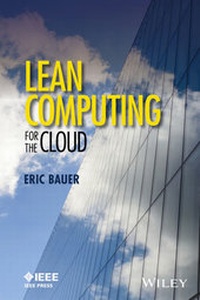
Lean Computing for the Cloud
Beschreibung

Weitere Details
Weitere Ausgaben
Andere Ausgaben
Person
Inhalt
Acknowledgments xv
Abbreviations xvii
1. Basics 1
1.1 Cloud Computing Fundamentals 1
1.2 Roles in Cloud Computing 6
1.3 Applications 9
1.3.1 Application Service Quality 11
1.4 Demand, Supply, Capacity, and Fungibility 13
1.5 Demand Variability 16
1.6 Chapter Review 18
2. Rethinking Capacity Management 19
2.1 Capacity Management 19
2.2 Demand Management 21
2.3 Performance Management 21
2.4 Canonical Capacity Management 23
2.4.1 Traditional Capacity Management 24
2.4.2 ITIL Capacity Management 27
2.4.3 eTOM Capacity Management 28
2.4.4 Discussion 30
2.5 Three Cloud Capacity Management Problems 30
2.5.1 Physical Resource Capacity Management 31
2.5.2 Virtual Resource Capacity Management 32
2.5.3 Application Capacity Management 33
2.6 Cloud Capacity Management as a Value Chain 36
2.7 Chapter Review 39
3. Lean Thinking on Cloud Capacity Management 41
3.1 Lean Thinking Overview 41
3.2 Goal 42
3.3 Seeing Waste (Nonvalue-Adding Activities) 43
3.3.1 Reserve Capacity 45
3.3.2 Excess Application Capacity 46
3.3.3 Excess Online Infrastructure Capacity 46
3.3.4 Excess Physical Infrastructure Capacity 46
3.3.5 Inadequate Capacity 47
3.3.6 Infrastructure Overhead 48
3.3.7 Capacity Management Overhead 48
3.3.8 Resource Overhead 49
3.3.9 Power Management Overhead 50
3.3.10 Workload Migration 50
3.3.11 Complexity Overhead 51
3.3.12 Resource Allocation Failure 51
3.3.13 Leaking and Lost Resources 53
3.3.14 Waste Heat 53
3.3.15 Carbon Footprint 54
3.4 Key Principles 54
3.4.1 Move toward Flow 55
3.4.2 Pull versus Push 55
3.4.3 Level the Workload 55
3.4.4 Stop and Fix Problems 55
3.4.5 Master Practices 56
3.4.6 Visual Management 57
3.4.7 Use Well-Tested Technology 57
3.4.8 Take a Long-Term Perspective 58
3.4.9 Grow, Learn, and Teach Others 58
3.4.10 Develop Exceptional People 58
3.4.11 Partners Help Each Other Improve 58
3.4.12 Go See 59
3.4.13 Implement Rapidly 59
3.4.14 Become a Learning Organization 59
3.5 Pillar: Respect 59
3.6 Pillar: Continuous Improvement 61
3.7 Foundation 62
3.8 Cadence 62
3.9 Lean Capacity Management Philosophy 63
3.10 Chapter Review 64
4. Lean Cloud Capacity Management Strategy 67
4.1 Lean Application Service Provider Strategy 68
4.1.1 User Workload Placement 71
4.1.2 Application Performance Management 73
4.2 Lean Infrastructure Service Provider Strategies 73
4.2.1 Physical Resource Capacity Management 76
4.3 Full Stream Optimization 77
4.4 Chapter Review 79
5. Electric Power Generation as Cloud Infrastructure Analog 81
5.1 Power Generation as a Cloud Infrastructure Analog 81
5.2 Business Context 83
5.3 Business Structure 86
5.4 Technical Similarities 88
5.5 Impedance and Fungibility 91
5.6 Capacity Ratings 94
5.7 Bottled Capacity 95
5.8 Location of Production Considerations 95
5.9 Demand Management 97
5.10 Demand and Reserves 98
5.11 Service Curtailment 99
5.12 Balance and Grid Operations 100
5.13 Chapter Review 103
6. Application Capacity Management as an Inventory Management Problem 105
6.1 The Application Capacity Management Service Delivery Chain 105
6.2 Traditional Application Service Production Chain 107
6.3 Elasticity and Demand-Driven Capacity Management 108
6.4 Application Service as Retail Analog 110
6.4.1 Locational Consideration 112
6.4.2 Inventory and Capacity 112
6.4.3 Service Level 113
6.4.4 Inventory Carrying Costs 114
6.4.5 Inventory Decision, Planning, and Ordering 115
6.4.6 Agility 118
6.4.7 Changing Consumption Patterns 118
6.5 Chapter Review 118
7. Lean Demand Management 119
7.1 Infrastructure Demand Management Techniques 120
7.1.1 Resource Scheduling 121
7.1.2 Resource Curtailment 121
7.1.3 Mandatory Demand Shaping 122
7.1.4 Voluntary Demand Shaping 123
7.1.5 Scheduling Maintenance Actions 123
7.1.6 Resource Pricing 123
7.2 Application Demand Management Techniques 124
7.2.1 Queues and Buffers 124
7.2.2 Load Balancers 124
7.2.3 Overload Controls 125
7.2.4 Explicit Demand Management Actions 125
7.2.5 Scheduling Maintenance Actions 125
7.2.6 User Pricing Strategies 126
7.3 Full Stream Analysis Methodology 126
7.3.1 Analyze Applications' Natural Demand Patterns 127
7.3.2 Analyze Applications' Tolerances 128
7.3.3 Create Attractive Infrastructure Pricing Models 129
7.3.4 Deploy Optimal Infrastructure Demand Management Models 130
7.4 Chapter Review 131
8. Lean Reserves 133
8.1 What Is Reserve Capacity? 133
8.2 Uses of Reserve Capacity 135
8.2.1 Random Demand Peaks 135
8.2.2 Component or Resource Failure 136
8.2.3 Infrastructure Element Failure 136
8.2.4 Infrastructure Resource Curtailment or Demand Management Action 137
8.2.5 Demand Exceeding Forecast 137
8.2.6 Lead Time Demand 137
8.2.7 Catastrophic Failures and Force Majeure Events 139
8.3 Reserve Capacity as a Feature 139
8.4 Types of Reserve Capacity 140
8.4.1 Automatic Infrastructure Power Management Controls 140
8.4.2 Utilize Application Reserve Capacity 141
8.4.3 Place/Migrate Demand into Underutilized Capacity 141
8.4.4 Grow Online Capacity 141
8.4.5 Service Curtailment/Degradation 141
8.4.6 Mandatory Demand Shaping 141
8.4.7 Voluntary Demand Shaping 142
8.4.8 Emergency Reserves 142
8.5 Limits of Reserve Capacity 144
8.6 Ideal Reserve 144
8.6.1 Normal (Co-located) Reserve 144
8.6.2 Emergency (Geographically Distributed) Reserve 146
8.7 Chapter Review 147
9. Lean Infrastructure Commitment 149
9.1 Unit Commitment and Infrastructure Commitment 150
9.2 Framing the Unit Commitment Problem 151
9.3 Framing the Infrastructure Commitment Problem 153
9.4 Understanding Element Startup Time 155
9.5 Understanding Element Shutdown Time 157
9.6 Pulling It All Together 160
9.7 Chapter Review 166
10. Lean Cloud Capacity Management Performance Indicators 167
10.1 Perfect Capacity Metrics 168
10.2 Capacity Management Metrics 172
10.3 Infrastructure Commitment Metrics 173
10.4 Waste Metrics 174
10.4.1 Reserve Capacity Waste Metrics 174
10.4.2 Excess Application Capacity Metrics 175
10.4.3 Excess Online Infrastructure Capacity Metrics 175
10.4.4 Excess Physical Infrastructure Capacity Metrics 175
10.4.5 Inadequate Capacity Metrics 175
10.4.6 Infrastructure Overhead Waste Metrics 176
10.4.7 Capacity Management Overhead Waste Metrics 176
10.4.8 Resource Overhead Waste Metrics 176
10.4.9 Power Management Overhead Waste Metrics 177
10.4.10 Workload Migration Metrics 177
10.4.11 Complexity Overhead Metrics 178
10.4.12 Resource Allocation Failure Metrics 178
10.4.13 Leaking and Lost Resources 179
10.4.14 Waste Heat Metrics 179
10.4.15 Carbon Footprint Metrics 180
10.5 Key Principle Indicators 180
10.6 Cost of Poor Quality 181
10.7 Metrics and Service Boundaries 182
10.8 Measurements and Maturity 183
10.9 Chapter Review 185
11. Summary 187
11.1 Cloud Computing as a Service Delivery Chain 187
11.2 Lean Cloud Computing 190
11.3 Reimagining Cloud Capacity 192
11.4 Lean Demand Management 195
11.5 Lean Reserves 197
11.6 Lean Infrastructure Service Provider Considerations 198
11.7 Lean Application Service Provider Considerations 198
11.8 Lean Infrastructure Commitment 199
11.9 Visualizing Perfect Capacity 201
11.10 Lean Cloud Computing Metrics 203
11.11 Concluding Remarks 204
References 207
About the Author 211
Index 213
CHAPTER 1
Basics
Upon completion of this chapter the reader will understand:
- The standard definition, characteristics, and benefits of cloud computing
- The key roles in the cloud computing ecosystem
- Key concepts of application, demand, supply, quality, and fungibility
This section reviews the following key concepts that are used extensively in this work:
- Cloud computing fundamentals (Section 1.1)
- Roles in cloud computing (Section 1.2)
- Applications (Section 1.3)
- Demand, supply, capacity, and fungibility (Section 1.4)
- Demand variability (Section 1.5)
1.1 Cloud Computing Fundamentals
Cloud computing is defined by ISO/IEC 177881 as a "paradigm for enabling network access to a scalable and elastic pool of shareable physical or virtual resources with self-service provisioning and administration on-demand." ISO/IEC 17788 specifies the following six key characteristics of cloud computing2:
- Broad network access - "A feature where the physical and virtual resources are available over a network and accessed through standard mechanisms that promote use by heterogeneous client platforms. The focus of this key characteristic is that cloud computing offers an increased level of convenience in that users can access physical and virtual resources from wherever they need to work, as long as it is network accessible, using a wide variety of clients including devices such as mobile phones, tablets, laptops, and workstations" (ISO/IEC 17788). Operationally, this means that end users access cloud-based application services via commonly available wireless and wireline IP networks.
- Measured service - "A feature where the metered delivery of cloud services is such that usage can be monitored, controlled, reported, and billed. The focus of this key characteristic is that the customer may only pay for the resources that they use. From the customers' perspective, cloud computing offers the users value by enabling a switch from a low efficiency and asset utilization business model to a high efficiency one" (ISO/IEC 17788). When cloud customers pay only for resources that are used, application services that are engineered so cloud resource usage tracks with application service usage which tracks with application revenue can reduce business risk by better linking application service provider's costs with application service revenues.
- Multi-tenancy - "A feature where physical or virtual resources are allocated in such a way that multiple tenants and their computations and data are isolated from and inaccessible to one another" (ISO/IEC 17788). Multi-tenancy enables infrastructure service providers to maximize resource sharing and boost their capacity utilization.
- On-demand self-service - "A feature where a cloud service customer can provision computing capabilities, as needed, automatically or with minimal interaction with the cloud service provider. The focus of this key characteristic is that cloud computing offers users a relative reduction in costs, time, and effort needed to take an action, since it grants the user the ability to do what they need, when they need it, without requiring additional human user interactions or overhead" (ISO/IEC 17788). This means that application service providers and/or automated systems working on behalf of those application operators can install, configure, and provision cloud resources to serve their applications in real time. On-demand self-service of capacity planning and fulfillment actions, coupled with rapid elasticity, enables significant reductions in fulfillment times for capacity change actions compared to traditional deployments.
- Rapid elasticity and scalability - "A feature where physical or virtual resources can be rapidly and elastically adjusted, in some cases automatically, to quickly increase or decrease resources. For the cloud service customer, the physical or virtual resources available for provisioning often appear to be unlimited and can be purchased in any quantity at any time automatically, subject to constraints of service agreements. Therefore, the focus of this key characteristic is that cloud computing means that the customers no longer need to worry about limited resources and might not need to worry about capacity planning" (ISO/IEC 17788). Application service providers and/or automated systems working on their behalf can allocate and release infrastructure resources on-the-fly, thereby enabling applications to transform from allocating and configuring capacity based on peak forecast demand (which may never even be approached) to just-in-time, demand-driven capacity configuration.
- Resource pooling - "A feature where a cloud service provider's physical or virtual resources can be aggregated in order to serve one or more cloud service customers. From the customer's perspective, all they know is that the service works, while they generally have no control or knowledge over how the resources are being provided or where the resources are located. This offloads some of the customer's original workload, such as maintenance requirements, to the provider" (ISO/IEC 17788). Resource pooling, coupled with multi-tenancy, enables cloud service providers (CSPs) to leverage economies of scale to boost operational efficiencies beyond what has traditionally been feasible.
Figure 1.1 offers a simplified view of cloud computing: many different applications simultaneously share a large and flexibly configured pool of compute, memory, storage, networking, and functional component resources offered by a CSP. Coupling on-demand self-service and rapid elasticity enables application service providers to fundamentally transform their businesses from configuring application capacity to meet peak forecast demand to just-in-time, demand-driven capacity management. Using measured service as the basis of charging application service providers for their resource usage enables at least a portion of the application provider's costs to shift from being fixed and independent of usage to variable so that resource charges are tied to resource usage, which is tied to application service usage, which should be tied to application revenue.
Figure 1.1 Cloud Computing in a Nutshell
Figure 1.2 visualizes key high-level business benefits of cloud computing:
- Lower infrastructure CapEx - the peak aggregate demand for compute, storage, and networking resources is smaller than the sum of peak demand of each individual application. Infrastructure resource sharing enables less total hardware to be deployed than with traditional operation models, and thus capital expense (CapEx) can be saved. Also, consolidating operation of that shared infrastructure enables efficiencies that can reduce operating expense (OpEx).
- Infrastructure available on demand - the ability of application service providers to allocate and release infrastructure resources on-the-fly enables agile, just-in-time application capacity management to minimize the twin business risks of over investing in application capacity that is never used (if demand forecasts are too optimistic) or being unable to serve customer demand (if demand forecasts are too conservative).
- Lower infrastructure OpEx because a single infrastructure service provider can operate and maintain shared infrastructure cheaper than each application service provider can operate and maintain their own private infrastructure. In addition, consolidating active resource loads onto the smallest number of physical elements enables unneeded capacity to be turned off.
- Application OpEx for infrastructure tracks with resource usage thereby derisking application service provider businesses by having their OpEXs for resource capacity track with service usage, and thus hopefully with revenue.
Figure 1.2 High-Level Benefits of Cloud Computing
Cloud enables disruption of IT service management in several ways:
- Encourage agile, incremental development and deployment models - these practices can reduce the organization's business risks around development activities by enabling applications and services to be developed and deployed via smaller project tasks which can generally be better managed rather than relying on massive software projects that are harder to manage.
- Elastic capacity enables new operational models for application release management - infrastructure available on-demand means that instead of relying on complex software upgrade, update, or retrofit procedures that must execute "in-place" on traditional hardware, an independent set of infrastructure resources can be allocated to host the new software upgrade, update, or retrofit and that release maintenance action can largely proceed without impacting the production instance thereby both reducing service risk for users and operational complexity (and presumably costs) for application service providers.
- Fungibility of virtualized...
