

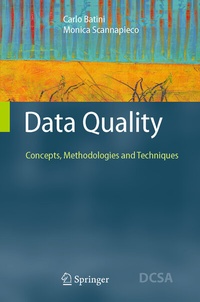
Data Quality
Beschreibung
Poor data quality can seriously hinder or damage the efficiency and effectiveness of organizations and businesses. The growing awareness of such repercussions has led to major public initiatives like the "Data Quality Act" in the USA and the "European 2003/98" directive of the European Parliament.
Batini and Scannapieco present a comprehensive and systematic introduction to the wide set of issues related to data quality. They start with a detailed description of different data quality dimensions, like accuracy, completeness, and consistency, and their importance in different types of data, like federated data, web data, or time-dependent data, and in different data categories classified according to frequency of change, like stable, long-term, and frequently changing data. The book's extensive description of techniques and methodologies from core data quality research as well as from related fields like data mining, probability theory, statistical data analysis, and machine learning gives an excellent overview of the current state of the art. The presentation is completed by a short description and critical comparison of tools and practical methodologies, which will help readers to resolve their own quality problems.
This book is an ideal combination of the soundness of theoretical foundations and the applicability of practical approaches. It is ideally suited for everyone - researchers, students, or professionals - interested in a comprehensive overview of data quality issues. In addition, it will serve as the basis for an introductory course or for self-study on this topic.
Weitere Details
Weitere Ausgaben
Personen
Carlo Batini is full professor of Computer Engineering at University of Milano Bicocca. He has been associate professor since 1983 and full professor since 1986. His research interests include cooperative information systems, information systems and data base modeling and design, usability of information systems, data and information quality. From 1995 to 2003 he was a member of the board of directors of the Authority for Information Technology in public administration, where he headed several large scale projects for the modernization of public administration.
Monica Scannapieco is a research associate at the Computer Engineering Department of the University of Roma La Sapienza. Her research interests are data quality issues, including data quality dimensions, measurement and improvement techniques, dynamics of data quality, record matching.
